Volunteers at the NORAD Tracks Santa operations center monitor phone lines at Peterson Space Force Base, Colorado, Dec. 24, 2025.NORAD is a binational command that monitors and defends North American aerospace 24 hours a day, seven days a week, 365 days a year using complementary, multi-domain defense capabilities, including military aircraft, radars, and satellites. The U.S. and Canadian professionals accomplishing this mission daily use these same systems with the additional mission of tracking Santa’s travels on Dec. 24 each year. (U.S. Space Force photo by Staff Sgt. Jaime Sanchez)
Space Force Officer Leads DAF Women’s Rugby Team to Historic Championship Victory
VANDENBERG SPACE FORCE BASE, Calif. – U.S. Space Force Maj. Adekunbi Adewunmi, stationed at Vandenberg Space Force Base, Calif., made history by coaching the Department of the Air Force (DAF) women’s rugby team to their first-ever championship victory at the Royal Australian Air Force, Royal New Zealand Air Force, and U.S. Department of the Air Force (ANZUS) Shield tournament at Whenuapai Air Base, New Zealand, Oct. 9-11.
The ANZUS Shield tournament highlighted Adewunmi’s ability to inspire discipline, trust, and teamwork—qualities that have defined her career. The DAF women’s rugby team built on their earlier silver medal performance at the Armed Forces Rugby Tournament, showcasing strong communication and cohesion throughout the competition.
They secured victories against the Royal New Zealand Air Force (24-14) and the Royal Australian Air Force (34-10) before facing their toughest challenge—a narrow 12-5 loss to RNZAF. Undeterred, the team rebounded with a decisive 24-5 win over RAAF and clinched the championship with a hard-fought 15-10 victory against a combined RNZAF-RAAF team.
Reflecting on the team’s historic victory, Adewunmi said, ‘I couldn’t be prouder of our team for coming together and achieving this victory. We knew going into this competition that we had to bring our absolute best because we were up against the best.'”
Adewunmi’s journey into rugby began in 2015 while serving as an operator at Schriever Space Force Base, Colo.
“My twin sister was living with me in Colorado,” Adewunmi shared. “She was already an established rugby player competing for a position on the USA Women’s 15s team and encouraged me to try it out, so I joined her at practice. I immediately fell in love with the sport.”
Encouraged by fellow servicemembers who played on local rugby teams, Adewunmi earned a spot on the Armed Forces Women’s Rugby Team, representing the Department of the Air Force in competitions. Her talent and commitment earned her a spot at the Department of the Air Force team camps and Armed Forces Rugby tournaments, where she honed her skills under the guidance of exceptional coaches.
“My DAF and club coaches helped shape me as a player and a leader, and they saw potential in me when I could not always see it,” said Adewunmi. “DAF rugby gives us an amazing opportunity to develop and strengthen connection and camaraderie with DAF, joint, allied, and partner athletes and build networks that will support us for the rest of our careers and beyond.”
For six years, she thrived as a player, but her rugby career took an unexpected turn when she tore her Achilles tendon during practice. Determined to stay connected to the sport she loved, Adewunmi made a brief comeback as a player in 2023, helping the DAF women’s team secure their first-ever 1st place finish at the Armed Forces Tournament.
Following this achievement, she transitioned to coaching and earned her certification through an Armed Forces program. This shift allowed her to continue contributing to the rugby community while channeling her leadership skills into a new role.
“It was hard to hang up my rugby boots but being able remain as a coach in this program has reinvigorated my excitement for rugby,” said Adewunmi. “I am at the beginning of my coaching career, but I am excited to learn and will be looking for opportunities in the new year to hone my coaching skills and philosophy.”
Known as both a skilled athlete and an exceptional leader, she serves as one of the senior ranking teammates and is one of only three Space Force representatives on the team. Her transition from elite player to championship winning coach not only defined the tournament but also underscores the leadership and professionalism she brings to her career in the service.
After commissioning as an Air Force engineer, she began her career at the Air Force Research Laboratory in Kirtland Air Force Base, N.M., focusing on laser effects, modeling, and simulation.
While in this role, she was encouraged by her leadership to attend a Space Operations Fundamentals course, which ultimately inspired her to transfer into the U.S. Space Force.
Her passion for space solidified during her time at Schriever Space Force Base, where she spent four years in space operations.
She later served at the National Reconnaissance Office and then the Pentagon under the U.S. Space Force Chief Operations Officer, where she assessed the Space Force’s alignment with the Chief of Space Operations’ strategic objectives, evaluated force design, and ensured the organization met its goals following its establishment.
At Vandenberg Space Force Base, Adewunmi oversees critical projects, including managing the ascent sonic boom study and environmental impact statements aimed at responsibly increasing launch capacity at the Western Range.
Adewunmi’s story is one of perseverance and dedication, both on the rugby field and in her Department of the Air Force career. Whether coaching rugby or contributing to the nation’s space capabilities, she continues to inspire those around her with her commitment to excellence and service to the nation.
Volunteers at the NORAD Tracks Santa operations center monitor phone lines at Peterson Space Force Base, Colorado, Dec. 24, 2025. NORAD is a binational command that monitors and defends North American aerospace 24 hours a day, seven days a week, 365 days a year using complementary, multi-domain defense capabilities, including military aircraft, radars, and satellites. The U.S. and Canadian professionals accomplishing this mission daily use these same systems with the additional mission of tracking Santa’s travels on Dec. 24 each year. (U.S. Space Force photo by Staff Sgt. Jaime Sanchez)
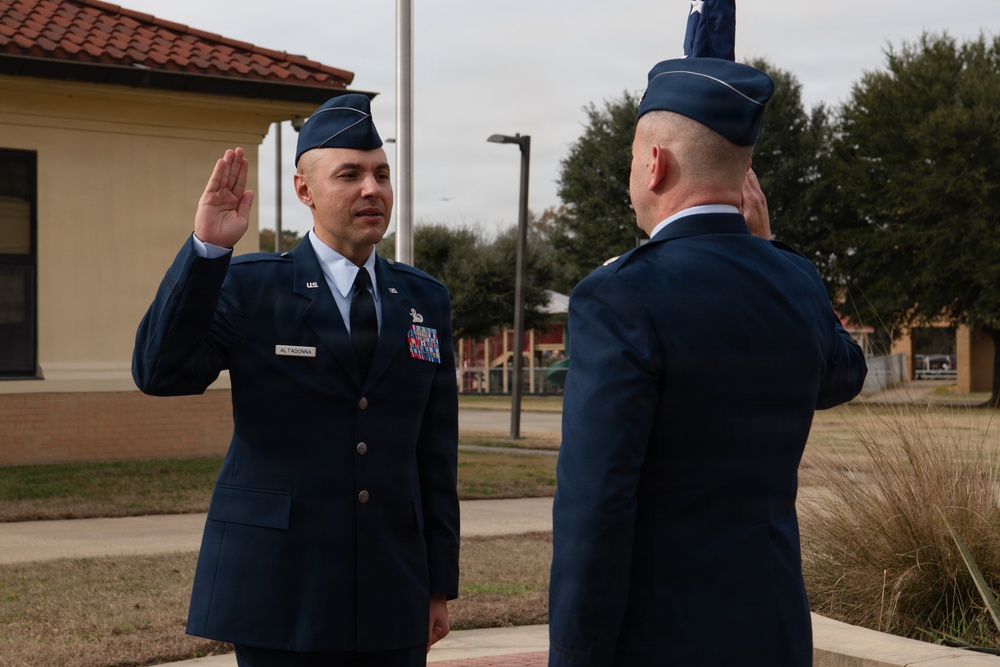
MAXWELL AIR FORCE BASE, Ala.—Chief Warrant Officer Two Marco Altadonna, chief technical advisor to the commander of the 290th Joint Communications Support Squadron, made Florida Air National Guard history as he walked across the stage during a graduation ceremony at Maxwell Air Force Base, Ala., Dec. 18, 2025. Altadonna was the first member of the FLANG to join the ranks of the U.S. Air Force Warrant Officer Corps in over 60 years.
“I feel honored to be a part of the future of the Air Force; it is a great experience to set a path for future warrant officers,” said Altadonna. “I look forward to progressing the unit in a cyber domain by creating those processes that advance the commander’s intent and get the team on the same page.”
As the U.S. Air Force expands upon its cybersecurity and IT fields, the Warrant Officer Corps is reintegrated as an essential part of the transformation. Warrant officers serve as a vital link between enlisted personnel and commissioned officers, acting as technical leaders, trainers, and advisors.
“As a commander, you aren’t involved in the technical intricacies,” said Lt. Col. Paul Martin, commander of the 290th JCSS. “As the coin he gave me during his commissioning reads, he’s going to be my technical integrator, my professional warfighter, and a credible advisor. I look forward to that and the technical integration as we move forward.”
Altadonna, one of the few individuals to attain the rank of Chief Warrant Officer Two upon their commissioning, is a trailblazer dedicated to expanding operational capabilities, mentoring the next generation of leaders, and building upon the future of the force.
“To those interested in following this path, stay technically relevant, stay focused on the mission, and understand what the strategic goals are for the Air Force and Florida Air National Guard,” said Altadonna. “It all plays a part in what we do and how we build those systems that make the organization better.”
In occupational fields such as cybersecurity and IT, skills proficiency can become obsolete if not adapted to continuous advancements. The warrant officer corps retains invaluable subject matter experts and allows them to exercise a role solely bound to their respective crafts. This form of specialized leadership is integral to maintaining technological superiority over space and cyberspace domains.
“It’s historic for the FLANG as well as our unit’s legacy,” said Capt. Jeffrey Beltran, director of operations at 290th JCSS. “It’s amazing to watch people you looked up to, like then MSgt. Altadonna, who was always an honest individual, attentive to our capabilities, accomplished something like this. Congratulations to CW2 Altadonna; this is a momentous occasion for his family as well as our family here at the 290th. We look forward to seeing what innovations he comes up with for our squadron in the future.”
Altadonna paves the way as the first of his kind, but not the last. As FLANG’s 290th JCSS continues to mobilize tactical communications Airmen capable of providing expeditious and secure communications networks, operators look to individuals like Altadonna to bring forth innovations that will lead them into the future of Joint All-Domain Operations. Together, their efforts ensure that our nation’s forces remain connected, adaptable, and ready for the challenges of tomorrow.
U.S. President Donald J. Trump speaks via video call with Guardians from the 42nd Electromagnetic Warfare Combat Detachment, delivering a holiday greeting and thanks within the U.S. Central Command area of responsibility, Dec. 25, 2025. The 42nd EWCD supports Space Forces Central by operating at an elevated tempo to integrate new systems, monitor space activity, and maintain mission readiness. (U.S. Air Force photo by Staff Sgt. Alexis Orozco)
A graphic on the wall displays technical information on Santa’s sleigh during the NORAD Tracks Santa event at Peterson Space Force Base, Colorado, Dec. 24, 2025. NORAD is a binational command that monitors and defends North American aerospace 24 hours a day, seven days a week, 365 days a year using complementary, multi-domain defense capabilities, including military aircraft, radars, and satellites. The U.S. and Canadian professionals accomplishing this mission daily use these same systems with the additional mission of tracking Santa’s travels on Dec. 24 each year. (U.S. Space Force photo by Staff Sgt. Jaime Sanchez)
Volunteers at the NORAD Tracks Santa operations center monitor phone lines at Peterson Space Force Base, Colorado, Dec. 24, 2025. NORAD is a binational command that monitors and defends North American aerospace 24 hours a day, seven days a week, 365 days a year using complementary, multi-domain defense capabilities, including military aircraft, radars, and satellites. The U.S. and Canadian professionals accomplishing this mission daily use these same systems with the additional mission of tracking Santa’s travels on Dec. 24 each year. (U.S. Space Force photo by Staff Sgt. Jaime Sanchez)
We Have The Watch decorations are flanked by holiday decor during the NORAD Tracks Santa event at Peterson Space Force Base Colorado, Dec. 24, 2025. NORAD is a binational command that monitors and defends North American aerospace 24 hours a day, seven days a week, 365 days a year using complementary, multi-domain defense capabilities, including military aircraft, radars, and satellites. The U.S. and Canadian professionals accomplishing this mission daily use these same systems with the additional mission of tracking Santa’s travels on Dec. 24 each year. (U.S. Space Force photo by Staff Sgt. Jaime Sanchez)
Volunteers at the NORAD Tracks Santa operations center monitor phone lines at Peterson Space Force Base, Colorado, Dec. 24, 2025. NORAD is a binational command that monitors and defends North American aerospace 24 hours a day, seven days a week, 365 days a year using complementary, multi-domain defense capabilities, including military aircraft, radars, and satellites. The U.S. and Canadian professionals accomplishing this mission daily use these same systems with the additional mission of tracking Santa’s travels on Dec. 24 each year. (U.S. Space Force photo by Staff Sgt. Jaime Sanchez)
CNRJ Fire and Emergency Services Sasebo, SRF-JRMC Conduct Confined Space Rescue Exercise
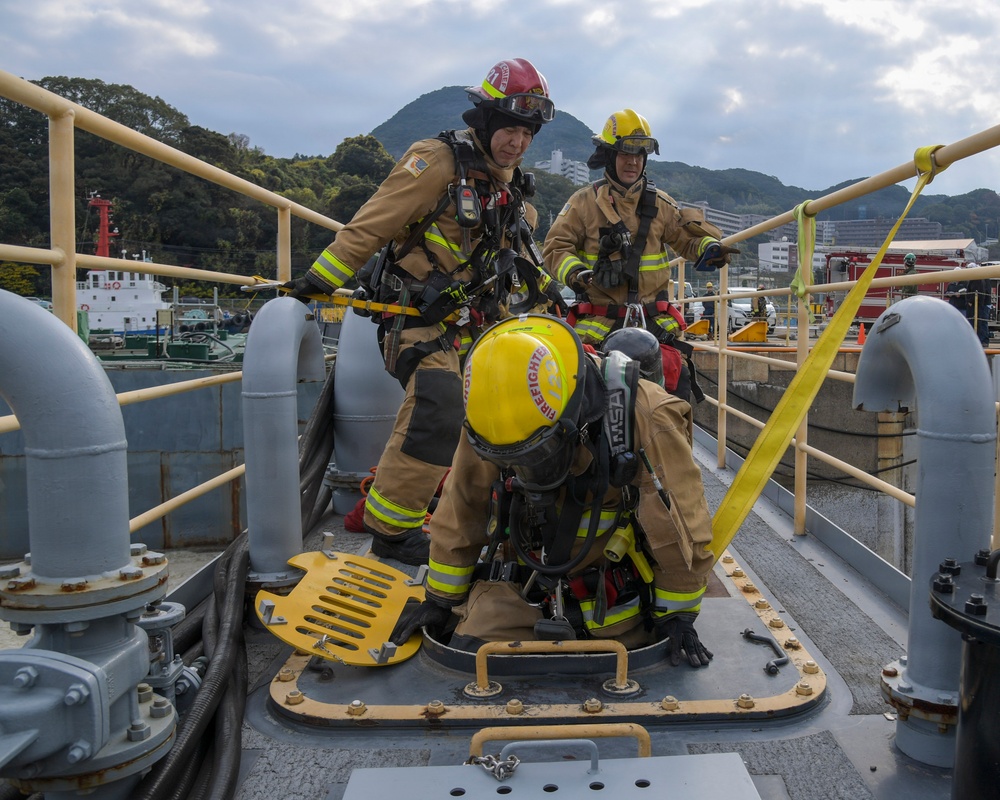
By Mass Communication Specialist 2nd Class Raquell Williams SASEBO, Japan (Dec. 16, 2025) – Commander, Navy Region Japan (CNRJ) Fire and Emergency Services Sasebo conducted a confined space rescue exercise at Sasebo Heavy Industries in Sasebo, Japan, Dec. 16, 2025. Overseen by U.S. Naval Ship Repair Facility and Japan Regional Maintenance Center (SRF-JRMC), this annual drill provided CFAS fire and emergency services an opportunity to demonstrate safety precautions in a simulated crisis by applying teamwork, technical application, and skill. “[CNRJ Sasebo fire department workers] are simulating rescuing two SRF workers becoming incapacitated because the oxygen content was very low,” said CNRJ Sasebo Fire Chief Mark Wampler. “[The rescuers] are using a mechanical advantage system and confined rescue techniques.” The rescuers utilized confined space air packs instead of standard breathing apparatuses for air supply. This type of compact air pack ensures the rescuer has a steady supply of breathing air and provides them greater mobility while working in tight spaces. In addition to limited oxygen supply, the atmosphere inside a confined space is a critical risk factor when conducting rescue operations. Rescuers can just as easily become victims if the environment is not properly accessed. Intoxicating gasses have been known to seriously incapacitate rescuers, exacerbating the situation entirely. “Typically, 66 percent of rescuers become a victim themselves,” said Wampler. “We use a gas detector to monitor the atmosphere [for] oxygen content, explosivity, and hydrogen sulfide. This training is important because it reinforces the safety element that we should always be following.” The exercise continued with two iterations of rescuers descending into a caisson to retrieve the victims. In this instance, a caisson is a tall, watertight box-like structure used as a gate across the entrance of a dry dock. “The interesting aspect of this drill is that it’s in a caisson,” said SRF-JRMC Environmental Program Manager Doug Hamilton. “Right now, they’re doing an exercise from about 30 to 35 feet high inside of an area where you can’t get typical response gear. The fire department is practicing an alternative set of skills at a more challenging-to-reach location.” Real-world scenarios, such as the confined space rescue exercise, are necessary to refine the skill and precision required to properly respond to a crisis. Performing an exercise in a caisson allowed the firefighters to fully understand the unforeseen difficulties of a confined space rescue. After thoroughly facilitating the confined rescue exercise, SRF-JRMC and CFAS fire and emergency services personnel successfully fulfilled an annual requirement compliant with Occupational Safety and Health Administration (OSHA) regulations, enhancing the installation’s readiness and response capabilities. For more than 78 years, CFAS has provided, maintained, and operated base facilities and services to empower forward-deployed U.S. and Allied Forces while providing superior support to their families and the community.

![DVIDS – Images – NORAD Tracks Santa 2025 [Image 10 of 21]](https://101veterans.com/wp-content/uploads/2025/12/1766943332_1000w_q95.jpg "DVIDS – Images – NORAD Tracks Santa 2025 [Image 10 of 21]")


 Private Internet Access gives you unparalleled access to thousands
of next-gen servers in over 83 countries and each US state. Your
VPN experience will always be fast, smooth, and reliable.
Private Internet Access gives you unparalleled access to thousands
of next-gen servers in over 83 countries and each US state. Your
VPN experience will always be fast, smooth, and reliable.
![DVIDS – Images – NORAD Tracks Santa 2025 [Image 9 of 21]](https://101veterans.com/wp-content/uploads/2025/12/1766856801_1000w_q95.jpg "DVIDS – Images – NORAD Tracks Santa 2025 [Image 9 of 21]")
![DVIDS – Images – POTUS recognizes Guardians on Christmas for Advancing Space Operations in CENTCOM [Image 3 of 3]](https://101veterans.com/wp-content/uploads/2025/12/1766770296_1000w_q95.jpg "DVIDS – Images – POTUS recognizes Guardians on Christmas for Advancing Space Operations in CENTCOM [Image 3 of 3]")
![DVIDS – Images – NORAD Tracks Santa 2025 [Image 8 of 21]](https://101veterans.com/wp-content/uploads/2025/12/1766727035_1000w_q95.jpg "DVIDS – Images – NORAD Tracks Santa 2025 [Image 8 of 21]")
![DVIDS – Images – NORAD Tracks Santa 2025 [Image 7 of 21]](https://101veterans.com/wp-content/uploads/2025/12/1766683782_1000w_q95.jpg "DVIDS – Images – NORAD Tracks Santa 2025 [Image 7 of 21]")
![DVIDS – Images – NORAD Tracks Santa 2025 [Image 5 of 21]](https://101veterans.com/wp-content/uploads/2025/12/1766640552_1000w_q95.jpg "DVIDS – Images – NORAD Tracks Santa 2025 [Image 5 of 21]")
![DVIDS – Images – NORAD Tracks Santa 2025 [Image 3 of 21]](https://101veterans.com/wp-content/uploads/2025/12/1766597314_1000w_q95.jpg "DVIDS – Images – NORAD Tracks Santa 2025 [Image 3 of 21]")