Maintenance window scheduled to begin at February 14th 2200 est. until 0400 est. February 15th
Issued by: on
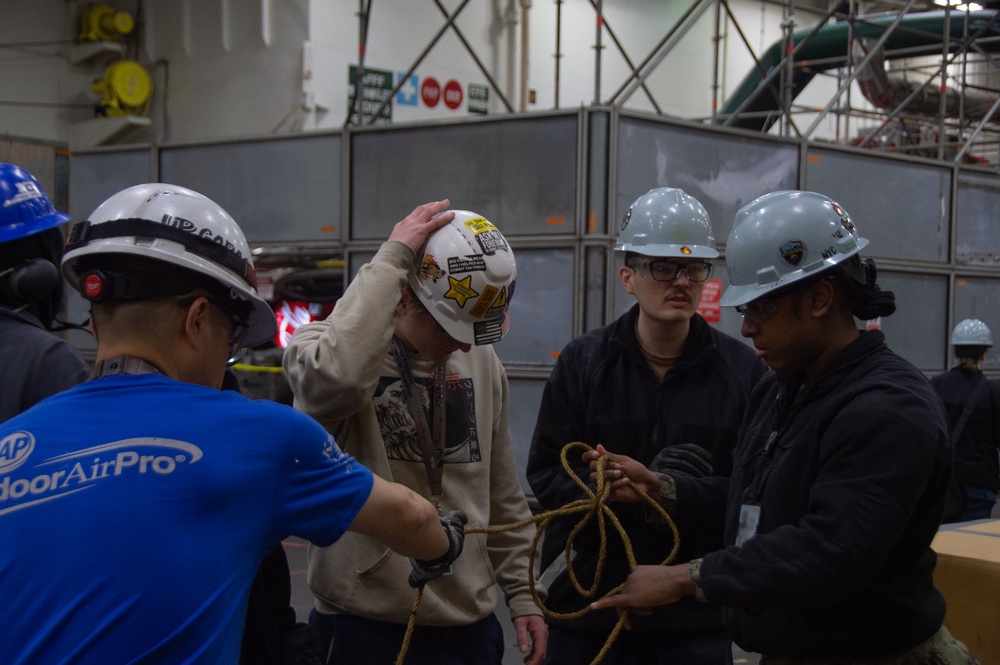
Airman Sheree Malcolm, from New York, right, and Machinist’s Mate Fireman Hunter Sager, from Ohio, secure a pallet alongside contractors in the hangar bay aboard USS Ronald Reagan (CVN 76), while in port Naval Base Kitsap-Bremerton, Washington, Nov. 19, 2025. The Nimitz-class aircraft carrier Ronald Reagan is undergoing scheduled maintenance at Puget Sound Naval Shipyard and Intermediate Maintenance Facility while remaining a combat-ready force dedicated to protecting and defending the United States. (U.S. Navy photo by Mass Communication Specialist Seaman Apprentice Morrigan May)
NAVAL BASE GUAM (Nov. 18, 2025) — Los Angeles–class fast-attack submarine USS Asheville (SSN 758) returned to Naval Base Guam, reaffirming the submarine force’s forward presence and readiness across the Indo-Pacific, Nov. 18, 2025.
“Asheville returns home to Guam, ready to once again serve as a vital part of our forward-deployed undersea arsenal,” said Capt. Neil Steinhagen, commander, Submarine Squadron Fifteen. “Naval Base Guam is a strategic outpost and the foundation of our undersea strength in the Western Pacific, and Asheville’s return directly enhances that combat-ready posture. True to their motto, ‘From the Mountains, to the Seas,’ Asheville’s crew is now back at the tip of the spear, sharpening our readiness and advancing our shared commitment to a free and open Indo-Pacific.”
Forward deployed to Guam in 2017, Asheville has completed multiple Western Pacific deployments and strengthened undersea partnerships across the region, including a 2023 port visit to HMAS Stirling in Western Australia. With its return, the submarine and crew resume their role in supporting missions vital to national security and reinforcing deterrence across the Indo-Pacific.
“The crew is excited to be home in Guam!” said Cmdr. Mike DeBoer, commanding officer, USS Asheville. “These Sailors have worked incredibly hard to get back home and return Asheville to the fleet. We couldn’t be more excited to rejoin the operational submarine force. Asheville returns to Guam more lethal than when we left, and we can’t wait to contribute to pressing America’s undersea advantage.”
Asheville’s homecoming also featured the Navy’s traditional “first kiss” and “first hug” ceremonies, with Machinist’s Mate 2nd Class Troy Kress receiving the first kiss and Chief Fire Control Technician Kenneth Huntley receiving the first hug.
Commissioned Sept. 28, 1991, USS Asheville is the fourth U.S. Navy ship to bear the name, honoring the city of Asheville, North Carolina. Asheville is one of five fast-attack submarines forward-deployed to Commander, Submarine Squadron Fifteen at Polaris Point, Naval Base Guam. Renowned for their unparalleled speed, endurance, stealth, and mobility, fast-attack submarines are the backbone of the Navy’s submarine force. Regarded as apex predators of the sea, Guam’s fast-attack submarines serve at the tip of the spear, helping to reaffirm the submarine force’s forward-deployed presence in support of a free and open Indo-Pacific.
Physical and Adaptive Therapy Provide a Better Quality of Life for Wounded Warriors at the Walter Reed
By Ann Brandstadter
Walter Reed Hospital Communications
BETHESDA, Md. – The Soldier Recovery Unit (SRU) at Walter Reed National Military Medical Center held “Spirit Week” during the last week of October as part of its adaptive reconditioning program. The week featured daily physical fitness competitions such as pickle ball, volleyball, and basketball, and team building exercises like “Draw your Squad Leader,” group problem solving, and a pumpkin painting contest. Spirit Week is a great way to build morale for those in the SRU, focusing on physical and cognitive activities, and is for Army Soldiers in recovery.
Dr. Jessica Best is the physical therapist for the Bethesda Soldier Recovery Unit, a board-certified clinical specialist in neurologic physical therapy (PT), and Adaptive Reconditioning Program Manager for the Soldier Recovery Brigade, National Capital Region.
“At the Soldier Recovery Brigade, we run an adaptive re-conditioning program for the Soldiers in recovery here. They [have access to] activities to assist with their recovery, and help with their transition,” said Best.
Speaking to adaptive reconditioning Best said, “It’s a way to help [Soldiers] maintain competitiveness and independence. We adapt [the events] so they can compete and do something meaningful, and it helps build community with others in a similar situation.”
Best leads a team comprised of a recreational therapist, an occupational therapist and occupational therapist assistant, and a physical therapist assistant, and works with specialists for adaptive programs. For example, “Team River Runner” is an organization that provides adaptive kayaking, paddle boarding, and white-water rafting for our Soldiers in recovery.
Best says these programs give Soldiers an opportunity to “get out in nature and away from a hospital setting and facilitate their goals.”
November is “Warrior Care Month.” Throughout the month, various activities take place that involve all the branches of the military.
One such event is an adaptive sports camp hosted by Navy Wounded Warrior with Mr. Lee Whitford (Navy). “This is an amazing week-long event facilitating coaching and competition in the adaptive individual and team sports seen at Warrior Games. said Best.
“Warrior Care Month featured a Warrior Care Event on November 5 and 6 coordinated by Dr. Rachel Jordan (Marines). It consisted of specialty clinics for adaptive yoga, massage and stretch therapy sessions, promoting total body wellness, as well as mental and physical resilience. “I presented a lecture on understanding pain,” said Best.
Best and her team hosted a 5K and Second Annual SRU Turkey Trot on November 14. For this event, participants can walk, run or cycle. “We also do collaborations with Harvey Naranjo, the hospital’s lead of the adaptive sport program, who works with the service dog programming as well.”
U.S., Japan Deepen Interoperability at Northwest Pacific Wargame
MONTEREY, Calif. – The Naval Postgraduate School (NPS) led a team of military professionals, academics, and defense experts through a complex two-and-a-half-week wargaming event in Kanagawa, Japan, earlier this year, aimed at strengthening bilateral maritime operational effectiveness among U.S. and Japanese forces.
The Northwest Pacific (NWPAC) wargame brought together more than 600 participants from the Japan Self-Defense Forces, U.S. Navy, U.S. Marine Corps, and supporting organizations across government, industry, and academia. Held annually, this iteration of the wargame was a fully comprehensive exercise representing a new level of coordination among allies and partners in the Indo-Pacific region.
“While we plan, operate, and execute with Japanese defense forces every day in the Western Pacific, dynamic wargaming refines the planning and teamwork required to provide for our common defense against future and developing threats,” said Vice Adm. Fred Kacher, commander, U.S. 7th Fleet. “NPS brought together the right talent and capability to enable us to rehearse how we fight, building confidence and strengthening our interoperability with our Japanese teammates.”
The wargame was planned and executed by a cross-disciplinary team from NPS with a focus on analyzing command structures, evaluating decision-making under uncertainty, and testing future warfighting concepts. Faculty and students from the NPS departments of Defense Analysis; Operations Research; Defense Management; National Security Affairs; Modeling, Virtual Environments, and Simulation (MOVES) Institute; and Physics worked directly alongside military planners to generate both qualitative and quantitative interdisciplinary assessments for operational sponsors.
“This isn’t just an academic exercise,” said Jason Perry, NPS NWPAC wargame director and a retired U.S. Marine Corps colonel. “Our approach to designing wargames allows us to integrate graduate education and applied research in support of operational planning and decision making, with real implications for U.S. and alliance force posture and interoperability in the Indo-Pacific region.”
This year’s wargame demonstrated how NPS uniquely bridges operational imperatives with academic rigor. Many of the scenarios were designed in partnership with Japanese defense leaders, including planners from the Maritime Staff Office and educators from the Maritime Command and Staff College. Operational U.S participants from U.S. Pacific Fleet and U.S. 7th Fleet were active throughout the game, from scenario development to post-event analysis.
“NPS is in a unique position to serve as an intellectual connector by translating academic models into operational recommendations and helping our allies do the same,” said Perry.
Warfighting scenarios were built around operations, activities, and investments frameworks to stress current organizational constructs, surface coordination gaps, and assess the potential of emerging technologies. Teams explored multi-domain operations involving naval, ground, and air elements, with an emphasis on unmanned systems, contested logistics, and alliance interoperability.
Central to this effort was a focus on creating realistic operational problems where participating units must generate coordinated responses stressing bilateral decision making and increasing shared understanding at every level of command.
U.S. Navy Lt. Cmdr. Hunter Marner, a 2023 NPS graduate and executive director for the NPS Wargame Center, said this year’s game marked a significant advancement in the series, featuring fully integrated joint participation across all warfare domains and doubling the participant size compared to the previous year.
“NPS collaborated with several technology industry partners to incorporate non-traditional sea denial into the vignettes and implement a model and simulation-supported adjudication process,” said Marner. “This approach combined traditional game methods with modern capabilities, enhancing analytics across the naval education enterprise. We evaluated not only how we fight, but how we plan, communicate, and adapt in dynamic environments.”
The NPWAC wargame with Japan demonstrated NPS’s unique value of combining applied research with professional military education. Many NPS students served as embedded analysts developing insights that simultaneously advanced their military education and thesis work while also providing immediate value to the wargame.
One of the NPS students on the joint team, U.S. Army Maj. Ryan A. Bilyeu, worked as a data collector for the NWPAC wargame observing and ascertaining why players were making critical operational decisions.
“After years of hearing about wargames from senior leaders, I had no concrete idea what that actually meant,” said Bilyeu. “This gave me a foundational understanding of how it can shape plans, doctrine, resource management, and fiscal allocations. U.S. and Japanese forces worked through operational processes, resource priorities, and national interests to solve overlapping national security problems.”
U.S. Air Force Maj. Sean Grindlay, another NPS student on the team, shadowed players to document decisions, techniques, and interactions. He said the NWPAC wargame immersed him in a real-world exercise which provided an unparalleled opportunity for hands-on learning.
“The academic course and subsequent wargame armed me with a deep understanding of wargaming, providing a foundation for future staff and command billets,” said Grindlay. “I organized daily breakout sessions with participating subject matter experts to discuss these questions and seek actionable solutions. Additionally, engaging in the wargame provided nuanced insight into a priority defense initiative. I am prepared to grapple with these challenges in the future.”
Behind the scenes, NPS leveraged custom modeling tools, simulations, and real-time data collection platforms to evaluate the implications of operational decisions. The technologies supported a team of subject matter expert adjudicators and analysts to measure key metrics such as force effectiveness, decision timelines, and sustainment feasibility across different scenarios.
NPS worked closely with a range of industry partners to explore how technologies might support player experience, move adjudication, data cataloging, and data analysis. One of those industry partners was Valkyrie Enterprises to advance the modeling and simulation Joint Theatre level Simulation-Global Operations software (JTLS-GO); they will continue to work with NPS to integrate artificial intelligence (AI) into the collected wargaming data creating more accurate scenarios and results for NWPAC Wargame ‘26.
Insights gained directly informed the strategic discussions that followed. Throughout the game, periodic in-stride assessments and post-move reviews helped shape the recommendations presented to senior leaders, ensuring operational outcomes were grounded in data as well as doctrine.
Flag and general officers attended the final event, a facilitated after-action review (AAR). The AAR allowed these decision-makers to review game findings related to force design, operational risk, and alliance readiness, which are all key components of Indo-Pacific deterrence strategy.
“NWPAC is a wargame, but it’s also a mechanism for advancing regional security,” said Jeff Appleget, NPS senior lecturer in the Operations Research department and a practitioner who has taught and applied wargaming in both academic and operational settings for many years. “By bringing together the analytical capacity of our wargame staff and the warfighters of U.S. and Japanese forces from across the security enterprise, we are helping shape future concepts and capabilities that are both innovative and grounded in reality.”
As the Indo-Pacific region continues to be a focal point for global security concerns, activities like NWPAC wargames demonstrate the evolving role of education, research, and analysis in support of operational readiness. NPS plans to incorporate lessons learned from the event into curriculum development, ongoing research, and future iterations of the game.
“The value of the NWPAC wargame isn’t only what we learn during the game,” said Perry. “It’s what we carry forward into NPS classrooms, into research, concepts of operations, command centers, and into alliance coordination mechanisms. NPS’ approach to wargaming is about principles and practice with real-world impact.”
Lessons learned from this year’s NWPAC are being integrated into the planning process for the 2026 NWPAC wargame, and participating teams will gather at NPS in December to complete final preparations.
NPS, located in Monterey, California, provides defense-focused graduate education, including classified studies and interdisciplinary research, to advance the operational effectiveness, technological leadership, and warfighting advantage of the naval service. Established in 1909, NPS offers master’s and doctorate programs to Department of War military and civilians, along with international partners, to deliver transformative solutions and innovative leaders through advanced education and research.
Maxillofacial Program at NMCSD Restores Form, Function, and Readiness
SAN DIEGO – Behind the doors of an operating room at Naval Medical Center San Diego, a team of medical and dental professionals are redefining what’s possible in the treatment and restoration of patients with life-altering head and neck injuries.
The Maxillofacial Restoration Program team at NMCSD is meticulously rebuilding faces and jaws destroyed by trauma, disease, or congenital defects. And what they are doing is more than reconstructing physical form and function—they are restoring patients’ lives and putting warfighters back in the fight.
“During my time at Walter Reed from 2011 to 2017, head and neck injuries—facial injuries—were the second most common injury in Iraq and Afghanistan,” said Cmdr. Daniel Hammer, program director and maxillofacial surgeon at NMCSD. “If you look at the current landscape with drone warfare and top-down trauma, head and neck injuries are only going to become more prevalent.”
The work being done by Hammer and his team at NMCSD is doing more than providing innovative care to patients; they are building a medical force that’s ready for the conflicts of tomorrow. They are ensuring that when our warfighters go into harm’s way, the team in San Diego will be standing by to provide the specialized care and treatment necessary to restore troops with head and neck injuries to full health and readiness.
By combining clinical expertise, 3D modeling, and virtual surgical planning, the team performs what is called “jaw-in-a-day” reconstruction—rebuilding a jaw by transplanting a segment of the patient’s own leg bone (fibula) after placing dental implants into the bone and attaching prosthetic teeth in a single operation. Traditionally, the process of reconstructing a patient’s jaw would take approximately two years and multiple procedures—a timeline not conducive with military readiness.
The results speak for themselves. Since November 2020, the program has treated more than 60 patients with a 94% return-to-duty rate for active-duty service members. Patients experience hospital stays of less than seven days, which is nearly half the national average of 12-13 days, and 100% are discharged without feeding tubes and walking unassisted within six weeks of surgery.
These outcomes are possible because of the program’s integrated approach. The team is made up of highly skilled professionals from across nine clinical care pathways, including dental and maxillofacial prosthodontics, mental health and well-being, speech and language pathology, and anesthesia and pain management, working together seamlessly.
“Teamwork is really important in complex reconstruction,” said Cmdr. Samuel Frasier, department chair for ear, nose, and throat. “There’s good data showing that teamed approaches improve patient outcomes, improve surgeon well-being, and decrease burnout. One of the advantages of working in the military system is that we have a structure that encourages collaboration in a way that’s easier than in the civilian world.”
This tightly coordinated team collaborates across sixteen services and specialties from the earliest stages of a patient’s care plan, putting the patient at the center of everything they do.
“We built this team with the absolute focus on readiness and patient outcomes, and our program has done what few others in the world have done,” said Hammer. “Having somebody stand up and walk without a walker one day after surgery. Having somebody take a sip of water two days after having their face completely transplanted. Having this accelerated track with patients getting their final teeth four months after surgery. We can innovate without the silos that often slow progress in the civilian sector, and that collaboration allows us to move faster and achieve better outcomes for our patients.”
For patients, that means fewer surgeries, shorter recovery times, and, for warfighters, earlier return to duty. For the Defense Health Agency (DHA), it represents a model of how high-reliability practices, patient-centered care, and cross-service collaboration drive both improved outcomes and force readiness, which is part of DHA’s strategic vision for military medicine.
Lt. Col. Christopher Chang, an oral maxillofacial surgeon at Evans Army Community Hospital at Fort Carson, Colorado, said the DHA’s structure allows military surgeons across the services to learn from and contribute to one another.
“Something like this—where an Army surgeon and a Navy surgeon are able to work together across the services—that’s all part of the Defense Health Agency,” Chang said. “It’s good for us as surgeons and doctors to be able to take care of patients together.”
This cross-service collaboration exemplifies DHA’s commitment to meeting evolving healthcare challenges while ensuring readiness for future conflicts.
“Programs like this show how the DHA is transforming military medicine,” said Rear Adm. Kevin Brown, director of Defense Health Network Pacific Rim, which has oversight of NMCSD. “They demonstrate that readiness and patient-centered care aren’t competing priorities—they’re complementary enablers of a shared mission. We are investing in warfighting readiness through innovative processes to accelerate a patient’s recovery while also investing in critical skill sustainment of our medical force. This restores the health of our fighting force and ensures we are ready to save lives on the battlefield when we are needed most.”
In an era where warfare is rapidly evolving and injuries are becoming more complex, the Maxillofacial Restoration Program demonstrates that one of military medicine’s greatest strengths is its ability to unite diverse expertise around a single mission to achieve success.
By breaking down traditional medical silos and fostering collaboration across specialties and services, this program doesn’t just rebuild faces; it transforms lives, restoring hope and readiness. For every warfighter who walks out of NMCSD ready to fight again and every patient who can face the world, military medicine is delivering on its promise to make extraordinary experiences ordinary and exceptional outcomes routine.
# # #
About Naval Medical Center San Diego:
The mission of NMCSD is to provide a superior experience for our patients, staff, and warfighters. NMCSD employs more than 5,000 active-duty military personnel, civilians, and contractors in Southern California to deliver exceptional care afloat and ashore.
About Defense Health Network Pacific Rim:
Defense Health Network Pacific Rim (DHN-PR) is one of the Defense Health Agency’s nine networks of hospitals and clinics that deliver high-quality health care to more than 140,000 enrolled beneficiaries, supporting major operational units through the Indo-Pacific. The DHN-PR headquarters is located in San Diego, overseeing military hospitals and clinics along the U.S. West Coast and overseas in Guam and Japan.
3rd LLB Sailor Recognized for Outstanding Leadership
MARINE CORPS BASE HAWAII – U.S. Navy Petty Officer First Class Andrew Mercier, a Hospital Corpsman with 3rd Littoral Logistics Battalion, 3rd Marine Littoral Regiment, was awarded the Exemplary Leadership Award for Senior Sailor of the 4th Quarter. His dedication and expertise have been instrumental in maintaining peak operational capability and unit readiness for 3rd LLB and the regiment.
Petty Officer First Class Mercier leads and mentors a team of over 50 sailors, overseeing all medical operations at the battalion’s medical facility. He carefully plans medical support for training exercises and ensures the team has the supplies and equipment they need. His attention to detail helps keep everyone healthy and mission ready.
Petty Officer First Class Mercier is dedicated to helping his team grow professionally, providing training to junior corpsmen and making sure they meet high standards. As an Independent Duty Corpsman, he’s directly responsible for the medical care of nearly 1,000 Marines, reporting to both the battalion and regimental surgeons, as well as the Commanding Officer.
Thanks to his proactive approach, Petty Officer First Class Mercier developed streamlined care procedures, leading to a 100% patient satisfaction rate. This commitment to excellent care directly supports the readiness of 3rd MLR.
Petty Officer First Class Mercier’s leadership, expertise, and dedication to the health of those he serves make him a well-deserved recipient of this award. 3rd MLR and 3rd LLB are proud to have him on their team.
3rd MLR is a dedicated U.S. Marine Corps unit specializing in amphibious and littoral warfare operations. Stationed on Marine Corps Base Kaneohe Bay, Hawaii, and deployed throughout the Indo-Pacific region, 3rd MLR is committed to promoting regional security and stability through strategic partnerships and collaborative efforts with the joint force and allied and partnered nations.
GUAM (Nov. 7, 2025) – U.S. Navy Quartermaster Seaman Damien Dobbs, assigned to Arleigh Burke-class guided-missile destroyer USS Fitzgerald (DDG 62), uses an alidade to locate a navigational marker during sea and anchor evolution in preparation to moor in Guam, Nov. 7, 2025. Fitzgerald is forward-deployed and assigned to Destroyer Squadron (DESRON) 15, the Navy’s largest DESRON and U.S. 7th Fleet’s principal surface force. (U.S. Navy photo by Mass Communication Specialist 1st Class Cyrus Roson)
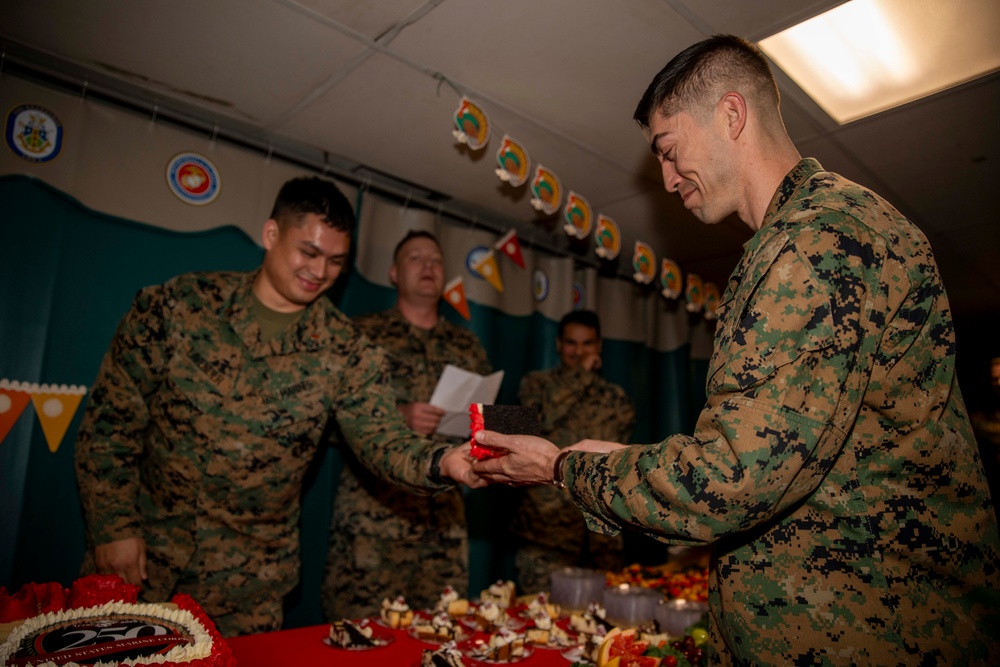
251115-N-EG735-1037 ATLANTIC OCEAN – (Nov. 15, 2025) Chief Warrant Officer Andrew Lavender, assigned to the Wasp-class amphibious assault ship USS Kearsarge (LHD 3), serves a piece of cake to Maj. David Brennan, as a part of the tradition of giving the oldest Marine in attendance the first piece of cake, Nov. 15, 2025. Kearsarge is currently underway conducting Basic phase certifications. (U.S. Navy photo by Mass Communication Specialist Seaman Apprentice Chase McDaniel)
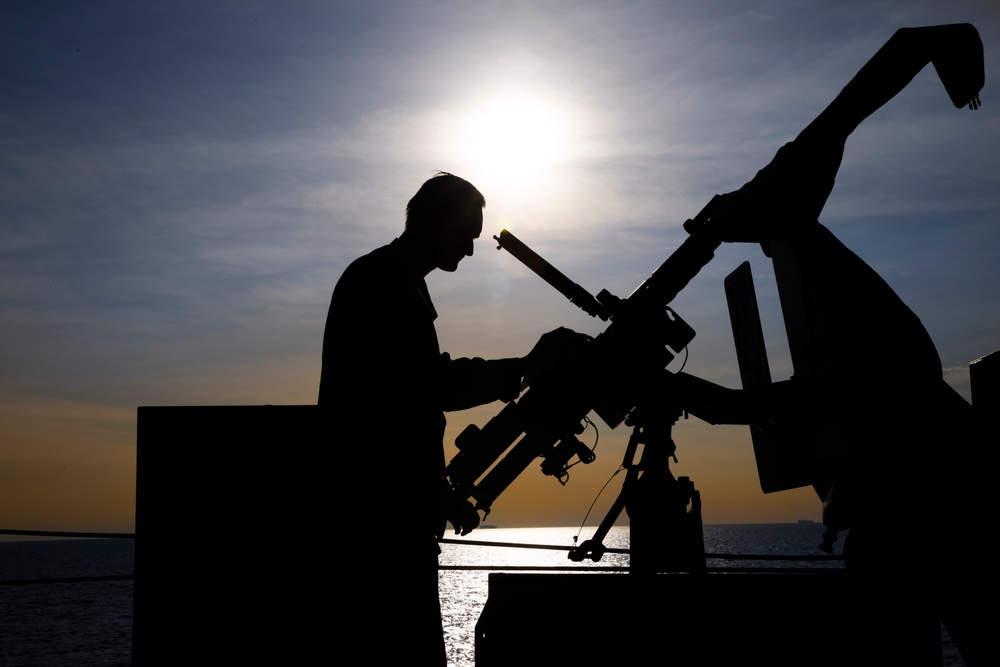
251115-N-EG735-1009 ATLANTIC OCEAN – (Nov. 15, 2025) Gunner’s Mate Seaman Nathan Preston, assigned to the Wasp-class amphibious assault ship USS Kearsarge (LHD 3), cleans a .50-caliber machine gun, Nov. 15, 2025. Kearsarge is currently underway conducting Basic phase certifications. (U.S. Navy photo by Mass Communication Specialist Seaman Apprentice Chase McDaniel)
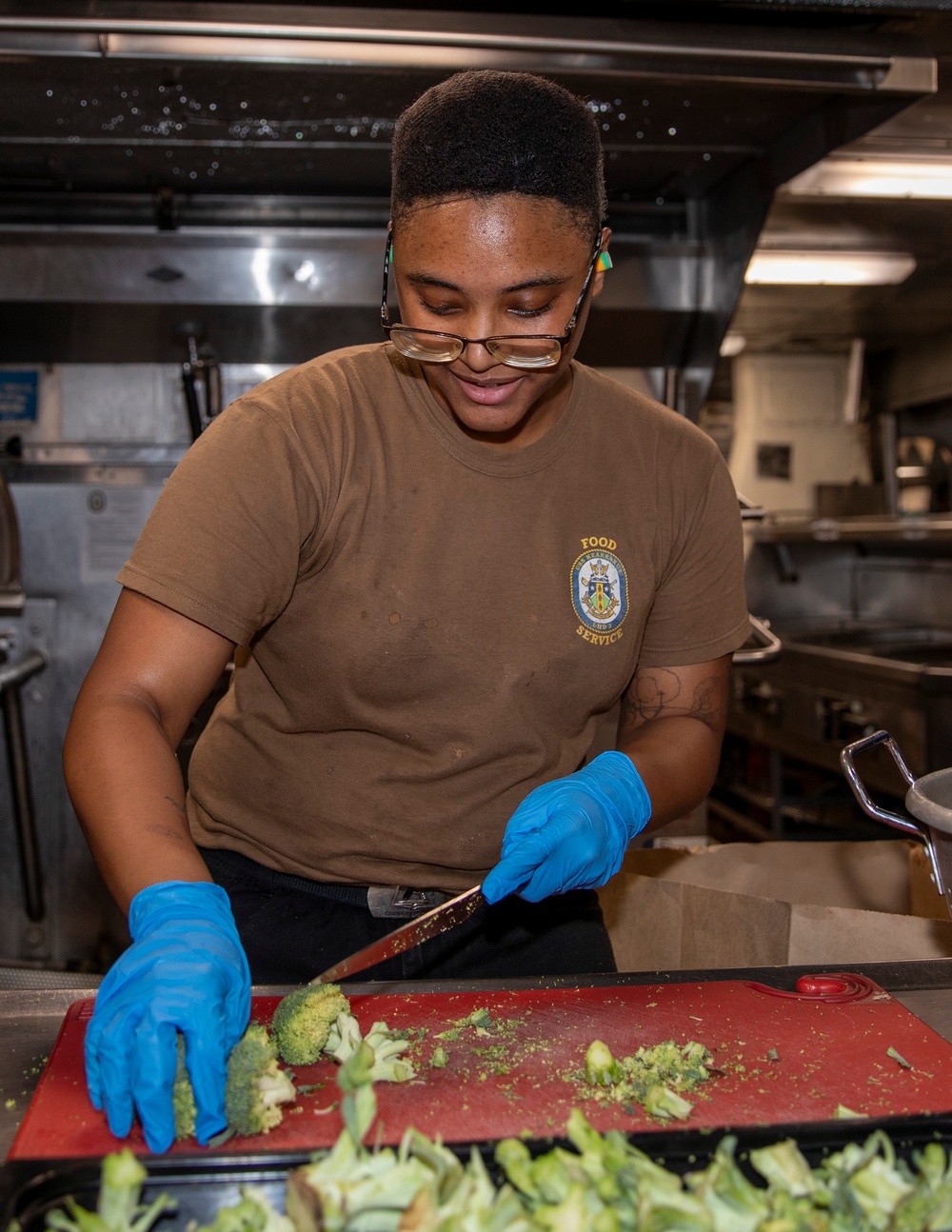
251115-N-EJ492-1019 ATLANTIC OCEAN – (Nov. 15, 2025) Culinary Specialist Seaman Kyleigh Brown, assigned to the Wasp-class amphibious assault ship USS Kearsarge (LHD 3), cuts broccoli in preparation for dinner, Nov. 15, 2025. Kearsarge is currently underway conducting Basic phase certifications. (U.S. Navy photo by Mass Communication Specialist Seaman Apprentice Dylan Spears)

![DVIDS – Images – Reagan Sailors conduct daily operations [Image 1 of 5]](https://101veterans.com/wp-content/uploads/2024/12/dvids_logo_20_main.png "DVIDS – Images – Reagan Sailors conduct daily operations [Image 1 of 5]")



 Private Internet Access gives you unparalleled access to thousands
of next-gen servers in over 83 countries and each US state. Your
VPN experience will always be fast, smooth, and reliable.
Private Internet Access gives you unparalleled access to thousands
of next-gen servers in over 83 countries and each US state. Your
VPN experience will always be fast, smooth, and reliable.