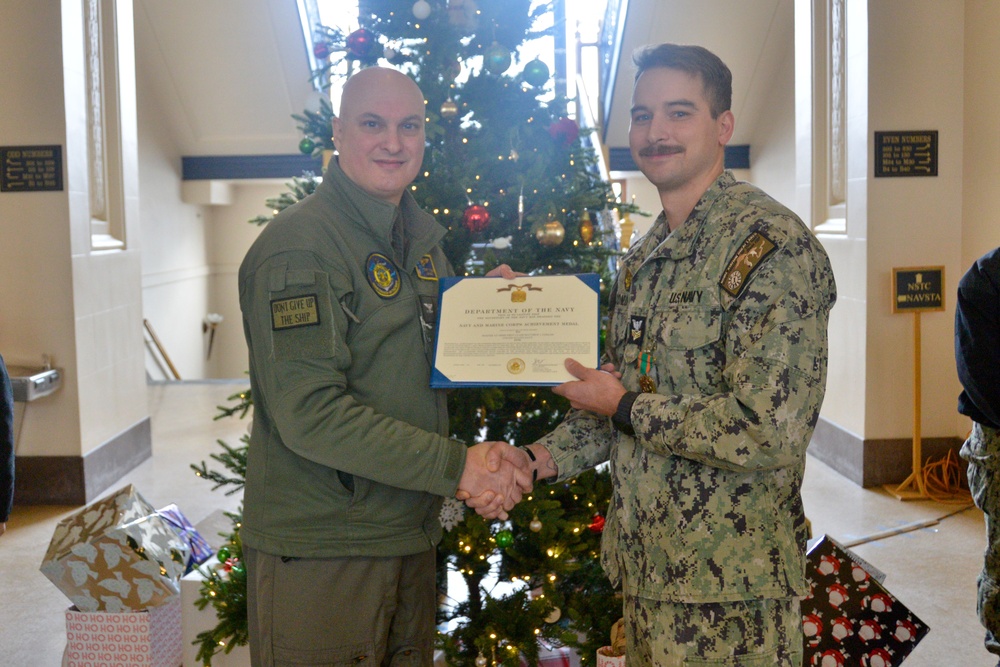
GREAT LAKES, Illinois (December 29, 2025) Master-At-Arms 1st Class Matthew Conlon receives Navy and Marine Corps Achievement Medal from Naval Station Great Lakes Commanding Officer, Capt. Stephen M. Yargosz during an award ceremony. (U.S. Navy photo by Mass Communication Specialist 2nd Class Evan Mueller)
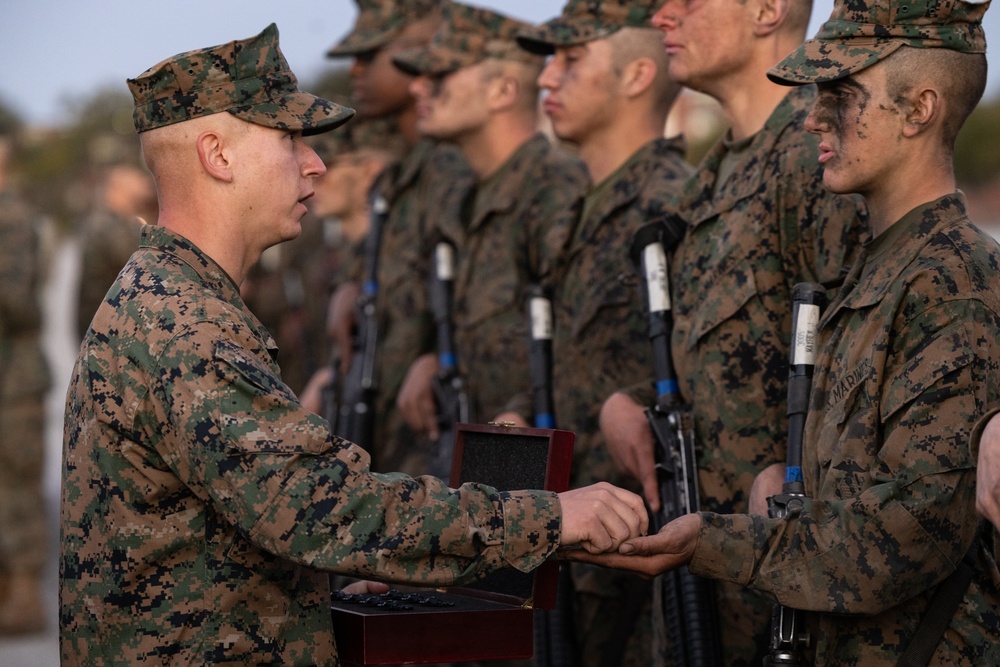
New Marines with Mike Company, 3rd Recruit Training Battalion, receive their Eagle, Globe and Anchor (EGA) on Marine Corps Recruit Depot Parris Island, S.C., Dec. 23, 2025. Recruits receive their EGA after completing the crucible, a 54-culminating event where they are tested on what they’ve learned over the past 57 training days. (U.S. Marine Corps photo by Cpl. Jordy Morales)
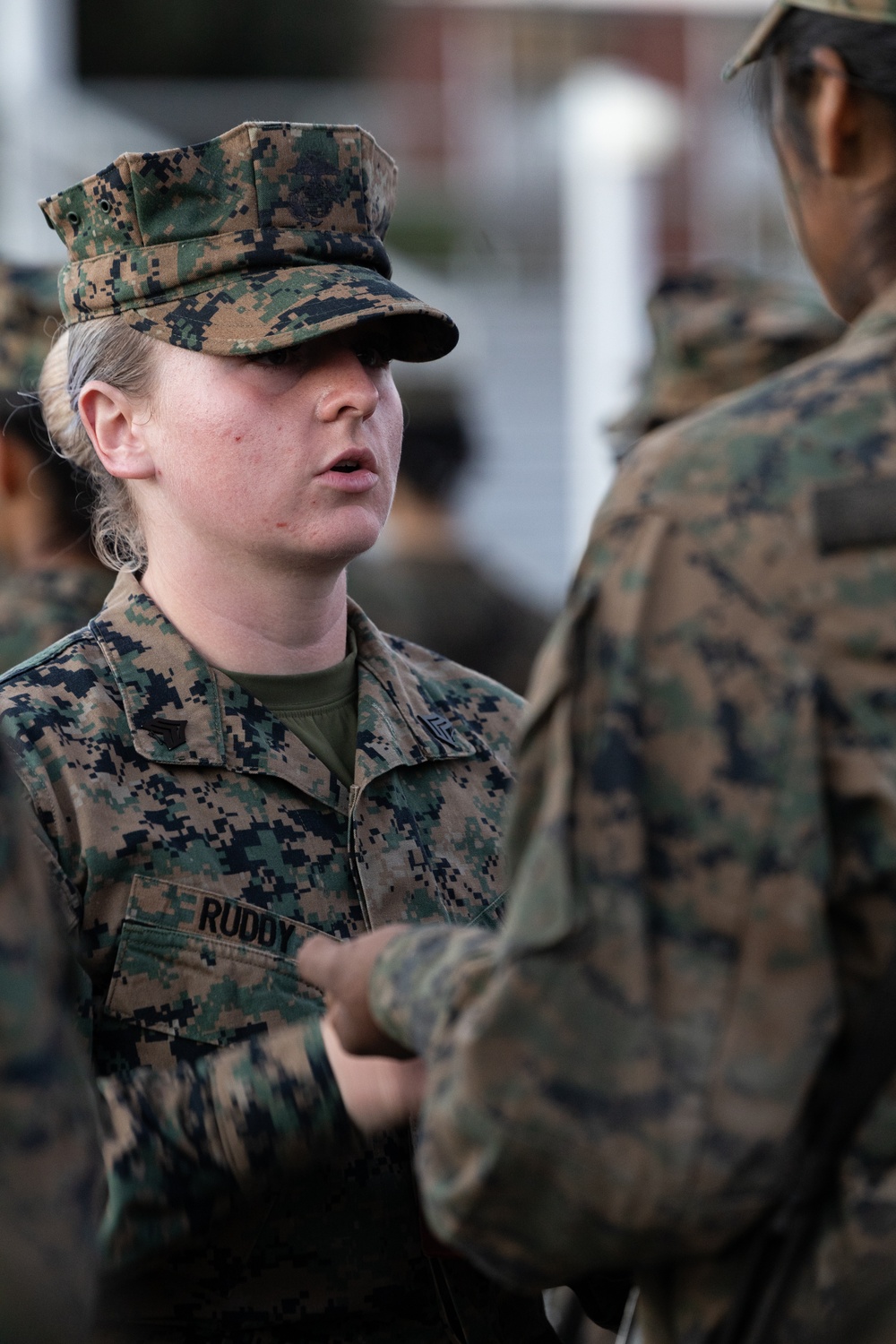
U.S. Marine Corps Sgt. Shannon Ruddy, a drill instructor with Mike Company, 3rd Recruit Training Battalion, awards new Marines their Eagle, Globe and Anchor (EGA) on Marine Corps Recruit Depot Parris Island, S.C., Dec. 23, 2025. Recruits receive their EGA after completing the crucible, a 54-culminating event where they are tested on what they’ve learned over the past 57 training days. (U.S. Marine Corps photo by Cpl. Jordy Morales)
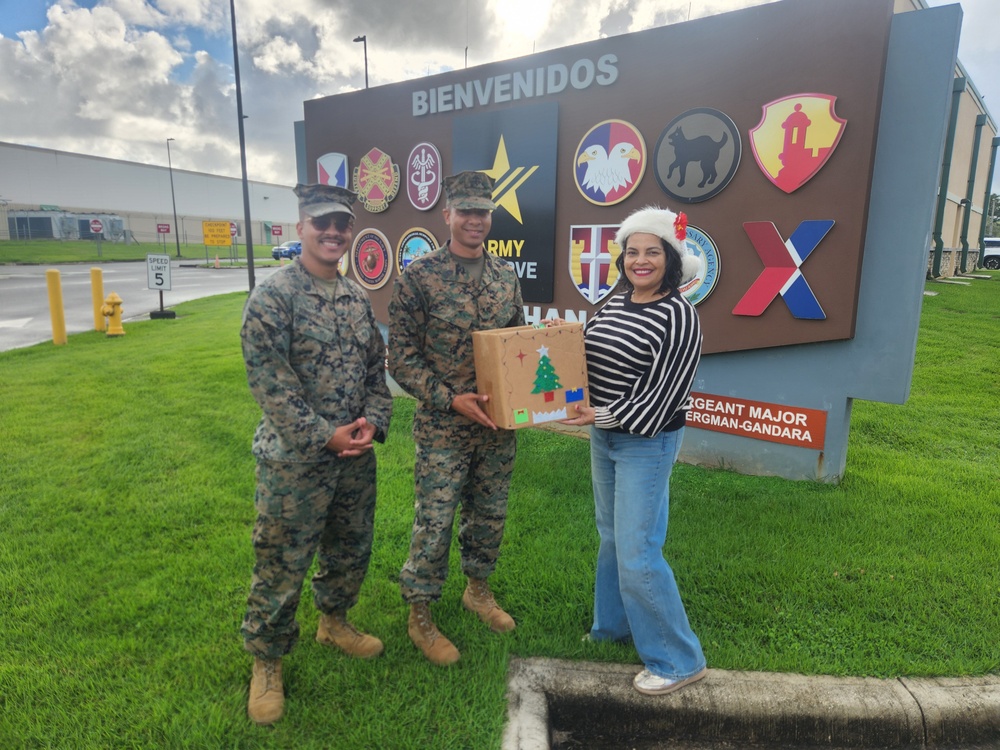
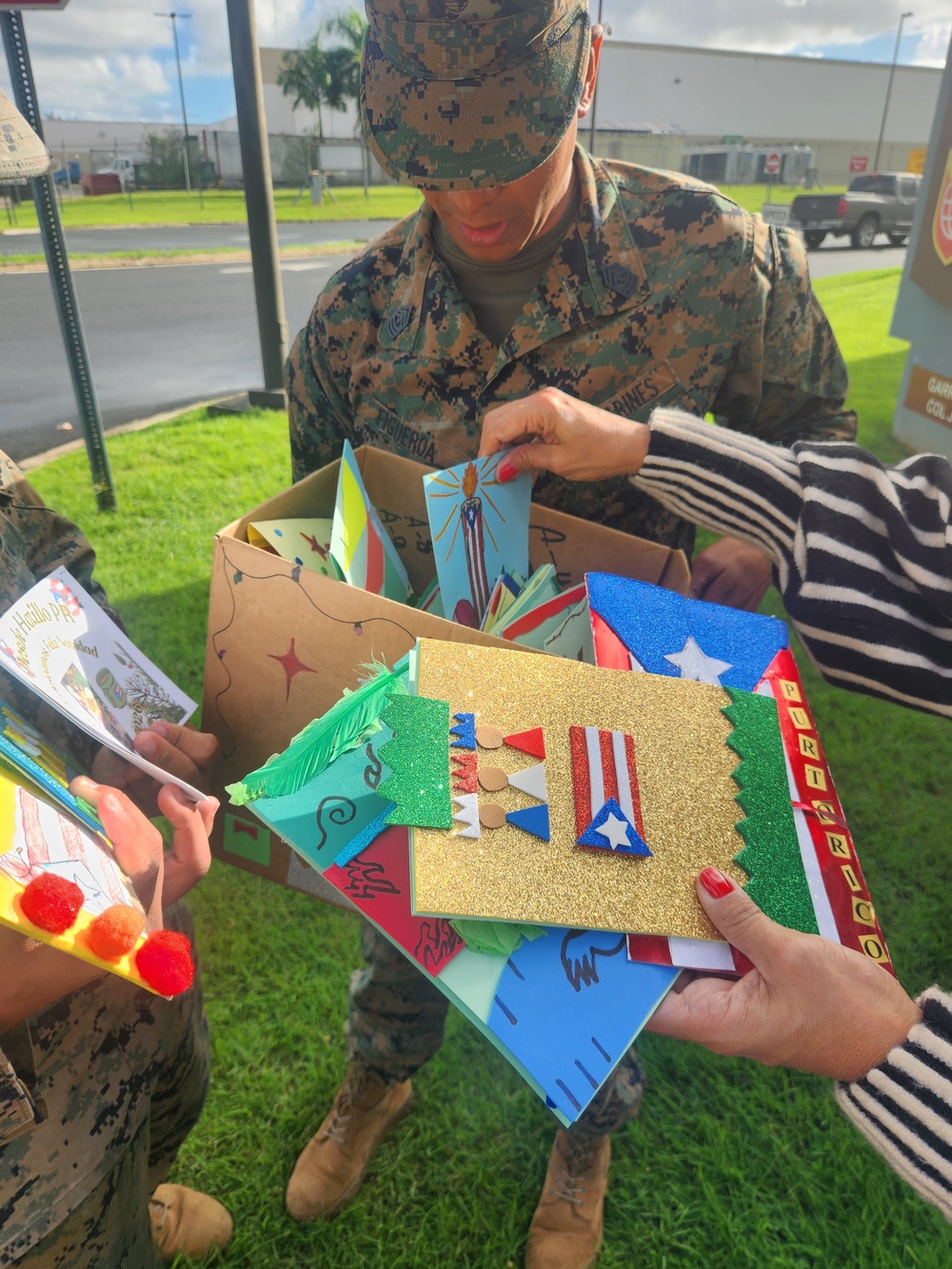
Representatives from the United States Marine Corps Reserve in Puerto Rico received Christmas cards, Dec. 23, made by students from three schools in the northern region of the island, as a show of support for military personnel deployed around the world, including those assigned to military vessels operating in the Caribbean.
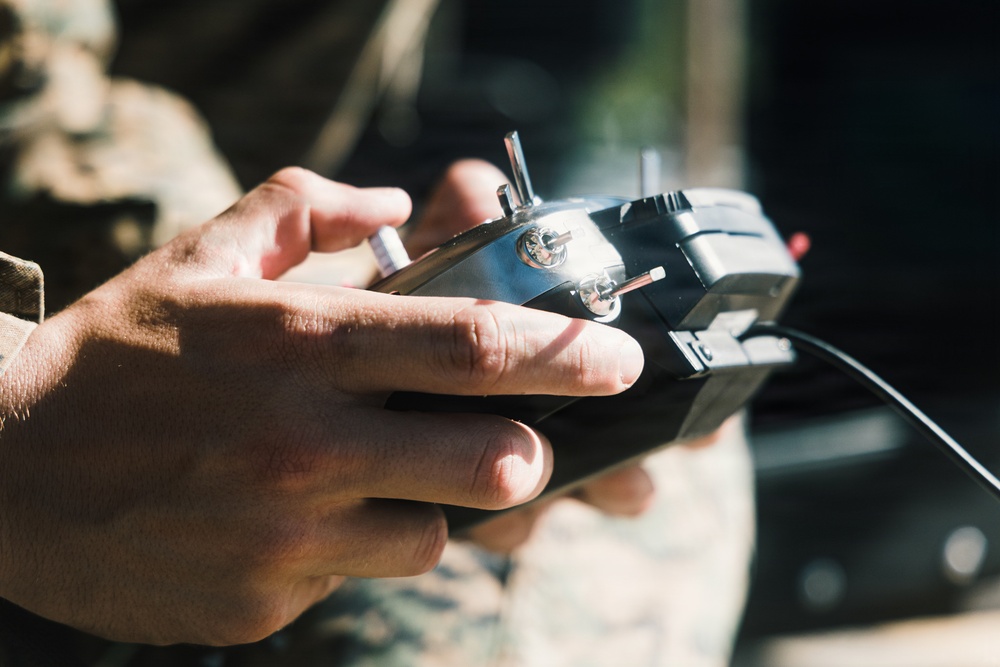
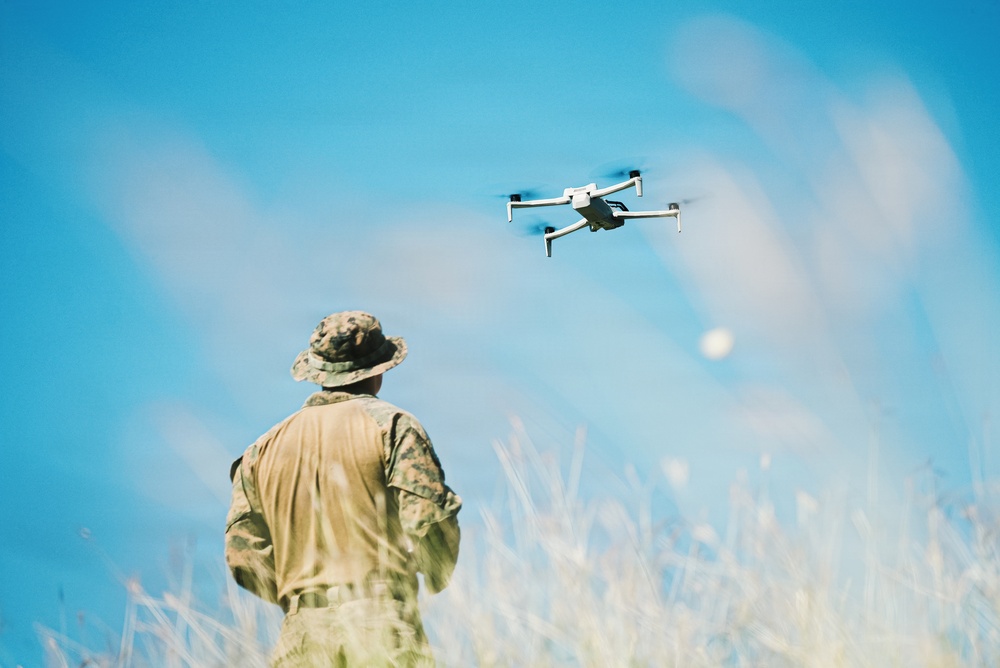
A U.S. Marine with Battalion Landing Team 3/6, 22nd Marine Expeditionary Unit (Special Operations Capable), flies a Neros Archer first-person view drone during attack drone training on Camp Santiago, Puerto Rico, Nov. 21, 2025. 22nd MEU(SOC) Marines are being trained and certified by the 2d Marine Division and the Marine Corps Attack Drone Team on first-person view drone systems to enhance combat readiness. U.S. military forces are deployed to the Caribbean in support of the U.S. Southern Command mission, Department of War-directed operations, and the president’s priorities to disrupt illicit drug trafficking and protect the homeland. (U.S. Marine Corps photo)
IWTC Virginia Beach strengthening battlespace awareness, brick by brick
By Lt. Isabel Shaw
Information Warfare Training Command Virginia Beach
VIRGINIA BEACH, Va. – Petty Officer 1st Class Eric Anderson knew his students needed a clearer, more tangible way to grasp just how many variables emerge when assessing a target’s physical environment.
The intelligence specialist and Information Warfare Training Command Virginia Beach instructor started by building a simple cardboard model, but it lacked the depth, complexity and precision he needed to emulate operational intelligence concepts to students.
“It was really bad, but it led me to another idea,” he said. “Why not use Legos? Everybody understands Legos.”
For two weeks, Anderson meticulously built a mock insurgent compound, brick by brick. What began as a single structure designed to support a few learning objectives soon evolved into a sprawling vignette that mirrors the complexity of an urban warfare environment.
The model’s success quickly sparked interest across enlisted and officer intelligence courses at IWTC Virginia Beach, prompting a growing demand for his Lego-built training tools. In just the past two weeks, he has engineered a second model of a detailed merchant shipping vessel, now slated for use in the Basic Shipboard Intelligence Course and Maritime Security Intelligence Operations Course.
The Lego model is riddled with operational dilemmas and opportunities for intelligence analysts to sharpen their battlespace awareness. Overgrown weeds on the ground encircle a dry well, hinting at low activity or poor upkeep.
Throughout the scene, visual cues prompt students to weigh humanitarian considerations and the laws of armed conflict that shape strike operations. The principle of distinction, for example, is reflected in a protected religious site’s inclusion.
Weaponeering questions are also embedded within the model’s design. The compound buildings and walls are constructed of distinct materials such as reinforced steel, exposed brick and composite pieces – each presenting its own challenges and opportunities. Three structures share a single power line, prompting students to identify a small gas generator as a potential center of gravity. Within this scenario, they’re tasked with identifying kinetic effects that are both proportionate and effective.
Outside the compound walls, Anderson installed myriad traces of adversary capabilities and intentions, beckoning the viewer to closely examine and scrutinize details. Students can peer inside the battered shell of a small building and note destroyed utilities and the remains of a roof, indicating limited feasibility for long-term use.
A pockmarked roadway raises several important questions about maneuverability and the potential presence of improvised explosive devices. Farther up the road, a pickup truck fitted with a gun mount offers yet another clue for students to dissect.
Anderson’s creative process didn’t just produce a training tool; it sparked new ways to enhance learning across courses. The Lego compound is now used in IWTC Virginia Beach’s K-10A Imagery Course to help illustrate complex techniques that students often struggle to visualize.
“The computer systems don’t always demonstrate concepts in a way students understand, so the Lego model helps bridge that gap,” Anderson explains.
None of Anderson’s complex designs come from kits or instructions; each one is built entirely from scratch. He selects every individual brick with a clear vision and rare talent for translating operational realities into a medium that resonates with students at multiple levels.
Instructors say his models reflect an uncommon degree of creativity and innovation, one IWTC Virginia Beach is proud to foster.
“When everything revolves around simulation and modeling, IS1 Anderson’s work delivers a classic, back-to-basics visual approach,” said Chief Warrant Officer 4 Karl Barnes, who utilizes the models for his courses. “He is also demonstrating how Sailor ingenuity will always be the standard by which all others are measured. It’s refreshing to see a Sailor valuing innovation and initiative while training information warfare teams for a future strategic competitor fight.”
IWTC Virginia Beach, part of the Center for Information Warfare Training, offers more than 70 specialized courses in fields such as information technology, cryptology and intelligence. The command is staffed by about 330 military, civilian, and contractor personnel and trains over 6,500 students a year at locations across the U.S., including Jacksonville and Mayport, Florida; Naval Submarine Base Kings Bay, Georgia; and Groton, Connecticut.
CIWT’s network of four schoolhouse commands and multiple training sites around the globe delivers world-class instruction to more than 26,000 students annually. It ensures the Navy, Marine Corps and Department of War are equipped with the highest caliber of intelligence professionals, ready to meet the demands of a rapidly evolving global landscape.
Date Taken:
12.15.2025
Date Posted:
12.26.2025 17:54
Story ID:
555277
Location:
VIRGINIA BEACH, VIRGINIA, US
Web Views:
48
Downloads:
0
PUBLIC DOMAIN
This work, IWTC Virginia Beach strengthening battlespace awareness, brick by brick, must comply with the restrictions shown on https://www.dvidshub.net/about/copyright.
A U.S. Marine Corps mortarman with Kilo Company, Battalion Landing Team 3/6, 22nd Marine Expeditionary Unit (Special Operations Capable), flies a SkyDio X10 small unmanned aircraft system during attack drone training on Camp Santiago, Puerto Rico, Nov. 22, 2025. 22nd MEU(SOC) Marines are being trained and certified by the 2d Marine Division and the Marine Corps Attack Drone Team on first-person view drone systems to enhance combat readiness. U.S. military forces are deployed to the Caribbean in support of the U.S. Southern Command mission, Department of War-directed operations, and the president’s priorities to disrupt illicit drug trafficking and protect the homeland. (U.S. Marine Corps photo)
Representatives from the United States Marine Corps Reserve in Puerto Rico received Christmas cards, Dec. 23, made by students from three schools in the northern region of the island, as a show of support for military personnel deployed around the world, including those assigned to military vessels operating in the Caribbean.
Small Hands, Big Messages: Students Support Deployed Military Personnel
FORT BUCHANAN, Puerto Rico — Representatives from the United States Marine Corps Reserve in Puerto Rico received Christmas cards, Dec. 23, made by students from three schools in the northern region of the island, as a show of support for military personnel deployed around the world, including those assigned to military vessels operating in the Caribbean.
Lisa Morales, a Family and Consumer Sciences educator at the University of Puerto Rico, Mayagüez Campus, helped organize the delivery. She worked with students from Eli Ramos Rosario Elementary School and Fernando Suria Chávez High School in Barceloneta, and Lorenzo Coballes Gandía High School in Hatillo.
The Christmas card project is part of the Expanded Food and Nutrition Education Program (EFNEP), a federal initiative. EFNEP encourages positive youth development, communication skills, and civic responsibility through community activities like this one.
“Aware that many service members cannot spend the Christmas holidays with their loved ones, today we are delivering these beautiful handmade cards made by our students. Through this gesture, our children are sending messages of encouragement, solidarity, and support to our military personnel as a sincere way of thanking them for their service,” said Morales.
1st Sgt. Alex Figueroa from the Marine Corps Reserve unit at Fort Buchanan spoke about what this gesture means to him both personally and professionally.
“Receiving Christmas cards like these means a great deal to a deployed service member. I have served in Iraq and Afghanistan, and I can attest that this type of support makes a real difference in our troops’ morale, especially during the holidays. It gives us strength to continue fulfilling the mission, even while far from our families, and reaffirms that our service has a positive impact on society,” Figueroa said.
Currently, hundreds of service members from Puerto Rico are deployed worldwide. In particular, U.S. military forces are deployed to the Caribbean in support of the U.S. Southern Command mission, Department of War-directed operations, and the president’s priorities to disrupt illicit drug trafficking and protect the homeland.
With an annual budget exceeding $500 million, Fort Buchanan serves a military community of approximately 15,000 members, including active-duty personnel, Reservists, National Guard members, Marine Corps Reservists, and Navy Reservists. Fort Buchanan’s mission is to serve as a strategic platform to enhance readiness and facilitate the deployment of military forces anytime, anywhere.
Fort Buchanan Honors Civilian Retirees for Decades of Service
FORT BUCHANAN, Puerto Rico— Service members, family members and civilian employees gathered at the Fort Buchanan Community Club Dec. 19 for a retirement ceremony honoring Victor M. Lopez and Libertad F. González for their decades of dedicated service to the installation and the U.S. Army.
Col. John D. Samples, Fort Buchanan’s commanding officer, presided over the ceremony, joined by Command Sgt. Maj. Kimberly D. Bergman-Gándara, the installation command sergeant major.
“To the retirees we honor today: your careers represent decades of dedication, problem-solving and quiet leadership. You ensured this installation remained resilient, compliant and ready—often behind the scenes, always essential,” Samples said.
Samples highlighted the critical role of the civilian workforce in sustaining the Army’s presence and mission in the region.
“Fort Buchanan’s strategic relevance in the Caribbean and the Western Hemisphere is sustained by civilian professionals like you, who provide continuity, expertise and local knowledge that cannot be surged in a crisis,” he added.
González concluded 38 years of distinguished civilian service, spanning from Oct. 21, 1987, to Dec. 31, 2025. Throughout her career, she served in multiple positions within the Directorate of Emergency Services, providing consistent support across a wide range of functions. In March 2023, she transitioned to the Directorate of Public Works, where she served as a business management support specialist until her retirement.
“I truly enjoyed my job,” González said. “It was a family that helped me every step of the way.”
A native of Río Piedras, Puerto Rico, González emphasized the sense of community she found throughout her career at Fort Buchanan.
Lopez began his civilian career at the Training Support Center on Nov. 22, 2009, where he served as a senior training instructor. He previously worked with the U.S. Army Corps of Engineers as a transportation specialist. Before entering civilian service, Lopez honorably completed 21 years of active-duty service with the U.S. Army.
“I cannot complain about anything,” Lopez said. “The Army helped me be successful and gave me the opportunity to travel around the world. I truly enjoyed serving our troops all these years.”
Lopez is a native of Cidra, Puerto Rico.
During the ceremony, each retiree received a retirement certificate, a Department of the Army Certificate of Retirement and a certificate of appreciation, recognizing both their individual contributions and the sacrifices made by their families.
The event concluded with a benediction and the playing of the Army Song, followed by a receiving line where attendees offered personal congratulations to the retirees.
For more information about upcoming retirement ceremonies, contact the Fort Buchanan Retirement Service Office at 787-707-2061.
With an annual budget of nearly $500 million, Fort Buchanan supports approximately 15,000 military personnel, including active-duty, Reserve, Puerto Rico National Guard, Marine Corps Reserve and Navy Reserve members. The installation’s mission focuses on enhancing readiness and enabling the deployment of forces anywhere, anytime.

![DVIDS – Images – NSGL Award Ceremony [Image 4 of 4]](https://101veterans.com/wp-content/uploads/2024/12/dvids_logo_20_main.png "DVIDS – Images – NSGL Award Ceremony [Image 4 of 4]")



 Private Internet Access gives you unparalleled access to thousands
of next-gen servers in over 83 countries and each US state. Your
VPN experience will always be fast, smooth, and reliable.
Private Internet Access gives you unparalleled access to thousands
of next-gen servers in over 83 countries and each US state. Your
VPN experience will always be fast, smooth, and reliable.