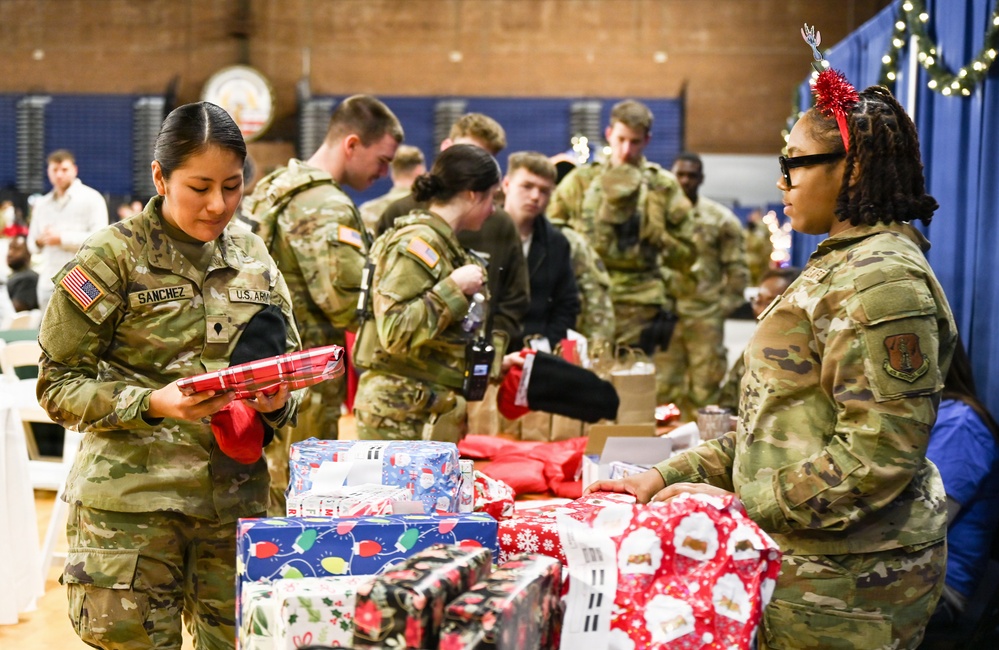
Soldiers with Joint Task Force–District of Columbia choose gifts provided by the Care Team during a holiday luncheon at the D.C. Armory in Washington, D.C., Dec. 23, 2025. Approximately 2,700 National Guard members are supporting the D.C. Safe and Beautiful mission, providing critical support to the Metropolitan Police Department to help ensure the safety of those who live, work and visit the District. (U.S. Air National Guard photo by Tech. Sgt. Missy Sterling)
YOKOTA AIR BASE, Japan — The 515th Air Mobility Operations Group hosted the fourth iteration of its Port Dawg Rodeo at Yokota Air Base, Japan, during the week of Nov. 17, strengthening interoperability with the Japan Air Self-Defense Force through hands-on aerial port competition.
The four-day event brought together 20 Airmen from the 730th Air Mobility Squadron and the 374th Logistics Readiness Squadron with 19 JASDF members representing 12 air wings across Japan. Integrated teams competed in a series of aerial port events while working alongside our counterparts, reinforcing shared standards and operational trust.
“The Port Dawg Rodeo allows our Airmen and JASDF partners to train together in a realistic, competitive environment that directly translates to mission readiness,” said Lt. Col. Shawn Cox, 730th AMS commander. “These engagements strengthen relationships and contribute to esprit de corps between our organizations.”
Competition events included a 10K standard forklift driving course, aircraft loading, pallet build-up, center of balance marking, and a Port Dawg fitness challenge. The events were designed to test technical proficiency, adaptability, and teamwork in a dynamic, multilingual environment.
“Working alongside JASDF members pushed us to communicate clearly, adapt quickly, and rely on each other to get the job done,” said Senior Airman Joseph Durhan, a 730th AMS Transportation Specialist who participated in the Rodeo. “It reinforced how important trust and teamwork are in real-world operations.”
The Rodeo concluded with an awards ceremony recognizing top-performing teams and individual standouts, highlighting professional excellence and allied cooperation.
In addition to the competition, JASDF members toured key facilities to expand mutual understanding of air mobility capabilities. Tours included the 730th AMS air freight warehouse, where Airmen demonstrated the Mechanized Material Handling System, as well as a JASDF cargo warehouse, a CH-47J Chinook hangar, a Kawasaki C-2 aircraft at Iruma Air Base, the 374th LRS Cargo Mobility Flight warehouse, and a briefing on CV-22 operations by the 21st Special Operations Aircraft Maintenance Squadron.
Date Taken:
12.23.2025
Date Posted:
12.23.2025 20:30
Story ID:
555265
Location:
JP
Web Views:
40
Downloads:
0
PUBLIC DOMAIN
This work, Allied Partnership Strengthened During 4th Port Dawg Rodeo at Yokota, must comply with the restrictions shown on https://www.dvidshub.net/about/copyright.
NAS Patuxent River Mourns Passing of Capt. Roger Hill
NAS Patuxent River mourns the passing of former Commanding Officer Capt. Roger Hill, NAS Patuxent River CO from June 1992 to January 1995.
A well-known fixture in St. Mary’s County, Hill was known not just for his tenure at NAS Patuxent River, but also his commitment to the community at large, notably as Chief Operations Officer for St. Mary’s City from 1999 – 2009. As commanding officer of NAS Patuxent River, his service was marked by the dedicated leadership of a man who had genuine affection for the base.
“Being commanding officer of a base is great; I couldn’t have asked the Navy for a better job,” said Hill prior to retiring from the Navy as the Pax River Commanding Officer. “You feel like you can make some positive impacts because you’re in a position where you can actually make some. If I could stay as CO of the base, I would stay here until they kicked me out. Unfortunately, other people get a chance at it too, because it’s such a wonderful job.”
A 1970 graduate of the U.S. Naval Academy, his storied career included flying A-7s in VA-105 and VA-174 both at sea and ashore, serving alongside other legendary naval aviators such as Richard “Moon” Vance, Raymond “Chip” Dudderar, Carlos Johnson, Jeff “Sundance” Harrison, and John McCain. Hill attributed much of his success in the Navy to the mentorship he received and would later pass on.
“When you’re in the Navy, you see a lot of leaders who you think a lot of,” said Hill in 1995. “There’s several who were role models for me on the way. They were people who were my heroes, made me aspire to things, and taught me things. I was very lucky that I had a lot of role models in the Navy.”
Hill was selected to join Class 71 at the U.S. Naval Test Pilot School in 1976, and became the Navy Weapon’s Representative at Eglin Air Force base after graduation where he flew developmental weapons test missions in the F-4, RF-4, F-111, F-15, and T-38. He would go on to serve in the Tomahawk Program Office (PMA-281), TAC D&E Officer at LATWINGPAC, and chief pilot at NAS Warminster before being tapped to lead NAS Patuxent River as the installation commanding officer in 1992.
Reflecting on his time at Pax River prior to his retirement, Hill remarked on his aspirations to lead at one of his favorite commands.
“I’ve been to every Naval Air Station in the world, but this was my first choice in terms of being commanding officer.”
Hill was noted by many in his command as a leader who trusted professionals to do their jobs. Marta Bullis, Naval Air Warfare Center Protocol Officer, previously served as Hill’s executive assistant, and noted his faith in his team to the job.
“Captain Hill let’s you do your job,” said Bullis in a 1995 interview. “It’s his trust in me that makes my job enjoyable.”
Hill’s tenure at Pax was one of noteworthy growth. The workforce at the air station increased nearly tenfold in the mid-1990s when a round of Base Realignment and Closures (BRAC) brought more than 20,000 military and civilian employees to Pax River as the air station it was selected to host the headquarters of Naval Air Systems Command (NAVAIR) and Naval Air Warfare Center Aircraft Division (NAWCAD), as well as dozens of mission partner commands. In that time, he oversaw the construction of a new commissary, VQ-4 alert facility, communications operations center, Test Pilot School academic building and runways, as well as renovations to existing structures such as the Frank Knox Building, the Navy Exchange, Bachelor Officers Quarters, hangars and labs to meet the demand of the expanded workforce.
In his change of command speech in January 1995, Hill made note of the importance of the work done at Pax and the people who do it, a sentiment that has echoed since.
“I have been in the Navy 29 years, and have been a Navy pilot almost 25 of those,” said Hill as he closed out his Navy career. “In that time, I have flown the best aircraft and had the best equipment in the world. That is a direct result of the efforts of the people who work at this base, who obviously, are also the best in the world at what they do. What we do is important to the country. Take credit for it, and be proud of it.”
Naval Air Facility Atsugi, Japan (December 23, 2025) – Every winter, the Tokyo metro area hosts the 10
Railway Company Stamp Rally, a massive scavenger hunt that stretches across the Kanto Plain. Naval Air
Facility (NAF) Atsugi, located a few miles south of the Kanagawa and Tokyo boarder with easy access to
several train stations, is a great location for starting the journey that takes you throughout the
seemingly endless urban metropolis.
During my tour in Japan I have been an avid stamp collector, documenting my travels across the country
by rail. I have completed several stamp rally events in the past but the 10 Railway Company Stamp Rally
is my favorite due to the difficulty, complexity and vast scale.
This rally requires the participant to collect two limited edition ink stamps in an issued stamp book and
one trading card for each of the 10 companies. Most of the stations near NAF Atsugi have the stamp
books in the display areas near the ticket gate.
While it may seem simple, the locations for these stamps are often deep into the outskirts of the city
limits or tucked into hard to access locations with great distances between.
This rally requires hours of planning and dozens of hours of train travel to complete and is both mentally
and physically exhausting. With all of the crowded trains and platforms with standing room only, tens of
thousands of steps, dozens of flights of stairs and cold weather, it is easy to get discouraged. Despite the
negative aspects, this rally was an exciting adventure that I am looking forward to participating in again
next year.
I was first introduced to the hobby of stamp collecting when I completed the 10 Railway Company
Stamp Rally two years ago. Since then I have been traveling Japan collecting stamps at train stations,
rest stops, shrines, and castles. With this hobby, I have also been falling deeper into the Japanese train
sub-culture, collecting train cards, stickers, and a variety of other items that employees often give away
for free at stations if you ask.
The first day of my journey I picked up a stamp book from Sagami-Otsuka Station and set off heading
north to Saitama Prefecture to collect the stamps on the North and West sides of the Kanto Plain. I
arrived first at Fujimino Station, a small local suburban station on the Tobu-Tojo Line, before heading back
south, following a parallel path with the western mountains on the way back to NAF Atsugi.
This path required taking a variety of different lines, some of them were very unique and not even
trains. The Seibu Yamaguchi Line, the line required to get the stamp at Seibuen-yuenchi Station, is a
people mover, a rubber tired four-car vehicle that operates on a single dedicated paved path. This line is
primarily used to shuttle people to and from the nearby baseball stadium and amusement park.
Further south is the Tama Monorail Line, one of the lines that can be used to get the stamp at
Takahatafudo Station, an elevated straddle beam monorail that services many of the urban centers to
the west of Tokyo. This elevated line, located high above the city streets, provides beautiful views of the
nearby city landscape and the mountains to the west.
The views from the elevated tracks combined with the different and unique modes of transportation
resulted in a fun first day. I thought after doing this rally in the past I would not experience anything
new, but the journey has taken me on lines, stations and vehicles that I had never seen before.
After making a lot of progress on the first day, I was motivated to begin the second day of exploration. I
set out from Yamato Station heading towards the furthest point, Miraidaira Station, a small station to
the northeast of Tokyo in Chiba Prefecture on the Tsukuba Express Line.
Despite my frequent train travel and daily use of Yamato Station for commuting to NAF Atsugi via the
Sotetsu Main Line, I underestimated the force of the Odakyu Enoshima Line morning rush to Shinjuku.
My motivation quickly dissipated as I lined up in one of the seemingly endless lines of people waiting for
the next train to arrive on the elevated platform.
The platform was full of people and organized like a military formation with two lines waiting at each
marked location on the platform where the train doors would be. The platform became a game of Tetris
as people arriving up the stairs and escalators moved quickly, weaving through the lines, looking for a
place to stand.
When the train arrived and came to a complete stop, all of the lines stretching down the platform
simultaneously moved in unison, splitting to each side of the train doors, creating gaps for the
passengers on the train to have room to exit. The choreography was seamless.
My awe of the reorganization of hundreds of people on the crowded platform was short lived as I
squeezed my way into the overly crowded train. When the doors closed, I was completely packed in. I
felt pressure from all sides and was unable to move. If I were to pass out, I would likely still be standing
due to the people crowded around me.
At each stop, the dance of transferring of hundreds of people on and off the platform would occur. As
the doors would open people inside the train would silently push and shove their way to the exit with
urgency, desperately trying to exit before the lines on the platform would enter leaving no room for
escape. At each station the passengers formed into an ocean current that went to and from the
platform and would leave anyone who hesitated stranded behind. The people on the platform would
wait anxiously, waiting for perfect timing to pounce into the train to secure a spot for themselves.
As the train would fill, the people still on the platform would get more desperate, pushing their way into
the crowded train car to ensure they would have a claim to a few square inches of real estate. People
already in the car would be pushed deeper into the train by the crowd funneling in. There was no
resentment by those being pushed against their will, there is a mutual understanding where the victim
knows they would be the aggressor if the roles were reversed.
As the last few people pushed their way through the doors of the train, the people at the edge would
grab onto anything they could to secure themselves from being pushed back onto the platform, forming
a wall across the entrance to the train. Even as a wall of commuters completely covered the entrance
door to the train, a few stragglers would arrive just in time before the doors closed.
Unable to fit through the people blocking their entrances, the straggler would face the wall of
opponents, offer a slight bow of apology, execute an about face, walk backwards, and push themselves
through until they themselves became part of the human barricade. When the doors closed everyone
settled into their positions, patiently waiting for the next stop and for the chaos to begin again.
What was amazing about this experience was the lack of sound. All of the commotion with hundreds of
people was done in complete silence. The experience was jarring at first, but I accepted it knowing that I
was in the same situation as hundreds of other people. There was a unique sense of camaraderie, I was
fully immersed in the shared experience. It was an opportunity to live, travel, commute, and
communicate with my neighbors without the typical language or social barriers and experience a small
glimpse of Japanese working culture.
I survived the journey north and covered the north and east sides of the Kanto Plain, collecting stamps
and trading cards. This day was the opposite of the previous day I spent near the mountains, this day
was spent mostly in the heart of Tokyo, going through Ginza, Nihonbashi, Akihabara, and Ueno.
I spent the third and final day of my adventure collecting all the stamps in Kanagawa Prefecture and the
few I was missing in the south of Tokyo Prefecture. I started the day heading south to get the stamp at
Zushi Station before heading north to Kawasaki.
I felt nostalgic as I rode the Keikyu Zushi Line north past Commander, Fleet Activities Yokosuka’s (CFAY)
Ikego Family Housing Facility, remembering collecting the stamp at the nearby Jimmuji Station during
the last stamp rally and my daily commute on the Keikyu Main Line when I worked at CFAY.
As I went further north, I was mesmerized by the views from the elevated tracks going through
Yokohama and Kawasaki, taking in the dense urban landscape and looking down at the bustling areas
below. It was amazing to see the scenery change from the quiet beach city of Zushi to the massive urban
port cities on the Tokyo Bay.
From there the urban sprawl continued into Tokyo as I collected stamps at Ookayama, Kyodo, and
Fujimigaoka stations. This route required a transfer at Shibuya Station and ended at a train store in
Shinjuku station where I collected one of the trading cards.
Navigating Shinjuku and Shibuya stations, the two busiest train stations in the world in terms of number
of daily passengers, was a hectic but good experience. This stamp rally took me to massive stations like
Shinjuku, a station that sees over 3 million riders per day, to small rural stations like Kunugiyama Station
that only has about 3 thousand riders per day.
It was interesting to see the opposite ends of such a massive and intricate rail network. Seeing firsthand
the many train lines servicing the small rural stations on the outskirts of the city move people like veins
to the heart of the massive city center stations and then pumping them back out in all directions with
such precision and ease is truly a marvel to witness.
I have been actively traveling the Kanto Plain by rail for the last three years, spending a lot of my free
time exploring and completing multiple stamp rallies. Before setting out to start this rally I thought I had already seen everything and been everywhere, but I did not realize until the third day how wrong I was. The more places I went, the more I discovered how little I had explored in this seemingly endless urban metropolis.
This rally took me by train through Kanagawa, Tokyo, Saitama, and Chiba Prefectures, and to parts of the
Kanto Plain I did not even know existed. Some places I had been to many times before, but many of
them I would not have traveled to if it had not been for this rally. I am glad to have had a reason to go to
these places and explore neighborhoods in the Tokyo Metro area I had never been before. Even though I
have just finished this rally, I am already excited to find out where it will take me next year.
Whether you are a rail fan, train enthusiast, traveler, scavenger hunter, or a person who wants to get
away from the tourist traps, this rally is for you. Start now because this year’s rally ends January 25,
2026. NAF Atsugi has a lot of fun things to do inside the base\, but from time to time it is good to get
beyond the gate, pick up a stamp book and enjoy your duty in Japan.
NAF Atsugi supports the combat readiness of Commander, Fleet Air Western Pacific, Commander,
Carrier Air Wing (CVW) FIVE, Helicopter Maritime Strike Squadron (HSM) 51 and 23 other tenant
commands, and provides logistic support, coordination, and services to units assigned to the Western
Pacific.
F.E. Warren Base Honor Guard performs at the Colorado Eagles Game
Loveland, Colo. — The F.E. Warren Air Force Base Honor Guard presented the colors at the beginning of a Colorado Eagles game during the playing of the National Anthem in Loveland, Dec. 20, 2025.
The ceremonial duty of the base honor guard is to perform drill and bear the colors for various events. The match between the Colorado Eagles and Henderson Silver Knights was a chance for guardsmen to represent the Air Force while showcasing the peak of military professionalism and discipline in a location service members are not often seen.
“We go out to these hockey games and out to the community to showcase our greatness, our resiliency, what we train for and give people a wider look on what we do,” said F.E. Warren AFB Honor Guard ceremonial guardsman. “Maybe even inspire someone else to join the military or do honor guard. You never know who is watching.”
The F.E. Warren AFB Honor Guard is a mixture of Airmen from different squadrons and jobs who volunteer to temporarily leave their designated duties to be guardsmen.. If accepted into the base honor guard, the Airmen are subjected to two weeks of intense drill and physical fitness training. Once finished with orientation they are then trained daily in further drill for a six-month tour which can be extended under certain circumstances.
“I wanted to be a multi-capable Airman, to do other things other than just my job, and the honor guard gave me the opportunity,” said Airman 1st Class Dulce Carmono Rivera, F.E. Warren AFB Honor Guard ceremonial guardsman. “It was something I always wanted to do, being able to be there for families, funerals, for the base overall, and also to represent the Air Force.”
The F.E. Warren AFB Honor Guard performs across the installation for ceremonies and memorials, and in the local community for events and funeral honors. To learn more about the F.E. Warren AFB Honor Guard, please follow this link: https://funatwarren.com/honor-guard
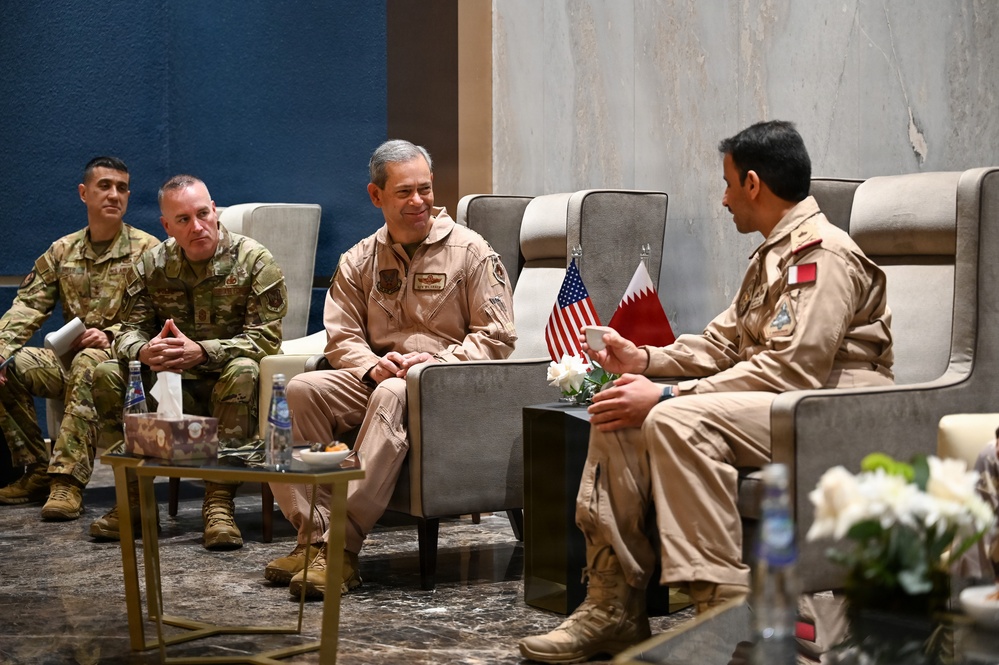
U.S. Air Force Chief of Staff Gen. Ken Wilsbach, third from left, speaks to Maj. Gen. Faisal bin Khalid AL-GHANIM, Qatar Emiri Air Force commander, during a visit in the U.S. Central Command area of responsibility, Dec. 21, 2025. Beyond interacting with Airmen, Wilsbach and Wolfe engaged with key regional military leaders, fortifying partnerships and reaffirming a shared dedication to security cooperation. Discussions centered on improving interoperability, tackling common security challenges, and maintaining a united front to promote stability within the CENTCOM AOR. (U.S. Air Force photo by Staff Sgt. Alexis Orozco)
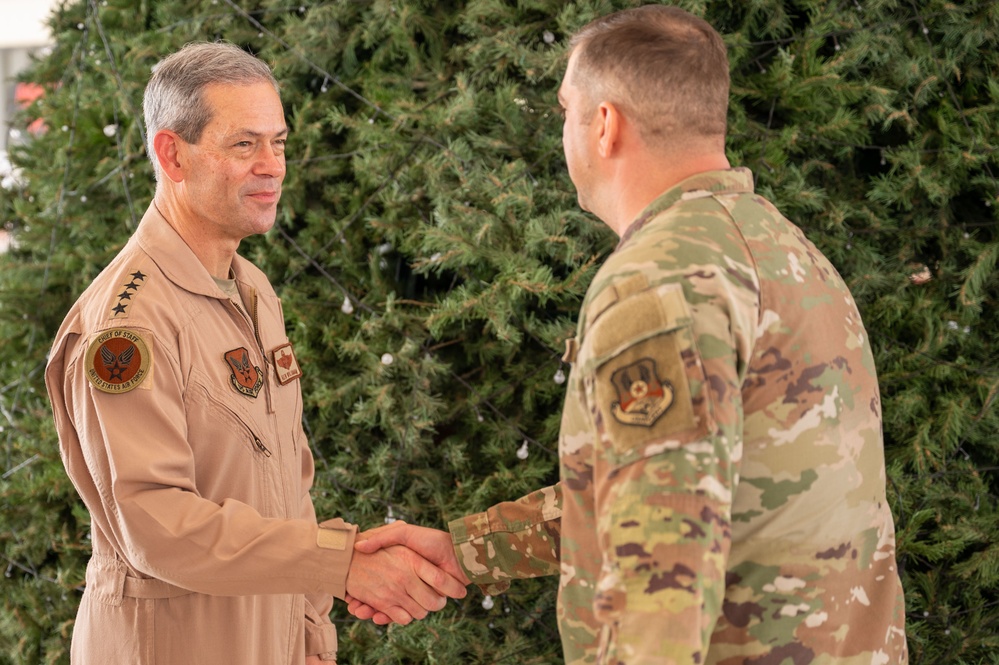
Air Force Chief of Staff Gen. Ken Wilsbach, second from left, and Chief Master Sgt. of the Air Force David Wolfe, left, speak to Lt. Col Stefanie Purdie, 379th Air Expeditionary Wing chief of staff, and Senior Master Sgt. Sasha Alejandro, A1 superintendent over manpower, personnel and Personnel Support for Contingency operations, prior to a coining ceremony in the U.S. Central Command area of responsibility, Dec. 21, 2025. During the holiday season, General Wilsbach and CMSAF Wolfe visited Airmen deployed to the CENTCOM Area of Responsibility. The visit offered a chance for the senior leaders to express their appreciation for the dedication and sacrifices made by Airmen far from home. (U.S. Air Force photo by Tech. Sgt. Kristen Pittman)
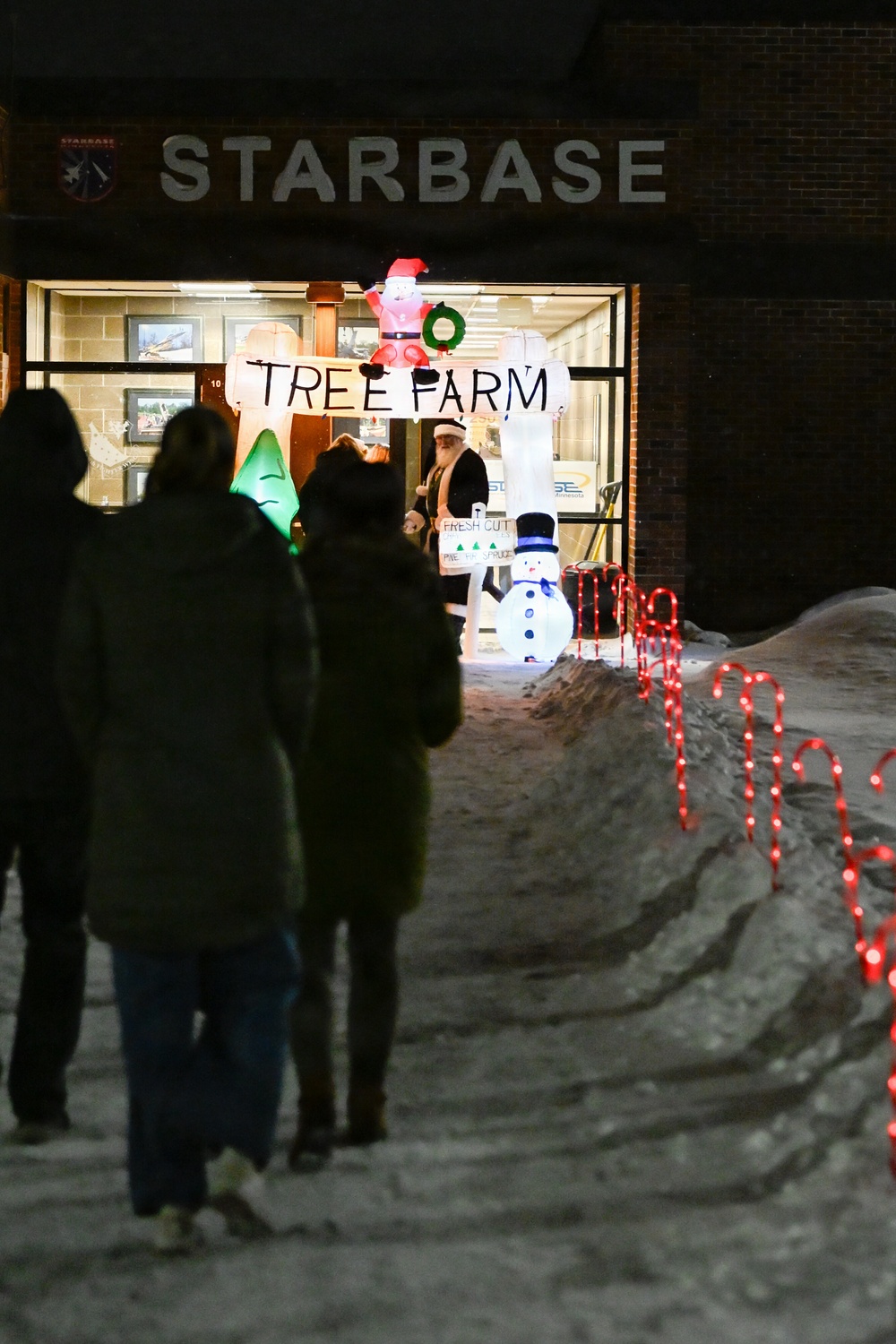
Santa Claus (retired U.S. Air Force Chief Master Sgt. William McRae) welcomes families arriving at the 148th Fighter Wing, Minnesota Air National Guard, Dec. 19, 2025. Santa joined military families for an evening of fun at the annual Kid’s Holiday Party planned by the 148th Fighter Wing’s Military & Family Readiness Programs Office. (U.S. Air National Guard photo by Master Sgt. Megan Shaner)
Air Force Chief of Staff Gen. Ken Wilsbach, his wife, Mrs. Cindy Wilsbach, Chief Master Sergeant of the Air Force David Wolfe, and his wife, Dr. Doniel Wolfe, visited the 48th Fighter Wing Dec. 19.
This visit kicked off a seven-base tour to meet with Airmen around the U.S. European Command and U.S. Central Command area of responsibility who stand watch 365 days a year.
“We know many of you are away from your families and friends this holiday season, and we wish you well and thank you for what you do,” said Wilsbach.
The CSAF and CMSAF held an all-call to emphasize that in every career field readiness, modernization and innovation all play key roles in flying and fixing to deter any adversary.
It’s the job of every leader in this room, which means every person in this room, to convince those around you that what we do is important,” said Wolfe.
Wilsbach and Wolfe immersed themselves in several of the Liberty Wing’s key mission areas to include weapons, security forces, airfield operations and command post.
The mission briefs and tours demonstrated how the Liberty Wing utilizes the strengths of nearly 7,000 active-duty and British and U.S. civilian personnel across RAF Lakenheath and RAF Feltwell. As the largest U.S. fighter operation in Europe, the wing employs four combat-ready fighter squadrons of F-15E Strike Eagles and F-35A Lightning II aircraft.
During the visit, the Key Support Liaisons also dedicated time to meet with the 48th Medical Group, base community center, child development center and more, reinforcing leadership’s charge to ensure we are taking care of our wingmen left and right.
“What I’d like for you to do,” said Wolfe, “is think about somebody you know that needs some help… and in the next couple of days, go help them.”
Before departing, the CSAF left Liberty Wing Airmen with one final message.
“What we do is hard, and doing hard things together builds strong teams,” said Wilsbach. “Everyone in this room is part of a winning team and has a connection to flying and fixing, no matter your job.”
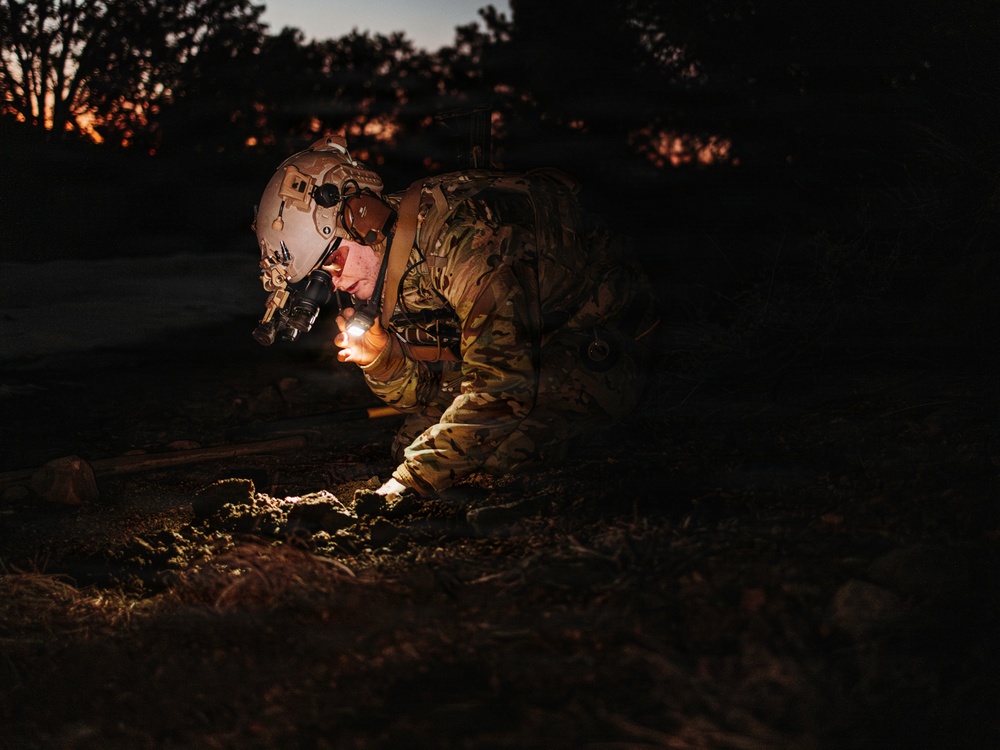
An Explosive Ordnance Disposal Technician with Explosive Ordnance Disposal Mobile Unit ELEVEN (EODMU-11) inspects overturned dirt during a roadside improvised explosive device call drill on Naval Air Weapons Station China Lake, Dec. 19, 2025. A pull line is used by EOD Technicians to move suspicious items from a distance. EODMU-11, a subordinate command of Explosive Ordnance Disposal Group ONE (EODGRU-1), operates as part of the Navy Expeditionary Combat Force, providing skilled, capable, and deployable maritime EOD and Navy Diver forces around the globe to support a range of operations. (U.S. Navy Photo by Mass Communication Specialist 2nd Class August Clawson)

![DVIDS – Images – Guardsmen gather at D.C. Armory for holiday celebration [Image 1 of 15]](https://101veterans.com/wp-content/uploads/2024/12/dvids_logo_20_main.png "DVIDS – Images – Guardsmen gather at D.C. Armory for holiday celebration [Image 1 of 15]")



 Private Internet Access gives you unparalleled access to thousands
of next-gen servers in over 83 countries and each US state. Your
VPN experience will always be fast, smooth, and reliable.
Private Internet Access gives you unparalleled access to thousands
of next-gen servers in over 83 countries and each US state. Your
VPN experience will always be fast, smooth, and reliable.