
WOODBRIDGE, Va., Dec. 11, 2025 /PRNewswire/ — Engineering Services Network, Inc. (ESN), a leading provider of advanced engineering, test and evaluation, cyber, logistics, and software solutions, announced today that it has been awarded a position on the Missile Defense Agency’s (MDA) SHIELD Multiple Award Contract (MAC). The contract vehicle carries a ceiling value of $151 billion over a 10-year period.
Engineering Services Network, Inc. (ESN) is proud to announce its selection as an awardee for the Missile Defense Agency’s SHIELD contract. Under the SHIELD contract, ESN will deliver comprehensive systems engineering, information technology, logistics, and cybersecurity capabilities designed to maintain and enhance the readiness, resilience, and effectiveness of missile defense systems. ESN will leverage its extensive experience in missile defense and naval systems to support MDA across a wide array of initiatives. This award highlights ESN’s longstanding commitment in delivering best-in-class technical solutions and mission-critical support services to the nation’s defense community.
The MDA is tasked with developing an advanced, multi-domain defensive architecture capable of detecting, tracking, intercepting, and neutralizing threats to the United States homeland, deployed forces, allies, and partners. This includes defending against ballistic, hypersonic, cruise missiles, and other advanced aerial threats across all phases of flight. The SHIELD MAC IDIQ contract will support national defense objectives by enabling continuous, layered protection against air, missile, space, cyber, and hybrid threats originating from any vector—land, sea, air, space, or cyberspace.
As part of this effort, ESN intends on supporting the planning and execution phases of key MDA activities—including AEGIS Ballistic Missile Defense (BMD) flight missions and Ground Testing—while also providing integral engineering and technical support across the agency’s missile defense programs.
The 10-year SHIELD MAC vehicle positions ESN to expand its Ballistic Missile Defense (BMD) support capabilities while contributing to a broader spectrum of Missile Defense initiatives, including programs such as Golden Dome.
“We’re honored to have been awarded SHIELD and look forward to supporting MDA in its mission to develop a comprehensive defense system protecting the U.S. homeland,” said Raymond F. Lopez Jr., CEO & Chairman of ESN and service-disabled retired Navy veteran. “For the past 30 years, ESN has provided missile defense–related test and evaluation, technical, and logistics services that meet or exceed our customers’ expectations. SHIELD opens the door for us to strengthen our partnership with MDA and further contribute to U.S. defense.”
This award further reinforces ESN’s position as a trusted provider of mission-critical services to the Department of Defense.
About Engineering Services Network, Inc.
ESN is a trusted leader in engineering and technology solutions. Founded in 1995, ESN is a Service-Disabled Veteran-Owned Small Business that proudly stands “Shoulder to Shoulder®” with our military and government customers, delivering critical services for missions that matter. ESN provides our military and government customers with mission-critical services in the areas of: Acquisition Management, Engineering & Technical Services, Test & Evaluation, Information Technology & Cybersecurity, Logistics & Maintenance, and Software Development. ESN customer experience includes the U.S. Navy, U.S. Army, U.S. Air Force, U.S. Marine Corps, Military Sealift Command, U.S. Department of Veteran Affairs, Department of Health and Human Services, and other federal agencies.
Based in Woodbridge, VA, ESN has regional and field offices throughout the U.S. and worldwide. ESN is ISO 9001:2015 certified and has achieved Software Engineering Institute’s Capability Maturity Model Integration (CMMI) Maturity Level 3 for Services and Development.
Fort McCoy, Wis., was established in 1909. Here is a look back at some installation history from December 2025 and back.
80 Years Ago — December 1945 FROM THE DEC. 7, 1945, EDITION OF THE REAL MCCOY NEWSPAPER:With festive holiday trimmings; Xmas trees order of day (By Newspaper Staff) — Christmas is coming to Camp McCoy with festive holiday trimmings, if unit commanders follow the suggestion of Brig. Gen. John Rice, commanding general.
Gen. Rice has urged the erection of Christmas trees in front of orderly rooms, in mess halls and day rooms, and wherever the Christmas spirit moves.
That shouldn’t start a wave of woodcutters into the surrounding forests, he cautioned, for Christmas tree cutting is the special job of the post engineer division.
Lt. Col. H.E. Fillinger, post engineer, has asked that requests for Christmas trees be phoned in to Paul Young, civilian post engineer superintendent, at phone 111 beginning next Monday. Trees will be cut under the supervision of Ray Bufton, agronomist, and will be ready for delivery at least by Dec. 17, Col. Fillinger said.
He also pointed out all Christmas trees and decorations used inside must be fireproofed. He warned against using unsafe extension cords and requested that those putting up trees with electrical decorations have them inspected by the fire department which also handles fireproofing. Phone 102 is the number to request this service, he said. Lighted candles are prohibited.
FROM THE DEC. 14, 1945, EDITION OF THE REAL MCCOY NEWSPAPER: McCoy grandson serving here (By Newspaper Staff) — Pvt. Robert Bruce McCoy, grandson of the late Maj. Gen. Robert Bruce McCoy, for whom Camp McCoy was named, is serving in the separation finance department.
Young McCoy, whose father Lt. Col. R.C. McCoy, Sparta, served with the 32nd Infantry Division, was inducted Nov. 29.
FROM THE DEC. 14, 1945, EDITION OF THE REAL MCCOY NEWSPAPER:B-r-r-r! These Badger Winters: Even La Crosse native finds the cold too much after tropical climes (By Newspaper Staff) — Thirty months of tropical weather without a winter has made Capt. Lyman J. Earney, assigned to Camp McCoy hospital, just a trifle concerned over the climate of his home state.
The recent cold wave as kept him inside longing for the warmth of the Virgin Islands sun where he was stationed for over two and one-half years with the medical unit on St. Thomas Island.
Currently residing in Sparta with his wife, Capt. Earney is attached to the surgery section of the camp hospital, which he states is “very active and well-staffed.”
While in the Virgin Islands he was assigned to a coast artillery unit which kept constant vigil to protect against enemy submarines lurking in the Caribbean waters. The captain’s main duties on the island were in preventing and treating tropical diseases, predominantly malaria and filiarisis.
Previous to entering the service, Capt. Earney graduated from Marquette University and served as an intern at Milwaukee County General Hospital. He received his basic training at Carlisle Barracks, Pa., and was shipped to his permanent station immediately after completing a month’s orientation work.
Upon his discharge, which his 66 points should entitle him to soon, he expects to take some post graduate training and then enter private practice.
FROM THE DEC. 21, 2025, EDITION OF THE REAL MCCOY NEWSPAPER:Sparta, Tomah carolers perform here for yule (By Newspaper Staff) — Christmas carols will be sung over the entire post on Monday afternoon and evening by a group of carolers from nearby towns.
A group of high school boys and girls from Tomah will sing during the afternoon and in the early part of the evening carols will be sung by a Sparta High School group.
Carols will be sung at the Station Hospital on Monday night by a choir composed of hospital personnel.
TURKEY AT BOTH CLUBS
Cafeterias at Service Clubs 1 and 3 will serve turkey dinner Christmas Day, Capt. Charles R. Hoggard, exchange officer, announced Thursday.
40 Years Ago — December 1985 FROM THE DEC. 12, 1985, EDITION OF THE TRIAD NEWSPAPER:McCoy DOL blankets snow-bound travelers (By Lou Ann Mittelstaedt) — When impassable road conditions stranded 563 travelers in the Tomah Senior High School gym, Fort McCoy did its part to give them a warm, fuzzy, welcome feeling by providing 150 blankets for their overnight stay.
On Sunday, Dec. 1, Lt. Col. Phillip Jones, Director of Logistics, received a call from Julie Zebro, executive director for the Tomah Area Chamber of Commerce. Road conditions were deteriorating rapidly, hotels in the area were already full and motorists were searching for a safe place to wait out the storm.
The Tomah Senior High School had been transformed into a “hotel” and blankets were needed for the overnight guests. Zebro asked Jones if Fort McCoy could supply 150 blankets.
With an affirmative answer, Master Sgt. Everette Patterson, Plans Office noncommissioned officer in charge for DOL, began wading through waist-deep snow to the buildings where the blankets were stored. When he arrived, he shoveled out the snow-blocked doorway with his hands.
With the help of the Fort McCoy military police and the roads and grounds crew, the roads and driveways leading to the buildings were cleared of snow, enabling trucks to be loaded with the blankets.
Patterson kept busy into the evening. Shortly after arrangements had been completed for the blankets needed in Tomah, a request for 50 cots and blankets for the National Guard armory in Mauston came in. Patterson and Maj. Nick Nugent did the organization for that request.
Meanwhile, two people in Tomah, each in four-wheel-drive vehicles, began the trip to Fort McCoy to get the blankets. Zebro said the trip, which normally takes 40 minutes round trip, took over two hours.
“The blankets and the support of Fort McCoy were greatly appreciated by the stranded travelers, the chamber, and the school,” Zebro said. “Fort McCoy was very cooperative. Lt. Col. Jones called me back within 10 minutes of my call and told me that we could count on the blankets.”
35 Years Ago — December 1990 FROM THE DEC. 14, 1990, EDITION OF THE TRIAD NEWSPAPER:Desert Shield to bring more troops to McCoy (By Newspaper Staff) — Three military units were deployed, and the activation of 11 units increased the number of soldiers training on post to approximately 4,600 as Phase II of Operation Desert Shield at Fort McCoy proceeded smoothly.
The 32nd Transportation Detachment, an Army Reserve unit from Fort McCoy, Wis., and the 213th Supply and Services Battalion, an Army Reserve unit from Wausau, Wis., both were deployed Dec. 2 from Volk Field near Camp Douglas, Wis.
The 12th Medical Detachment, an Army Reserve unit from Beloit, Wis., was deployed Sunday.
Eleven additional units were activated, bringing the total number of units activated here in Phase II to 38. The most recent units activated, by state, are:
Wisconsin — Army National Guard: the 229th Engineer Company from Prairie du Chien and Platteville; the 132nd Military History Detachment from Madison; and the 1157th Transportation Company from Oshkosh. No Army Reserve units were activated.
Michigan — Army National Guard: the 745th Ordnance Detachment from Camp Grayling. Army Reserve: The 182nd Transportation Company from Traverse City, Mich.
North Dakota — Army National Guard: the 133rd Quartermaster Detachment from Cando; the 136th Quartermaster Headquarters and Headquarters Detachment from Grafton; and the 191st
Military Police Company from Mandan. No Army Reserve units were activated.
Iowa — No Army National Guard units were activated. Army Reserve: The 189th
Transportation Company from Council Bluffs.
Minnesota — Army National Guard: the 257th Military Police Company. No Army Reserve units were activated.
Illinois — No Army National Guard units were activated. Army Reserve: the 308th Medical Detachment from Fort Sheridan, Ill.
The latest round of call-ups is due to the Department of Defense being authorized to activate an additional 60,000 reserve-component Soldiers from all branches of the military to support Operation Desert Shield, said Garrison Commander Col. Raymond Boland. That brings the total reserve component call-up to approximately 180,000 Soldiers nationwide.
Boland said the post is getting indications from higher headquarters that more units may be activated at Fort McCoy. These activations, if realized, would bring the total number of Soldiers activated here for Phase II past the 6,000 mark, he added. A total of about 1,450 Soldiers were activated and deployed during Phase I from Fort McCoy.
During their stay at Fort McCoy, the Soldiers receive refresher training in individual Soldier skills, such as marksmanship, first aid, land navigation, nuclear, biological and chemical warfare training and other military skills. They also are briefed on the customs and culture of Saudi Arabia.
30 Years Ago — December 1995 FROM THE DEC. 12, 1995, EDITION OF THE TRIAD NEWSPAPER:Post archaeologist back from Laos (By Rob Schuette) — A final determination of the fate of the crew member(s) of an F-4C fighter jet that crashed into a jungle area in Laos 25 years ago during the Vietnam War may be one step closer to being resolved.
Dell Greek, the Fort McCoy archaeologist, said his one-month humanitarian mission to Laos in October and November was everything he thought it would be — long plane rides, hot weather, painstaking work in primitive conditions and long days.
The mission to find the remains of military service members missing in action was sponsored by the Joint Task Force-Full Accounting Team, an Army organization headquartered in Hawaii.
“I know if it were a member of my family in that aircraft, I would want to know for sure,” Greek said. “Proper identification allows the family to put the issue to rest and give the servicemember a proper burial.”
Greek, the only civilian member on the mission, said the final stages of a monsoon greeted the group upon its arrival to Laos. The weather delayed work for four days before the sun came out and it reached 105 degrees the next day, which is normal for that time of the year.
A previous group had started excavating the triple-canopy jungle site, which is surrounded by mountains, but was forced to stop by monsoon rains.
Greek said his pre-mission briefings included access to flight records, eyewitness accounts of the crash, and dental records to help identify the aircraft and crew members. He said a global positioning system was used to help pinpoint locations of distinct areas within the crash site.
“Still, some missions have to go through a lot of work to find the actual crash site because there are few signs of the crash after 25 years,” Greek said. “Then there is the fact the locals usually have salvaged whatever scrap metal or material they can from the aircraft to sell for reuse.”
Fortunately, there still were indications of where the 30-ton aircraft had crashed into the jungle at 400 to 500 mph after being hit by hostile fire in 1970, Greek said. The crash site is near the famous Ho Chi Minh Trail.
“Local villagers helped the eight-person crew, which included a logistics specialist, mortuary affairs specialists, a medic and a linguist, make the painstaking search for aircraft and human remains,” Greek said. Americans performed quality control on all fragments to ensure they were actually from the crash.
Because the plane hit the ground at high speed, it was reduced to fragments. Greek said the largest aircraft fragment the team found was about two to three inches in length. The group did discover one of the aircraft’s 750-pound bombs intact and another bomb partially decomposed.
Greek said the group could not disarm them but was able to work around them. During the month, the eight-member team, along with 35 to 50 villagers, sifted through 122 cubic meters of dirt, and recovered about 150 pounds of plane parts. Greek said the search was very exhaustive to ensure the team didn’t miss anything.
20 Years Ago — December 2005 FROM THE DEC. 9, 2005, EDITION OF THE TRIAD NEWSPAPER:McCoy site of Army Reserve Conference (By 84th Reserve Training Command Public Affairs) — More than 160 senior leaders and staff from across the Army Reserve gathered at Fort McCoy for the Fall 2005 Army Reserve
Commanders’ Conference, which was held at the 84th U.S. Army Reserve Readiness Training Command.
The theme of the three-day conference, which was held Nov. 18-20, was “Answering America’s Call to Duty,” and it provided leaders an opportunity to come together and focus on the proactive and holistic management of change within the Army Reserve.
“It is our obligation as the leaders of this great organization to effectively implement change in our force, while continuing to fight, win, and prepare for future wars,” said Lt. Gen. James R. Helmly, Chief, Army Reserve, while speaking to attendees during the conference.
Many spouses of leadership personnel also attended the conference and attended meetings geared toward their needs, to include topics on family readiness. Maria Helmly, wife of Lt. Gen. James R. Helmly, attended and led several of these meetings.
10 Years Ago — December 2015 FROM THE DEC. 11, 2015, EDITION OF THE REAL MCCOY NEWSPAPER:State Patrol K-9 teams train at McCoy’s CACTF (By Scott T. Sturkol) — Several K-9 teams with the Wisconsin State Patrol (WSP) trained at Fort McCoy’s Combined Arms Collective Training Facility (CACTF) for the first time Dec. 2.
The teams conducted numerous narcotics search-and-recovery scenarios, and the CACTF proved to be the perfect location, said WSP K-9 Unit Supervisor Sgt. Todd Brehm in Milwaukee.
“We’ve trained at Fort McCoy before at the (WSP) Academy, but this is the fi rst time we’ve used the CACTF,” Brehm said. “The (CACTF) is a great place to train. We completed scenarios in buildings, vehicles, and open areas.”
Exposing the dogs and their handlers is crucial to team success, said Trooper and K-9 Handler Dave McCarthy from the Tomah WSP post.
“Any time we can get into multiple areas like we (see at the CACTF), it exposes the dogs to new environments,” McCarthy said. “And, in training like this, it’s not only for the dog but the handler as well. It helps the handlers to recognize changes in behaviors in their dogs.”
WSP has both narcotic- and explosive-detection dogs, which are stationed throughout all areas of the state, Brehm said. Dog breeds used are Belgian Malinois, German shepherds, and Labrador retrievers. Each breed from every WSP K-9 team participated in this narcotics detection training.
Brehm also noted how important the K-9 teams are to the State Patrol, especially during traffic stops.
“Narcotics are transferred at one time or another by a vehicle,” Brehm said. “Our primary focus, as the State Patrol, is to ensure the safe passage of motorists and to enforce the motor vehicle laws, and to do that, we do what is called interdiction. Highway criminal interdiction is done on the interstate highways, state highways, and even county highways.
“Some areas (of the state) are more prevalent to narcotics movement than others, particularly in the more-populated areas, so we look at some areas closer than others,” Brehm said. “There are certain things we will look for at traffic stops called indicators. If we see those indicators, that will determine whether or not we will deploy a K-9 around the vehicle.
It’s not just one indicator; it’s several indicators, the totality of the circumstances during the traffic stop. That’s why this training is so important.”
While the K-9 teams trained at Fort McCoy, they stayed at the Wisconsin State Patrol Academy.
“Fort McCoy offers a vast opportunity for different locations to train,” Brehm said. “And since the installation also houses our academy for the Wisconsin State Patrol, it’s a good location for all of the handlers from throughout the state to meet up.”
McCarthy said having accommodation at Fort McCoy also allows for more opportunities for training. “It allows us to get a lot more training completed in a shorter amount of time,” he said.
5 Years Ago — December 2020 FROM THE DEC. 11, 2020, EDITION OF THE REAL MCCOY NEWSPAPER:2020-21 Cold-Weather Operations Course training season starts at Fort McCoy (By Scott T. Sturkol) — The 2020-21 season of the Fort McCoy Cold-Weather Operations Course (CWOC) started Dec. 4 at the installation, beginning officially the fifth season of the course.
This season, the CWOC training team of instructors — Hunter Heard, Joe Ernst, Manny Ortiz, and Brian Semann — is prepared to hold five, 14-day training sessions of CWOC as well as two, three-day sessions.
Class dates are: class 21-01, Dec. 4-17; class 21-02, Jan. 4-17, 2021; class 21-03, Jan. 21 to Feb. 7; class 21-04, Feb. 15-28; and class 21-05, March 8-21. Dates for the three-day short courses are Jan. 22-24 and March 5-7.
At the end of the 2019-2020 CWOC training season at Fort McCoy in March, the CWOC staff and students experienced the start of the COVID-19 pandemic and had to adapt and adjust training, said Heard, who works for contractor Veterans Range Solutions, which supports the Directorate of Plans, Training, Mobilization and Security, or DPTMS. And since the pandemic is still going on at the start of this new season, COVID-19 safety precautions are in place for students and staff.
“We are just hoping to get a full and successful training season this year while still abiding by the safety guidelines for COVID-19,” Heard said.
In addition to social distancing, hand washing/sanitizing, and mask requirements, Heard said they reduced the class size from 50 students per class to 30.
“We will do everything we can to ensure our students are safe,” Heard said. “Since the pandemic started, we have all learned a lot about how to increase the safety measures in our training program, and what we have in place should help us have a successful training season.”
During the 2019-20 season, the CWOC training program trained dozens of Soldiers, Sailors, and Marines, and — for the first time — Airmen.
“I believe we will continue to see another diverse collection of students from all the services this season,” Heard said. “As word has spread about how Fort McCoy is a great place to hold this training, we’ve had continued interest from active duty, Guard, and Reserve service members from all the military branches. CWOC training has truly become a Total Force training environment.”
The CWOC is modeled after the Cold-Weather Leader Course taught by the Army Northern Warfare Training Center at Black Rapids, Alaska. During training, students learn about a wide range of cold-weather subjects, including skiing and snowshoe training, how to use ahkio sleds and the Arctic 10-person cold-weather tent, and how to build improvised shelters.
For each class, students start with classroom training and then move into various aspects of field training. Ernst said some students come to the course having never been on skis or snowshoes.
“It’s amazing to see how they adjust and learn throughout the training experience,” Ernst said. “Every season, our students are tested in tough conditions. And in the feedback we receive from every class, most students are appreciative of everything they have learned.”
Students complete miles of ruck marching in the snow and cold during the season. Sometimes students move in snowshoes and skis covering dozens of miles. Students also complete training terrain and weather analysis, camouflage and concealment, and risk management. They also learn about properly wearing issued cold-weather clothing and how to prevent cold-weather injuries.
“An important part of the training and understanding operations in the cold weather is how to identify and understand what causes cold-weather injuries,” said Ortiz, who was a combat medic in the Army. “Continuing in this year’s training, we will have training that will include scenarios on how students can respond to help a victim of hypothermia. This will help them build confidence and knowledge in understanding cold-weather injuries as well.”
Semann will be working his first full season as an instructor. “I’m definitely looking forward to supporting this training,” he said.
And the training should continue to help students help their own units be prepared for winter operations. Sgt. Jacob Larson, a past student in CWOC Class 20-05 with the 950th Engineer Company at Superior, Wis., completed training in March. He said he’ll be able to share what he has learned and that Fort McCoy was the right place to be for the training.
“I feel like I have learned a lot of skills I can take back to teach the Soldiers on my team,” Larson said. “I can help teach the proper way to wear the Army’s cold-weather gear as well as fire-starting tricks. … Also, completing this training at Fort McCoy was excellent.”
Fort McCoy’s motto is to be the “Total Force Training Center.”
Located in the heart of the upper Midwest, Fort McCoy is the only U.S. Army installation in Wisconsin.
The installation has provided support and facilities for the field and classroom training of more than 100,000 military personnel from all services nearly every year since 1984.
Learn more about Fort McCoy online at https://home.army.mil/mccoy, on Facebook by searching “ftmccoy,” on Flickr at https://www.flickr.com/photos/fortmccoywi, and on X (formerly Twitter) by searching “usagmccoy.”
Also try downloading the My Army Post app to your smartphone and set “Fort McCoy” or another installation as your preferred base. Fort McCoy is also part of Army’s Installation Management Command where “We Are The Army’s Home.”
PICATINNY ARSENAL, N.J. – Lt. Col. Craig A. Bonham II, U.S. Army Garrison Picatinny Arsenal Garrison Commander, renders a salute after laying a wreath at the base of the installation’s World War II memorial. (U.S. Army photo by Carly Michelson)
Date Taken:
12.13.2025
Date Posted:
12.13.2025 11:56
Photo ID:
9440900
VIRIN:
251213-O-GY890-9140
Resolution:
5029×7041
Size:
4.47 MB
Location:
PICATINNY ARSENAL, NEW JERSEY, US
Web Views:
2
Downloads:
0
PUBLIC DOMAIN
This work, From Revolutionary War Graves to Modern Conflicts: Picatinny Arsenal and PAHS Expand Wreaths Across America Tributes [Image 8 of 8], by Eric Kowal, identified by DVIDS, must comply with the restrictions shown on https://www.dvidshub.net/about/copyright.
CALIFORNIA — In support of Exercise Steel Knight 25, 3rd Marine Aircraft Wing partnered with the U.S. Navy and U.S. Air Force to conduct a joint, simulated maritime strike Dec. 10, 2025, demonstrating the Marine Corps’ ability to project aviation power across the contested maritime domain. Steel Knight is an annual exercise that strengthens the Navy–Marine Corps team’s ability to respond forward, integrate across domains and sustain Marine Air-Ground Task Force readiness.
The MARSTRIKE brought together fourth- and fifth-generation aircraft, joint aviation assets and contracted simulated adversary forces to rehearse long-range detection, targeting, and simulated engagement of maritime threats. U.S. Air Force KC-135 Stratotankers, HH-60 search-and-rescue aircraft, B-1 and B-52 bombers and fighter support aircraft enabled the strike alongside contracted “red air” replicating realistic adversary actions. The event required robust command and control across dispersed nodes, validating the joint force’s ability to operate as a cohesive strike team.
To manage aviation operations spread across California and adjacent maritime spaces, 3rd MAW employed an evolving hub-spoke-node framework designed to enable distributed aviation operations. The hub provides centralized command, control and sustainment, while spokes extend communications and logistics forward. Nodes operate at the tactical edge for limited durations, allowing aviation units to refuel, rearm and maneuver before displacing, within 72-96 hours, to avoid detection. This approach enables Marine aviation to generate combat power from austere locations while maintaining survivability in a contested maritime environment.
“The maritime domain is one of the most challenging battlespaces we face,” said Col. Llonie Cobb, Chief of Staff, 3rd Marine Aircraft Wing. “Gone are the days when we operated from predictable locations with static logistics chains. Today we have to be ready to fight from anywhere, and 3rd MAW, partnered with our joint forces, is proving we can.”
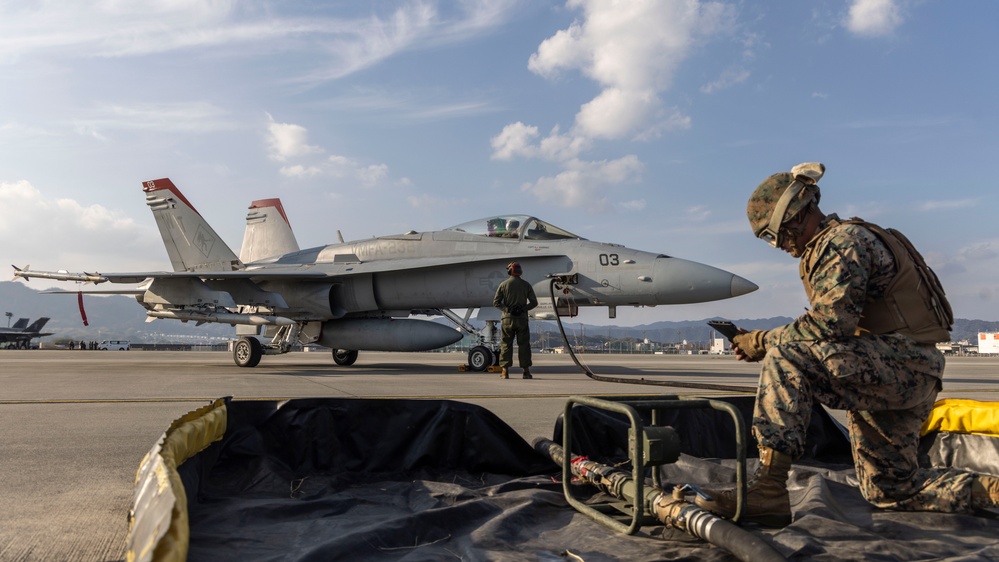
With the architecture in place, F-35B Lightning II aircraft with Marine Fighter Attack Squadron (VMFA) 214, Marine Aircraft Group 13, 3rd Marine Aircraft Wing, launched from Marine Corps Air Station Yuma, identified as the Hub for Steel Knight 25, and F-35C Lightning II aircraft with VMFA-311 and F/A-18C Hornets with VMFA-323, MAG-11, departed from Marine Corps Air Station Miramar, one of the spokes, to join the fight. The aircraft integrated with joint partners for air-to-air refueling, targeting and fires coordination, and arming and refueling at the dispersed forward operating nodes.
A key element of the evolution was a node established at Mather airfield in Sacramento, California, and its role as a forward arming and refueling node, allowing Marine fixed-wing aircraft to extend their reach, regenerate combat power and remain engaged over long distances. This marked the first time 3rd MAW established and sustained a node at a distance equal to that of Mather from Marine Corps Base Camp Pendleton, approximately 400 nautical miles, demonstrating the wing’s ability to maneuver aviation assets well beyond traditional support ranges.
“Forward arming and refueling at Mather showed that we can extend the reach of Marine aviation across California and into the maritime fight,” said Col. Jarrod DeVore, commanding officer of Marine Aircraft Group 11, 3rd Marine Aircraft Wing. “This is exactly the type of distributed sustainment required for modern conflict.”
This level of coordination enabled Marines and joint partners to fight simulated maritime threats in an end-to-end demonstration of closing kill webs across distributed aviation assets. Closing kill webs refers to the ability to rapidly sense, track, target, engage and assess threats across multiple domains using a network of integrated platforms. In practice, dispersed aircraft share data in real time, coordinate fires and seamlessly pass targets as they maneuver, compressing decision timelines, increasing lethality, and allowing the joint force to strike at speed and depth.
The strike also showcased seamless integration between fourth- and fifth-generation aircraft, illustrating how F-35s and legacy Hornets combine survivability, sensor fusion and maneuver to complicate an adversary’s targeting while maintaining persistent pressure across the battlespace.
Naval and joint force integration remained central to the mission, with Marine aviators working alongside Navy and Air Force command-and-control elements and maritime intelligence to synchronize fires and maintain situational awareness across the operating area.
“Steel Knight gives us the chance to rehearse the hardest problems: long-range fires, maritime targeting, and distributed aviation operations with the joint force,” DeVore said. “These are exactly the challenges we expect in future conflict against a near-peer adversary.”
Following the MARSTRIKE, 3rd MAW aircraft executed a series of defensive counterair and offensive counterair missions, reinforcing maritime security and enabling follow-on maneuver by the Marine Air-Ground Task Force and joint partners. The missions demonstrated the wing’s ability to sustain combat aviation operations across multiple distributed sites while supporting I Marine Expeditionary Force objectives.
“The MARSTRIKE affirmed that 3rd MAW is ready to support the joint force in a future fight, integrating with Navy and Air Force partners, generating combat power from distributed nodes, and delivering lethal aviation fires across the maritime battlespace,” DeVore said.
PICATINNY ARSENAL, N.J. – Command Sgt. Maj. Claudia Tapia places a wreath at the base of the Korean War monument dedicated to the 949 men of the U.S. Marine Corps’ 21st Infantry Battalion who left for the conflict in Korea in 1950, and the memory of the 32 men from three Dover, New Jersey companies who did not return and were killed in action during the Battle of the Chosin Reservoir. (U.S. Army photo by Carly Michelson)
Date Taken:
12.13.2025
Date Posted:
12.13.2025 11:56
Photo ID:
9440901
VIRIN:
251213-O-GY890-9941
Resolution:
3629×5080
Size:
4.37 MB
Location:
PICATINNY ARSENAL, NEW JERSEY, US
Web Views:
2
Downloads:
0
PUBLIC DOMAIN
This work, From Revolutionary War Graves to Modern Conflicts: Picatinny Arsenal and PAHS Expand Wreaths Across America Tributes [Image 8 of 8], by Eric Kowal, identified by DVIDS, must comply with the restrictions shown on https://www.dvidshub.net/about/copyright.
PICATINNY ARSENAL, N.J. – U.S. Army Garrison Picatinny Arsenal officials, along with the assistance of the Picatinny Arsenal Historical Society (PAHS), conducted a wreath laying ceremony in coordination with the nation’s annual Wreaths Across America observances that will be held at thousands of cemeteries nationwide, Dec. 13.
A Wreaths Across America ceremony is a solemn, patriotic event held annually in December, where volunteers place fresh balsam wreaths on veteran’s graves, serving as living tributes to ensure no hero’s memory is forgotten. Historically, Picatinny servicemembers would lay three wreaths at the Arsenal’s Revolutionary War cemetery, known as the Walton Burial Ground, as part of the Wreaths Across America initiative.
This year, PAHS officials worked closely with the Wreaths Across America organization to expand the tribute to four other memorials situated across the northern New Jersey military installation.
Lt. Col. Craig A. Bonham II, U.S. Army Garrison Picatinny Arsenal Garrison Commander opened the ceremony at a memorial dedicated to the 174 New Jersey servicemembers who paid the ultimate sacrifice while conducting missions in Operations Enduring Freedom, Iraqi Freedom, and New Dawn between 2001 and 2014.
“The United States of America was founded on the ideals of Freedom, Justice, and Equality,” Bonham said. “Our Nation stands as a shining beacon of liberty and freedom to the world. We thank those who gave their lives to keep us free, and we shall not forget you. We shall remember.”
Command Sgt. Maj. Claudia Tapia, U.S. Army Garrison Picatinny Arsenal Garrison Command Sergeant Major; Lt. Col. Joseph W. Lawhorn, Picatinny Arsenal Garrison Chaplain; Sgt. First Class Randy Mckire Jr, Picatinny Arsenal Religious Affairs Specialist; and Sgt. Riki Acosta, Veterinary Food Inspector, each placed a wreath in honor of each of the four branches that lost servicemembers from the Garden State to include the U.S. Army, U.S. Marine Corps, U.S. Navy, and U.S. Air Force.
“Today, more than ever, we reflect on our nation’s veterans and active-duty servicemembers who have had and continue to fight to protect the innocent and oppressed,” Bonham said. “This nation has always been the first to stand up for the freedom of people from around the world.”
Two wreaths were then laid at a monument erected in honor the 17 military officers and two women who died 99 years ago in the explosion at Lake Denmark Naval Ammunition Depot which occupied the northeast corner of Picatinny from 1891 to 1945. Lighting struck a temporary ammunition magazine which resulted in a fire that later set off 2.5 million pounds of TNT across the installation.
A single wreath was then laid at the Korean War monument dedicated to the 949 men of the U.S. Marine Corps’ 21st Infantry Battalion who left for the conflict in Korea in 1950, and the memory of the 32 men from three Dover, New Jersey companies who did not return and were killed in action during the Battle of the Chosin Reservoir.
Another wreath was laid at the site of the installation’s World War II memorial which was erected to commemorate the service of more than 4,500 Picatinny workers who answered the call, and as a tribute to the 90 who made the supreme sacrifice.
Three wreaths were then laid at the graves marked for John Burwell, Peter Doland, and Jonathan Wiggins, and one to honor all others buried at the Walton Burial Grounds located at the edge of what was the Walton Farm and the Faesch Iron Works. It was a communal burial ground from the mid/late 1700’s, until the last burial estimated to be 1884.
The Walton name is derived from the family name of the only grave markers that remained legible into the 20th Century, when Picatinny acquired the property during World War II. While bearing the Walton name, the burial ground is believed to also hold remains from other local family members, including from the Doland, Wiggins, and Burwell families.
Wreaths Across America is a nonprofit organization founded in 2007, to continue and expand the annual wreath-laying ceremony at Arlington National Cemetery, in Washington, D.C.
In 2024, Wreaths Across America and its national network of volunteers placed more than 3 million wreaths on headstones of our nation’s service members at 4,909 participating locations.
Date Taken:
12.13.2025
Date Posted:
12.13.2025 11:56
Story ID:
554101
Location:
PICATINNY ARSENAL, NEW JERSEY, US
Web Views:
3
Downloads:
0
PUBLIC DOMAIN
This work, From Revolutionary War Graves to Modern Conflicts: Picatinny Arsenal and PAHS Expand Wreaths Across America Tributes, by Eric Kowal, identified by DVIDS, must comply with the restrictions shown on https://www.dvidshub.net/about/copyright.
Secretary of War Pete Hegseth unveils the U.S. Space Command sign alongside Secretary of the Air Force Troy E. Meink, and U.S. Space Force and U.S. Army leadership at the U.S. Space Command Sign Unveiling Ceremony, Huntsville, Ala., Dec. 12, 2025. (DoW photo by U.S. Navy Petty Officer 1st Class Alexander Kubitza)
ORLANDO, Fla., Dec. 12, 2025 /PRNewswire/ — LightPath Technologies, Inc. (NASDAQ: LPTH) (“LightPath,” the “Company,” “we,” or “our”), a leading provider of next-generation optics and imaging systems for both defense and commercial applications, today announced the pricing of an underwritten public offering of 7,750,000 shares of its Class A common stock at a price to the public of $7.75 per share for gross proceeds of approximately $60 million, before deducting underwriting discounts and commissions and other estimated offering expenses. In addition, LightPath has granted the underwriters a 30-day option to purchase up to an additional 1,162,500 shares of its Class A common stock at the public offering price for the Class A common stock, less underwriting discounts and commissions. All shares of Class A common stock are being offered by LightPath. The offering is expected to close on or about December 15, 2025, subject to the satisfaction of customary closing conditions.
Canaccord Genuity and Craig-Hallum are acting as joint bookrunners and representatives of the underwriters for the offering. Lake Street is acting as co-manager for the offering.
LightPath intends to use the net proceeds from the offering for working capital, investments, acquisitions, and general corporate purposes.
The offering is being made pursuant to a shelf registration statement on Form S-3 (File No. 333-291717) that was declared effective by the Securities and Exchange Commission (“SEC”) on December 10, 2025. A preliminary prospectus supplement and accompanying prospectus relating to the offering has been filed with the SEC and a final prospectus supplement with the final terms of the offering will be filed with the SEC and will be available for free on the SEC’s website, located at www.sec.gov. Copies of the final prospectus supplement and the accompanying prospectus relating to the offering may be obtained, when available, from Canaccord Genuity, Attention: Syndication Department, One Post Office Square, Suite 3000, Boston, Massachusetts 02109, or by telephone at (617) 371-3900, or by email at [email protected], or Craig-Hallum, Attention: Equity Capital Markets, 323 North Washington Ave., Suite 300, Minneapolis, MN 55401, or by telephone at (612) 334-6300, or by email at [email protected].
This press release does not constitute an offer to sell or the solicitation of an offer to buy these securities, nor shall there be any sale of these securities in any state or jurisdiction in which such offer, solicitation or sale would be unlawful prior to registration or qualification under the securities laws of that state or jurisdiction.
About LightPath Technologies
LightPath Technologies, Inc. (NASDAQ: LPTH) is a leading provider of next-generation optics and imaging systems for both defense and commercial applications. As a vertically integrated solutions provider with in-house engineering design support, LightPath’s family of custom solutions range from proprietary BlackDiamond™ chalcogenide-based glass materials – sold under exclusive license from the U.S. Naval Research Laboratory – to complete infrared optical systems and thermal imaging assemblies. The Company’s primary manufacturing footprint is located in Orlando, Florida with additional facilities in Texas, New Hampshire, Latvia and China. To learn more, please visit www.lightpath.com.
Forward-Looking Statements
This press release includes statements that constitute forward-looking statements made pursuant to the safe harbor provisions of the Private Securities Litigation Reform Act of 1995. Forward-looking statements may be identified by the use of words such as “forecast,” “guidance,” “plan,” “estimate,” “will,” “would,” “project,” “maintain,” “intend,” “expect,” “anticipate,” “prospect,” “strategy,” “future,” “likely,” “may,” “should,” “believe,” “continue,” “opportunity,” “potential,” and other similar expressions that predict or indicate future events or trends or that are not statements of historical matters. These forward-looking statements include, without limitation, statements regarding the satisfaction of customary closing conditions related to the offering and the anticipated use of proceeds. These forward-looking statements are based on information available at the time the statements are made and/or management’s good faith belief as of that time with respect to future events and are subject to risks and uncertainties that could cause actual results to differ materially from those expressed in or suggested by the forward-looking statements. Factors that could cause or contribute to such differences include, but are not limited to, the likelihood that the Company will need additional capital to sustain its operations in the future and to repay indebtedness; the impact of varying demand for the Company products; the Company’s reliance on a few key customers; the ability of the Company to obtain needed raw materials and components from its suppliers; the impact that international tariffs may have on our business and results of operations; the impact of political and other risks as a result of our sales to internal customers and/or our sourcing of materials from international suppliers; general economic uncertainty in key global markets and a worsening of global economic conditions or low levels of economic growth; geopolitical tensions, the Russian-Ukraine conflict, and the Hamas/ Israel war; the effects of steps that the Company could take to reduce operating costs; the inability of the Company to sustain profitable sales growth, convert inventory to cash, or reduce its costs to maintain competitive prices for its products; circumstances or developments that may make the Company unable to implement or realize the anticipated benefits, or that may increase the costs, of its current and planned business initiatives; and those factors detailed by the Company in its public filings with the SEC, including its Annual Report on Form 10-K and other filings with the SEC. Should one or more of these risks, uncertainties, or facts materialize, or should underlying assumptions prove incorrect, actual results may vary materially from those indicated or anticipated by the forward-looking statements contained herein. Accordingly, you are cautioned not to place undue reliance on these forward-looking statements, which speak only as of the date they are made. Forward-looking statements should not be read as a guarantee of future performance or results and will not necessarily be accurate indications of the times at, or by, which such performance or results will be achieved. Except as required under the federal securities laws and the rules and regulations of the SEC, we do not have any intention or obligation to update publicly any forward-looking statements, whether as a result of new information, future events, or otherwise.
BELLEVUE, Wash., Dec. 12, 2025 /PRNewswire/ — Exia Labs, a leader in spatial intelligence and autonomous agent development for critical missions, today announced that it has been selected by the Defense Innovation Unit (DIU) for the Blue Object Management Challenge.
Designed with the U.S. Indo-Pacific Command (USINDOPACOM) Chief Data Officer and J32 Fires Division, this partnership aligns with the Department of War’s designation of Applied Artificial Intelligence (AAI) as a Critical Technology Area to achieve AI-enabled decision superiority.
Exia initially developed Keystone, an AI-enabled Object Management System, for the U.S. Army with a focus on the land domain. Keystone ingests reports about friendly units from across echelons and allies, resolves inconsistencies and duplicates, and generates distinct unit entities with assigned confidence levels. Keystone updates these entities in real time, creating a single, trusted object-based data layer for mission systems like Maven Smart System and Lattice. Validating this capability, Task Force Maven recently selected Exia to demonstrate Keystone’s integration with an unclassified, cloud-based Maven Smart System environment with nominal data, at NATO Headquarters.
For this challenge, Exia expands Keystone to the U.S. Navy and the maritime domain. To assist with this transition, the company has brought on retired Rear Admiral Douglas Small to provide product feedback. Admiral Small commanded at multiple echelons, concluding his U.S. Navy career as commander of the Naval Information Warfare Systems Command (NAVWAR). There, he led a global workforce of 11,000 civilian and military professionals designing, developing, and supporting the Navy’s networking, communications, and cyber capabilities.
“The Exia team couples the ingenuity of the gaming industry with deep understanding of military decision-making processes,” said Small, “they are ready to deliver intelligent tools to warfighters for decision advantage.”
This selection marks a critical step in Exia’s mission to advance AI-enabled decision-making capabilities that seek to improve how mission-critical data is integrated, accessed, and used across Department of War platforms and forces.
About Exia Labs
Exia Labs is a leader in spatial intelligence and autonomous agent development for critical missions. The company develops AI-enabled decision advantage products through its patent-pending machine-readable worlds and commercial game technology. The company’s suite of products includes Blue tactical planning and wargaming suite, Keystone object management system, and more. Headquartered in Bellevue, Washington, Exia Labs is dedicated to delivering decision advantage to the tactical edge. To learn more, visit https://www.exialabs.com
Fort McCoy officials take part in December 2025 Area Workforce Collaborative Meeting
Leaders with Fort McCoy Garrison and installation agencies met Dec. 11, 2025, with community leaders and workforce professionals in Sparta, Wis., during the Fort McCoy Area Workforce Collaborative Meeting.
The meeting brought together people who are working to improve employment opportunities in the region, including at Fort McCoy. Among those attending the meeting were Maj. Zachary Daugherty, commander of U.S. Army Garrison-Fort McCoy Headquarters and Headquarters Company; and representatives from several other post agencies to include Army Community Service, Fort McCoy Public Affairs Office, and Fort McCoy Directorate of Family and Morale, Welfare and Recreation.
Officials at the meeting noted the collaboration is helpful in filling jobs at Fort McCoy, and also helps people like military family members learn about opportunities for employment.
Community outreach is an important part of the Army mission. According to the Army, as stated at https://www.army.mil/outreach, “the Army is about more than ensuring our national security at home and abroad, it’s about giving back and getting to know the communities that support us.”
It’s also possibly important for community leaders to see the installation that provides a significant economic impact to their communities. Fort McCoy’s total economic impact for fiscal year (FY) 2024 was an estimated $1.6 billion, Fort McCoy Garrison officials announced, which is up from FY 2023’s total impact of $1.38 billion.
The data was compiled by Fort McCoy’s Plans, Analysis and Integration Office. Workforce payroll, operating costs, and other expenditures totaled more than $398 million for FY 2024. A total of 1,934 personnel worked at Fort McCoy in FY 2024 — 1,061 civilians, 495 military, and 378 contract employees.
Approximately 66 percent of the workforce lives within Monroe County. The total FY 2024 workforce payroll for civilian and military personnel was $270.4 million. FY 2024 operating costs of $170 million included utilities, physical plant maintenance, repair and improvements, new construction projects, purchases of supplies and services, as well as salaries for civilian contract personnel working at Fort McCoy.
Other expenditures accounted for $21.2 million and covered $511,296 in payments to local governments (including land permit agreements, school district impact aid, etc.) as well as $20.7 million in discretionary spending in local communities by service members training and residing at Fort McCoy.
Other factors of economic impact for the fiscal year included more than $92.6 million in military construction on post. Fort McCoy also supported training for 73,991 troops in FY 2024, which ran from Oct. 1, 2023, to Sept. 30, 2024. The training population included reserve- and active-component personnel from throughout the military.
Fort McCoy’s motto is to be the “Total Force Training Center.”
Located in the heart of the upper Midwest, Fort McCoy is the only U.S. Army installation in Wisconsin.
The installation has provided support and facilities for the field and classroom training of more than 100,000 military personnel from all services nearly every year since 1984.
Learn more about Fort McCoy online at https://home.army.mil/mccoy, on Facebook by searching “ftmccoy,” on Flickr at https://www.flickr.com/photos/fortmccoywi, and on X (formerly Twitter) by searching “usagmccoy.”
Also try downloading the My Army Post app to your smartphone and set “Fort McCoy” or another installation as your preferred base. Fort McCoy is also part of Army’s Installation Management Command where “We Are The Army’s Home.”