Retired Maj. James Capers Jr. is a man of mythic status within the Marines’ Reconnaissance and special operations communities. In October 2010, he became one of the first US service members added to the US Special Operations Command’s Commando Hall of Honor.
Maj. Gen. Paul E. Lefebvre, then-commander of Marine Forces Special Operations Command, called Capers “the spiritual founder of Marine Corps special operations.”
Capers served in Force Recon half a century before the Corps officially fielded a unit under SOCOM. As a member of 3rd Force Recon Company in Vietnam, Capers led or participated in dozens of missions, pioneering and refining unconventional and jungle warfare tactics along the way. Many of his missions were top secret and remained so for decades.
Team Broadminded in Vietnam. Photo courtesy of James Capers Jr.
The recently released documentary Major Capers: The Legend of Team Broadmindedprovides a detailed account of Capers’ life and career in the Marines.
The film follows Capers, the son of South Carolina sharecroppers, from the harsh realities of the Jim Crow South to Baltimore, where his family fled after Capers’ father faced “harsh punishment” for a crime he didn’t commit. From Baltimore, Capers joined the Marines, launching the storied career at the center of the film.
After he became the first member of his family to graduate high school, Capers enlisted in the Marine Corps in 1956. Two years later, he deployed to Lebanon where, the film claims, Capers’ squad held off more than 100 enemy insurgents. The impressive feat earned him a meritorious promotion to sergeant.
As a staff sergeant in Vietnam, Capers earned a battlefield commission and was promoted to second lieutenant in November 1966. His jump to the officer corps made Capers the first African American Marine to receive a battlefield commission, according to the film.
In Vietnam, Capers and his team of Recon Marines — nicknamed “Team Broadminded” for their ability to think outside the box — developed a deadly reputation as one of the most reliable unconventional units in the US military. Their combat exploits grabbed the attention of America’s top brass and even the White House. Despite its rapidly decreasing numbers of combat-effective Recon Marines, Team Broadminded was continually tapped for the most dangerous missions.
Through interviews with surviving members of Team Broadminded, military historians, retired officers, and others, the documentary provides a summary of Capers’ life and some of his most harrowing missions. In a mostly chronological narrative, the accounts are cut together with sometimes-repetitive archival footage.
Marines from 3rd Force after a combat-dive mission to recover a cache of enemy ordnance at the bottom of a river. Photo courtesy of James Capers Jr.
The film’s most powerful sequence comes when Capers describes his last patrol. In March of 1967, Capers led his Recon team through the mountainous region north of Hue City known as Phu Loc. Sgt. Richard Crepeau, one of Team Broadminded’s original members, described the four-day mission as “the worst fucking patrol Force Recon ever went on.” Their mission: find an enemy regiment and draw them into a fight with a larger American force, including the 3rd Battalion, 26th Marines, which Capers’ team was assigned to support.
By the second day of the patrol, Team Broadminded had racked up 20 confirmed kills while suffering two wounded Marines, including Capers, who refused to leave the patrol. Two days later, everyone in Capers’ team was badly wounded in a complex ambush. A series of Claymore mines and unrelenting machine-gun fire left Capers with 19 wounds, including two broken legs. In a desperate attempt to turn back the enemy, Capers called fire missions on the patrol’s position. The gamble worked, and the men of Team Broadminded were able to escape.
James Capers Jr. in 2013. Photo by Ethan E. Rocke.
“How do you see such a scene and stay sane?” Capers says in the film. “How do you get the smell of death out of your clothes? And when you come home or go back to your base, and you’ve got blood and whatever else on you that you can’t wash off. I could take my rifle and put it in a barrel of oil to clean the rust off my weapon, so it would work, so when I squeeze the trigger, somebody would fall. But how do you wash your soul? How do you wash your body when other men, parts of their bodies are there? You know, it’s madness. It’s madness.”
More than 40 years after his actions on his last patrol in Vietnam, Capers was nominated for the Medal of Honor, but he received the Silver Star after the medal recommendation was downgraded two levels. During his 22 years of service in the Marines, Capers served in all three of the Corps’ active-duty Force Recon companies, finishing his career as the commanding officer of 2nd Force on Camp Lejeune, North Carolina.
While the film’s editing and production value don’t always reflect the gravity and grandeur of the story being told, the film provides an important chronicle of a highly accomplished and widely revered combat leader.
Read Next:The Legend of Jim Capers: The Hero Who Never Was
CAPE CANAVERAL SPACE FORCE STATION, Fla., Feb. 26, 2022 /PRNewswire/ — A United Launch Alliance (ULA) Atlas V rocket is in final preparations to launch the GOES-T mission for the National Oceanic and Atmospheric Administration (NOAA) and NASA. The launch, managed by NASA’s Launch Services Program (LSP) based at Kennedy Space Center, is on track for March 1 from Space Launch Complex-41 at Cape Canaveral Space Force Station. Launch is planned for 4:38 p.m. EST. The live launch broadcast begins at 4:00 p.m. EST on March 1 at www.ulalaunch.com.
“We are excited to launch the GOES-T spacecraft for our NASA and NOAA mission partners. ULA, and our heritage vehicles, have launched all 17 operational GOES missions to date,” said Gary Wentz, vice president of Government and Commercial Programs. “GOES-T will be delivered to a geosynchronous transfer orbit, which will place the spacecraft closer to its final destination and conserve the satellite’s fuel supply for a longer mission life.”
GOES-T is the third satellite in NOAA’s revolutionary GOES-R Series, GOES-T will provide NOAA and NASA with continuous imagery and atmospheric measurements of Earth’s Western Hemisphere, lightning detection and mapping, solar imaging, and space weather monitoring.
The mission will launch on an Atlas V 541 configuration rocket, that includes a 17-ft (5-m) diameter short payload fairing and stands 196 ft. (59.7 meters) tall. The Atlas booster for this mission is powered by the RD AMROSS RD-180 engine. Aerojet Rocketdyne provided the RL10C-1 engine for the Centaur upper stage and Northrop Grumman provided the Graphite Epoxy Motor (GEM) 63 solid rocket boosters.
This mission will be the 92nd launch of the Atlas V rocket, and the 22nd Atlas V launch in partnership with LSP. To date ULA has launched 148 times with 100 percent mission success.
Leveraging a legacy of 100 percent mission success over 145 plus missions to explore, protect and enhance our world, ULA is the nation’s most experienced and reliable launch service provider with world-leading reliability, schedule confidence, and mission optimization. We deliver value unmatched by any launch services company in the industry, a tireless drive to improve and commitment to the extraordinary. For more information on ULA, visit the ULA website at www.ulalaunch.com, or call the ULA Launch Hotline at 1-877-ULA-4321 (852-4321).
Join the conversation: Facebook, Twitter, Instagram and LinkedIn. Photos available on the ULA Flickr page.
Twenty-two a day — suicides have plagued our veterans for many years. While the causes of suicide are complex and not fully understood, military leaders and community members continue to search for answers in combating this unfortunate number. The COVID-19 pandemic has added additional stressors to an already strained force as well. Our military forces these past two years were called upon to support testing and vaccine clinics while struggling with the virus themselves, with their families and friends. They also dealt with continued war-zone deployments, national disasters and often violent civil unrest.
Each community offers a variety of counseling programs to help our veterans as they work through the road to recovery. Some of the programs offered are traditional counseling sessions, music therapy and outdoor adventure. One Rhode Island Army veteran, Jason Morel, has come up with an alternative program incorporating the world of magic and laughter.
In 2017, Jason founded Operation Magic Touch, dedicated to helping veterans and their families through magic. Morel created his magic show to be a safe form of entertainment for veterans who suffer from PTSD and their families. From a young age this veteran began his studies with magic. Upon his discharge from the Army, Jason continued his studies as a means of combating his PTSD.
Each year the National Veterans Arts Competition is conducted. Veterans who are enrolled at VA health care facilities are eligible to compete. In 2019, Jason entered the competition and placed second in his division with his magic show. That year, over 5,600 veterans representing 130 VA medical facilities competed. Jason’s placement was the highest for any participant representing the Providence VAMC.
Jason is now on a journey to aid veterans and their families through his magic. The public is invited to see this veteran in action on March 12 for a steak dinner and magic show at Veterans of Foreign Wars Post 9404, 29 South Main Street, Coventry. The dinner begins at 5 p.m., followed by Jason’s spectacular magic show at 7 p.m.
Tickets are $25 and can be purchased by calling 401-828-9705. All proceeds will go to VFW Post 9404 to assist Jason Morel with his objective of helping his fellow veterans and families.
St Patrick’s Special Corned Beef Dinner
Come and enjoy a St Patrick’s traditional corned beef dinner, with all the trimmings, on March 15 from 5 to 8 p.m. You have the choice of dining in or take-out, $20 a plate, at Amancio-Falcone-Gaccione VFW Post 8955, 113 Beach St., Westerly.
Auxiliary announces visit of national president to R.I.
VFW Auxiliary Department of Rhode Island is excited to announce the visit of Jean Hamil, national president of the Veterans of Foreign Wars of the United States Auxiliary. Hamil will tour the Rhode Island State Capitol and the Rhode Island Office of Veterans Services, enjoy dinner at the Valley Inn in Portsmouth, and take a helicopter tour of Aquidneck Island.
The VFW Auxiliary Past Department Presidents’ Club will host a dinner at Davenport’s in East Providence, upon Hamil’s. Her visit will include speaking with VFW and Auxiliary members in Pawtucket and throughout Rhode Island. VFW Auxiliary Department President Shauna Fournier will serve as her official escort.
President Hamil, of Orlando, Fla., was elected to office at the Auxiliary’s 108th National Convention in Kansas City, Mo. For more information, contact GinaMarie Doherty, VFW Auxiliary Rhode Island, Historian, [email protected], 401-500-1721.
About the VFW Auxiliary: The VFW Auxiliary is one of the nation’s oldest veterans’ service organizations and our members are the relatives of those who served in a location of foreign conflict. We have nearly 470,000 members representing all 50 states who volunteer millions of hours and give millions of dollars to support veterans, military service personnel and their families. Learn more at www.vfwauxiliary.org.
Amancio-Falcone-Gaccione VFW Post 8955
New members are always welcome to attend our next monthly meeting on March 2 at 6:30 p.m. at the Post Home, 113 Beach St, Westerly. Voice of Democracy winners will present their winning essays at this meeting. The Post meets the first Wednesday of each month. The three qualifiers for membership in the VFW: Citizenship — U.S. citizen or U.S. National; honorable service — received a discharge of Honorable or General (Under Honorable Conditions); or be currently serving, service in a war, campaign, or expedition on foreign soil or in hostile waters, or service in Korea for 30 consecutive or 60 non-consecutive days.
Project Outreach
The mission of Project Outreach is to assist all veterans to gain access to the VA and eligibility for all benefits and programs they offer. The program is staffed by certified Chapter Service Officers that have attended the yearly Disabled American Veterans training. The service officer provides the proper VA forms and guidance to properly complete required documents to then ensure that they have proper representation at the VA. If a veteran is not in the VA system, he/she or their family are not eligible for all the great services and benefits the VA offers. Hours: VFW Post 8955, first Wednesday and third Monday of each month, 5 p.m.
Prayers of peace to Ukraine
“Pray for Ukraine!”
“May God hear our loving petitions and soften the hearts and minds of all, those within and outside Ukraine, during these dangerous times,” wrote the Ukrainian Orthodox Church of the USA Council of Bishops, in a statement responding to news of the Russian invasion this week.
U.S. AIR FORCE ACADEMY, Colo. – Senior Alex Schilling stopped all 22 shots he faced as Air Force defeated RIT, 1-0, in overtime in the final regular season game of the season, Feb. 26, at Cadet Ice Arena. With the win, Air Force secured the sixth seed in the Atlantic Hockey tournament. The Falcons have a bye in the first round and will travel to Army in the quarterfinals, March 11-13.
Nate Horn netted his second overtime game-winner of the season with 40 seconds left in the extra period to give the Falcons two points in the standings. On senior night, Schilling, the Falcons’ only senior, recorded his third career shutout, and his first since blanking RIT in 2020.
After three scoreless periods, the game headed to a 3-on-3 overtime period. With under a minute remaining, Willie Reim started a rush down the left wing. His shot was saved, but Brandon Koch poked the puck free from a group of players and Horn scored his 11th of the season with 40 seconds left in overtime.
On the first shift of the game, RIT (16-14-4, 12-10-4 AHA) forced a turnover leading to a flurry in front of Schilling. RIT outshot Air Force, 5-0 in the first three minutes of the game, but Schilling kept the net clean.
Early in the second period, a major penalty was called on RIT’s Gianfranco Cassaro for a hit on Blake Bride. The Tigers killed the penalty, allowing just three shots on goal. On that power play, Schilling stopped a 3-on-1 shorthanded breakaway by Kobe Walker.
Air Force (13-16-3, 11-12-3 AHA) outshot RIT, 21-8, in the second and third periods, but Tiger goalie Tommy Scarfone kept the game scoreless until Horn’s third career game winner.
“What a great night,” Schilling said. “It was awesome to take a lap in front of our great fans after that win. I always try to do my very best for the boys in front of me. I can’t wait to go into the playoffs with this team. We know it will be a great environment at Army. But we have a mature group. We are young, but we are mature. We stay level-headed when things get hectic and we will need that at Army.”
Air Force outshot RIT, 34-22, in the game. The Falcons were 0-for-3 on the power play and killed all four of RIT’s advantages. Scarfone made 33 saves for the visitors.
“I’m happy for our boys,” head coach Frank Serratore said. “With all the adversity that we have had over the last couple weeks with giving up so many third period leads. We were in a situation tonight where we needed to win and we did. We earned this first-round bye. Having won this game, and winning our way in, there’s no reason why we shouldn’t feel good about ourselves heading to West Point. It will be a series for the ages.”
OCEANSIDE, CA — Oceanside’s military community will soon have a new resource with the opening of a mental health clinic from Cohen Veterans Network (CVN).
The purpose of the clinic is to meet the increasing mental health needs for post-9/11 veterans, active duty service members, and military families. This will be the second Cohen Clinic in the state as the San Diego clinic opened in 2019.
CVN’s partner for these clinics is Veterans Village of San Diego (VVSD),which is its current partner at the Cohen Clinic in San Diego, located in Mission Valley. Each year, VVSD provides services to more than 3,000 military veterans throughout San Diego County.
These clinics offer brief, client-centered therapy for a variety of mental health issues including depression, anxiety, post-traumatic stress, adjustment issues, anger, grief and loss, family issues, transition challenges, relationship problems, and children’s behavioral problems.
More than 33,000 post-9/11 veterans, nearly 40,000 active duty service members, and more than 31,000 military family members will be eligible for care at the Steven A. Cohen Military Family Clinic in Oceanside, according to a statement from the Cohen Veterans Network.
The Oceanside clinic, which will be located at 3609 Ocean Ranch Blvd, Ste. 120, and is expected to begin serving clients virtually in March.
The Patch reached out to Dr. Anthony Hassan, President & CEO of CVN and Akilah Templeton, CEO of VVSD to get more information about the new Oceanside clinic.
Can you tell us more about the plans for the new Steven A. Cohen Military Family Clinic in Oceanside?
“There are many factors in play these days which are negatively impacting our mental health, including the continued challenges of COVID-19 and the possibilities of future deployments. We are here to serve veterans, active duty and families throughout the entire state of California,” said Dr. Anthony Hassan. “We are expanding on our proven success in San Diego and scaling up to the meet the additional need.”
“I think for everyone in our country, mental health is a real societal challenge. Trying to find access to care and getting good quality care. I think that’s true for our military community where they have problems getting access to care and waiting a long time for appointments and high costs. Cohen Veterans Network is here just to make sure that mental health support is available to the military without any barriers.”
“It’s a sad state when people who need help can’t get it and continue to suffer in silence. As a retired military mental health guy I know for military people it takes a lot for them to even make that call. So I’ve got to take that moment and make good use of it.”
“CVN was established to fill gaps in care that exist in military communities across the country. We are a nonprofit, integrated mental health system, exclusive for the military community, which includes Veterans, Active duty, National Guard Reserves and of course their family members.”
“We’re so proud of the fact that half of the patients we serve are family members, so we’re filling this gap in care as well for families. We’ve served 28,000 military to date and we’re eager to save more lives, to save more families, and save more futures in Oceanside.”
Homelessness is a big issue in Oceanside and a large percentage of our homeless are military or former military. Are your services set up to address the homeless issues among our military?
“Veterans Village of San Diego has a 40-year track record of providing services to homeless veterans. So this partnership was just really a match made in heaven.” said Akilah Templeton. “We are a veteran-focused agency here in San Diego. We consider ourselves experts on the topic of military homelessness and while homeless individuals may not be the targeted population for CVN, we use a no wrong door approach. Certainly, a veteran who is struggling or may be at risk for homelessness, CVN is just one touch point. Our clinicians that come in contact with individuals that have those challenges are able to refer veterans to other programs in the area.”
“That’s the reason why the Cohen Veterans Network programs exist. There are many programs that are on the far end of the continuum. In other words, you have to be seriously persistently mentally ill, you have to be homeless down and out. You have to be in an emergency room to get attention and get the care, but what we want to do is get upstream on this problem.”
“We really want to focus on the mild and moderate conditions and get upstream on all of this so that our Veterans, Military members and their families never end up homeless and desperate. But the beautiful thing is that our partner, VVSD, who operates our clinic is an expert and has the ability to treat veterans anywhere in their journey, which is fabulous.”
So CVN sets up the clinic and then VVSD runs it. Is that an oversimplified explanation of how your programs work?
“Very good explanation. CVN gives VVSD and our other partners everything to operate a clinic at the highest level according to our standard operating procedures. We share the brand name. We fund them to deliver care the way we would like it to be delivered with the highest evidence. We provide training. We provide data analytics and electronic health records. VVSD is known and respected in the community and that’s why we chose them to operate, not just the clinic, but in Oceanside and eventually in Los Angeles because of their local brands. So we believe community is important and we believe the scalable model that we bring has proven to be extremely effective.”
You mentioned that the clinics will offer brief client-centered therapy. Can you go into more detail about what that means?
“That means that a person who is coming in has a particular challenge that would likely benefit from a short-term evidence intervention that helps them to deal with the problem as it is happening, but also equips them with coping strategies and tools they can use.”
“Our average length for a client is 10 sessions across the entire network of 20 clinics. So our patients come in, they get the support they need when they need it. They get routine care, routine evidence-based care for depression, anxiety, PTSD, marital, whatever the situation, our belief is that they’re going to be stronger and they’re going to be better.”
“This approach is much better than hanging onto people forever because then you don’t have enough room at the front for new patients. So the way we’re able to provide accessible care as we get people in, we get them what they need, they’re feeling better and we challenge them to go out and practice what we’ve just shared with them. That allows us to have better access upfront.”
“Most of the folks that we see benefit from that short-term therapy model. One thing that’s unique about our clinic’s model is we have a case manager that makes sure that when they have other things that get in the way like financial assistance or housing or other services like employment. We have someone in the clinic who can help work with them on those things outside of the therapy session.”
“All of our CVN clinics have a community room that is really a community. It’s a room about 1000 square feet where we host events. We have educational things like parenting and stress management. We have room for meetings. So we want the clinic to not only be a place for clinical care, but a place for convening, a place for positive and preventative activities. Because we believe that the more we can get people circling through the clinic, the more trusted, the clinic will be the word of mouth will spread.”
In San Diego, the community room has been fantastic during Covid. We sort of took that concept outdoors and put on events. So CVN is very much about staying connected to the community, we recognize that word of mouth is our largest referral source here in San Diego. So many of the folks that come to receive services at our local clinics were referred by someone who has also received services or by someone that they know.”
“While we will not offer in person for the soft launch in March, but we will begin seeing clients via telehealth. We’re able to give more people access to care even when we can’t do face to face. In addition to providing care to those within reach of the Oceanside location, the new Cohen Clinics will also offer telehealth services state-wide to more than 655,000 potential clients. CVN Telehealth is face-to-face video therapy where the client can receive treatment from the privacy and comfort of their own home.”
“The ability to provide telehealth services is critical and a game changer, especially in southern California where we have seen the number of COVID-19 cases rise significantly in recent months. Telehealth provides a great option for veterans, service members and their families who want to stay connected to a trusted provider, regardless of location. Our partnership with CVN has helped to expand our reach and build out VVSD’s continuum of care so that the entire military family has access to high-quality outpatient mental health services and supports for years to come.”
“We hope to have the brick and mortar location operating by the end of summer. Otherwise, we are currently accepting referrals and we’re ready to go for the opening in March.”
About Cohen Veterans Network: Cohen Veterans Network (CVN) is a 501(c)(3) national not-for-profit philanthropic organization for post-9/11 veterans, active duty service members and their families. CVN focuses on improving mental health outcomes, operating a network of outpatient mental health clinics in high-need communities, in which trained clinicians deliver holistic evidence-based care to treat mental health conditions. It was established in 2016 by philanthropist Steven A. Cohen with a commitment of $275 million to build the network. Learn more about CVN.
About VVSD: Veterans Village of San Diego (VVSD) has served all veterans since 1981 and is dedicated to “Leave No One Behind.” Each year, VVSD provides services to more than 3,000 military veterans throughout San Diego County. For more information, please visit our website at www.VVSD.net.
This article originally appeared on the Oceanside-Camp Pendleton Patch
Colorado’s elected leaders are pointing to former president Trump’s recent comment about Space Command as a reason to reconsider making Alabama its permanent home.
This week Trump told the syndicated radio show “Rick&Bubba” that he alone made the last-minute decision to move the Command headquarters to Huntsville, Alabama.
“Space Force – I sent to Alabama,” said Trump, according to the news site AL.com. “I hope you know that. (They) said they were looking for a home and I single-handedly said ‘let’s go to Alabama.’ They wanted it. I said, ‘let’s go to Alabama. I love Alabama.’”
While Trump referred to ‘Space Force’, what is actually going to Alabama is Space Command, which is currently temporarily housed in Colorado Springs. Space Force, the newest branch of the military, is based at the Pentagon.
“Former President Trump has admitted what we already knew: that he made a strictly political decision to move Space Command and completely disregarded both critical national security and budgetary considerations,” said Democratic Senator John Hickenlooper in an emailed statement. “This is exactly why we’ve called for a review and reconsideration of the decision. We look forward to the Air Force doing just that — looking at what is best for our national security — and making sure Space Command is located where it belongs, in Colorado Springs.”
Senator Michael Bennet also criticized the comments and said they showed the need to investigate the selection process.
Colorado was one of several potential permanent homes in the running when the Air Force announced it had chosen Huntsville, just days before Trump left office. According to Air Force documents obtained by Al.com, Alabama bested its competitors on most of the selection criteria.
That decision is currently under review, both by the Government Accountability Office and the Defense Department’s Office of the Inspector General. And Colorado’s leaders continue to lobby the Biden Administration to revisit the selection.
“Colorado is the natural home for Space Command,” said Gov. Polis and Lt. Governor Primavera in a joint statement Friday. “These callous comments fly in the face of Coloradans, military families, and those who have worked to cultivate our aerospace ecosystem that is suited to guarantee the operational success of U.S. Space Command and deliver the best value to taxpayers … it’s clear that the former President – now through his own admission – made this misguided decision for political or personal purposes.”
The former president holds a rally in Alabama Saturday evening.
Tiffany Harris, a coordinator at the Smith Middle School and Teen Center, talks to Col. Seth Graves, the U.S. Army Garrison Humphreys commander, and a guest about the Black History Art Exhibit at the Camp Humphreys youth center Feb. 18, 2022. (Photo Credit: Sgt. Courtney Davis)
VIEW ORIGINAL
2 / 3 Show Caption + Hide Caption –
Roxanne Venegas, a ninth grade student at Humphreys High School and a Keystone Club member at Smith Middle School and Teen Center, shows her drawing during the Black History Art Exhibit at the Camp Humphreys youth center Feb. 18, 2022. (Photo Credit: Sgt. Courtney Davis)
VIEW ORIGINAL
3 / 3 Show Caption + Hide Caption –
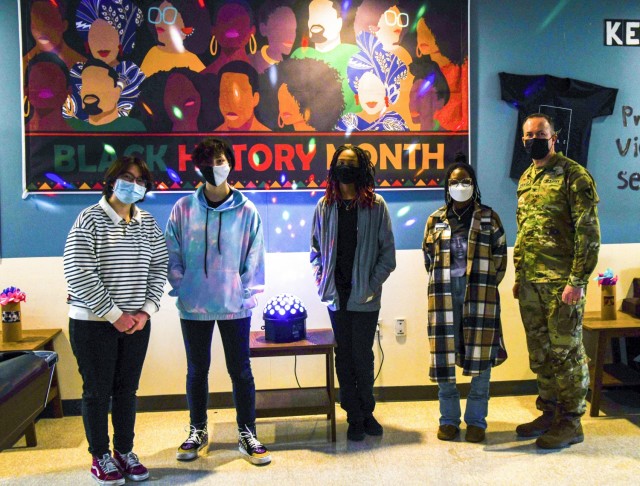
Students from the Smith Middle School and Teen Center’s Keystone Club join Alexandra Harris, the youth center’s interim program director, and Col. Seth Graves, the U.S Army Garrison Humphreys commander, to celebrate Black History with an art exhibition at the Camp Humphreys youth center Feb. 18, 2022. (Photo Credit: Sgt. Courtney Davis)
VIEW ORIGINAL
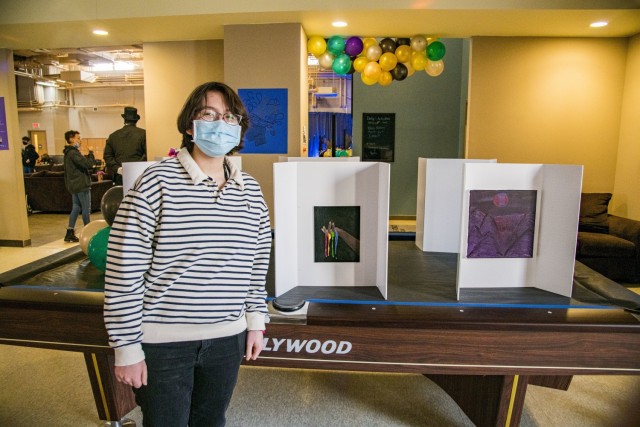
CAMP HUMPHREYS, Republic of Korea (Feb. 23, 2022) – Students at the U.S. Army Garrison Humphreys Smith Middle School and Teen Center participated in a Black history art exhibition Feb. 18, 2022.
The art exhibition was a creative way for the students to set their differences aside and learn about Black history.
“Actually, this is our first black history art exhibit,” said Alexandra Harris, interim program director for the Smith Middle School and Teen Center, also known as the youth center. “The youth, they drew a lot of these pictures. We also created a power point with black actors, black athletes, and black inventors to play in the background, so onlookers could read their bios.”
Keaira Richardson, an eleventh grade student at Humphreys High School and the youth center’s Keystone Club president, said the students wanted to do something fun and decided on the art exhibition as a way to pay tribute to the Black change makers in the U.S., both past and present.
“I thought the exhibit was great, not only because of the beautiful art pieces on display, but also because of the diversity in the kids that provided the art work,” said Command Sgt. Maj. Benjamin Lemon, the USAG Humphreys senior enlisted advisor. “It was the epitome of what observing Black History Month is about, providing the ability for others outside the African American community to learn about and appreciate the contributions African Americans have made towards the betterment of the United States. The more we learn about each other, the more empathy and understanding we gain.”
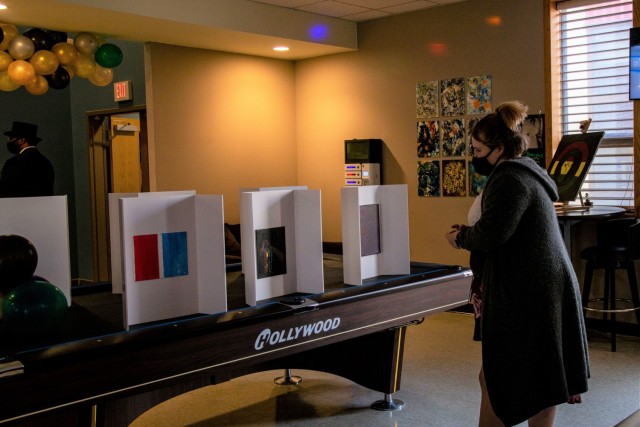
Madam C.J. Walker, Martin Luther King Jr. and Frederick Douglass posters hung on the exhibit walls with biographies and affirming words from the iconic Black history figures. Renditions of a black power fist, Black Lives Matter paintings, and other abstract art were displayed across the tabletops.
The exhibition included paintings and drawings created by students from Humphreys Middle School and Humphreys High School.
1 / 3 Show Caption + Hide Caption –
Julia McCants, a ninth grade student at Humphreys High School and a Keystone Club member at Smith Middle School and Teen Center, shows her drawing during the Black History Art Exhibit at the Camp Humphreys teen center Feb. 18, 2022. (Photo Credit: Sgt. Courtney Davis)
VIEW ORIGINAL
2 / 3 Show Caption + Hide Caption –
Jimmy Scoggin, a youth program assistant at the Smith Middle School and Teen Center, welcomes guests to the Black History Art Exhibit at the Camp Humphreys youth center Feb. 18, 2022. (Photo Credit: Sgt. Courtney Davis)
VIEW ORIGINAL
3 / 3 Show Caption + Hide Caption –
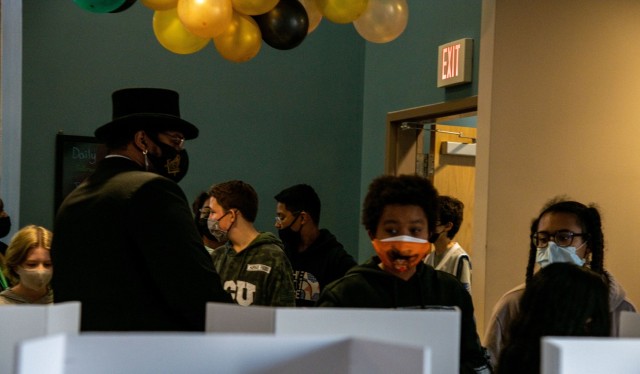
A U.S. Army Garrison Humphreys community member explores paintings displayed as part of the Black History Art Exhibit at the Camp Humphreys Smith Middle School and Teen Center Feb. 18, 2022. (Photo Credit: Sgt. Courtney Davis)
VIEW ORIGINAL
Jimmy Scoggin, a youth program assistant at the youth center, explained the Keystone Club members – ninth through twelfth grade students – encouraged the middle school students to paint and draw by telling them their work would be part of the art exhibit.
“The middle schoolers were in the art center everyday painting something,” said Scoggin.
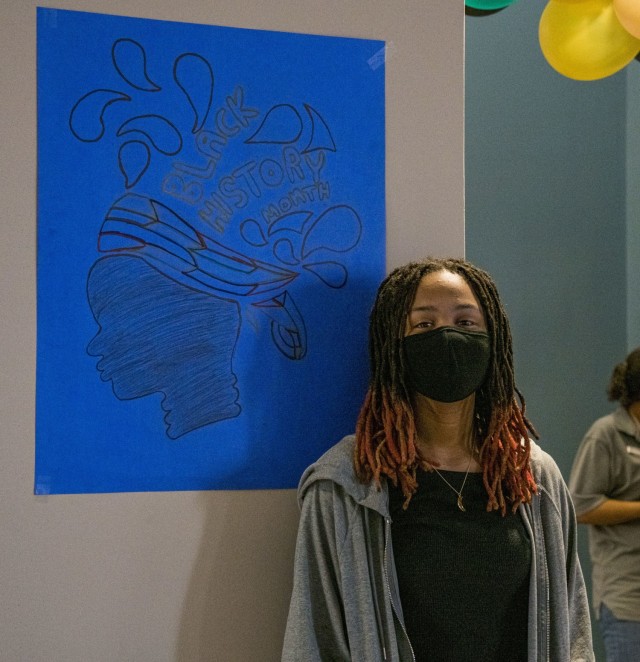
Julia and Lilian McCants, ninth grade students at Humphreys High School, highlighted the drawing of a woman’s profile with a beautiful headdress created from the words “Black History Month.” Each letter glistened with black, red, yellow, or green flecks.
“The person who did the art work is Lilian McCants,” gushed her twin Julia, as she explained the inspiration behind the artwork. “We were looking for art pieces to do for Black history, and this one kind of stood out to us both. We thought it would be kind of cool to try and interpret it our own way and make it look cool for other people to view.”
Camp Humphreys students and community members walked through the exhibition, admiring the beautiful displays of black culture, discussing what the artists were trying to convey, and learning a little history in the process.
VISHAKPATNAM, India – U.S Navy Arleigh Burke-class guided-missile destroyer USS Fitzgerald (DDG 62) and a P-8A Poseidon maritime patrol and reconnaissance aircraft (MPRA), from Patrol Squadron (VP) 47, joined with ships, aircraft and personnel from India and numerous other navies to begin Exercise Milan 2022, in the Bay of Bengal, Feb. 25.
This year marks the first time U.S. has participated in Exercise Milan. Milan in Hindi means “meeting”. The first Exercise Milan took place in 1995 with four navies and has taken place every two years since. This is the first Exercise Milan since 2018 as the 2020 iteration was cancelled due to the COVID-19 pandemic. This year’s exercise is focused on enhancing professional interaction between professional navies and gaining experience in multilateral large force operations at sea.
The exercise is scheduled to include a harbor phase followed by a sea phase where the ships will focus on a variety of high-end tactical training, maneuvering drills, air-defense exercises, submarine familiarization, multinational replenishment-at-sea, communications drills, gunnery exercise, and joint warfighting scenarios.
“Milan provides an opportunity for like-minded navies that sharing a common vision of a more stable, open, and prosperous Indo-Pacific, to operate and train alongside one another,” said Cmdr. David Catterall, commanding officer, USS Fitzgerald. “We are grateful for India’s hosting this important event and their efforts to harmonize our contributions to the region, and look forward to ensuring future engagements to build strong alliances and partnerships.”
Exercise Milan includes forces from Australia, Bangladesh, France, India, Indonesia, Japan, Malaysia, Myanmar, Seychelles, Singapore, South Korea, Sri Lanka, Thailand, United Kingdom, United States, and Vietnam. The last multinational exercise the U.S. participated in the Indian Ocean was MALABAR, in Oct. 2021, a QUAD maritime exercise with the Royal Australian Navy, Indian Navy, Japan Maritime Self-Defense Force, and U.S. Royal Australian Navy ship HMAS Arunta (FFH 151) transited with Fitzgerald during a group sail ahead of Exercise Milan commencing.
Fitzgerald is underway conducting operations in support of a free and open Indo-Pacific, while assigned to Destroyer Squadron (DESRON) 15, the Navy’s largest forward-deployed DESRON and the U.S. 7th Fleet’s principal surface force.
The “Golden Swordsmen” of VP-47 are part of Commander Task Force (CTF) 72, are stationed in Whidbey Island, Washington, and are currently deployed to Misawa Air Base in Aomori, Japan. Throughout the deployment, they will be conducting maritime patrol and reconnaissance and theater outreach operations within the 7th Fleet area of operations.
U.S. 7th Fleet conducts forward-deployed naval operations in support of U.S. national interests in the Indo-Pacific area of operations. As the U.S. Navy’s largest forward-deployed fleet, 7th Fleet employs 50 to 70 ships and submarines across the Western Pacific and Indian Oceans. U.S. 7th Fleet routinely operates and interacts with 35 maritime nations while conducting missions to preserve and protect a free and open Indo-Pacific region.
DUBLIN, Ga. (WALB) – Carl Vinson Veterans Administration Medical Center officials say Friday, they have had patients test positive for possible infection of hepatitis or HIV.
More than 4,000 veteran patients were informed surgical instruments used on them were not sterilized properly. Veterans and their families tell us they are overwhelmed with worry.
“Pure devastation. Sick to my stomach. Sadness.”
Rachel Heath’s father, Larry Heath of Nashville, received a letter from the Carl Vinson Medical Center. It says the medical equipment used on him was not properly sterilized. Center officials say 4,594 veteran patients possibly could have been infected and urged them to be tested for two types of hepatitis and HIV.
Larry Heath served in Vietnam and his daughter says he has received treatment for Agent Orange maladies, along with cancer, heart attack, and stroke.
“This is an outrage. That it’s 2022 and veterans are still being treated like this. For negligence,” said Rachel.
The medical director of the Carl Vinson Medical Center says a member of their staff reported that all steps for cleaning medical instruments were not being made. The procedures were stopped, and veterans were told they needed to be tested.
“So people have tested positive so far?” medical director, Dr. Manuel Davila said. “Well, at this point, I don’t know the number, but yes. Absolutely.”
Now more testing is being done, although the medical center says the risk of infection is very low.
Carl Vinson VA Center Medical Director, Dr. Manuel Davila(Carl Vinson VA Medical Center)
“We will make it right. We do own it. We are transparent about it,” Dr. Davila said.
Larry has been tested. Now they have to wait for the results.
“We have to wait two weeks and it could be life-changing. We don’t know what we are about to face. No one does.”
The medical center has brought in another sterilization team from the Augusta VA Hospital, while the Carl Vinson staff is being re-trained. Officials want to reassure their patients.
“And it certainly a tremendous honor for us to serve our veterans. Because they have given so much, for us. And we certainly want to give them all that we can as well. And that needs to be no compromise on safety. Zero harm. That’s our goal,” Dr. Davila said
But Heath says her father and family have been very disappointed with their treatment since the 1980s at Carl Vinson. And now Rachel wants all veterans to contact their veteran organizations and politician’s offices demanding improvements.
Rachel Heath(Rachel Heath)
“If you don’t use your voice, nothing is going to change. There is power in numbers. It’s just time that veterans are treated with the respect they deserve,” Rachel said.
Dr. Davila says only about one thousand of the veterans they sent this letter have been tested. He urges all the veterans contacted to be tested, for their safety.
The Carl Vinson Medical Center has set up a communication center to answer questions for veterans. It’s (478) 274-5400 if you have questions.
Space Systems Command created a Space Systems Integration Office led by former launch enterprise director Claire Leon
CHANTILLY, Va. — Claire Leon, a former Boeing executive who previously led the national security space launch program, is now in charge of a new office that will coordinate military space programs across multiple organizations.
Leon was named director of the Space Systems Command’s Space Systems Integration Office. Hiring Leon to lead this new office is a “huge win for SSC,” Lt. Gen. Michael Guetlein said Feb. 23 at the National Security Space Association’s Defense and Intelligence Space Conference.
Guetlein, commander of Space Systems Command, is a former deputy director of the National Reconnaissance Office and has been in charge of SSC since August. The command is a massive organization with an $11 billion annual budget and nearly 10,000 personnel.
A key goal of SSC is to accelerate the pace of procurement programs so technologies get “into the hands of warfighters” sooner rather than later, Guetlein said. One of the challenges is that space programs have stakeholders across multiple agencies in the Space Force, the Air Force and the Department of Defense. SSC also wants to integrate allied nations’ space technologies into U.S. programs.
What is needed is “unity of effort” so space programs move in the same direction and don’t get bogged down in analysis, reviews and bureaucratic in-fighting, said Guetlein.
Leon’s job will require coordinating projects not just within SSC, but across the entire space enterprise, he said. “Her job is to do horizontal integration across systems to make sure that we’re actually delivering capabilities” rather than just hardware.
The systems integration office will have a broad portfolio that is still being defined, Guetlein said. “I think we’re going to get an enormous amount of lift at that organization. That’s something we have never had in the past, somebody looking across the horizon.”
An effort to improve coordination across space organizations started two years ago when the Space Force stood up a “program integration council” that includes the Space Systems Command, the National Reconnaissance Office, the Missile Defense Agency, the Air Force Rapid Capabilities Office, the Space Rapid Capabilities Office, the Space Development Agency and the Space Warfighting Analysis Center.
“Unity of effort was a foreign concept to us at the time,” said Guetlein, noting that military organizations have a hard time with horizontal integration. “We are classically trained. The military is classically trained on unity of command,” he said. “I can look up above me to understand who’s in charge.”
The problem in acquisitions is that they are spread across multiple organizational boundaries. The coordination done via the council “has been going extremely well,” he said. “We meet once a month. We have already been talking about data standards.”
The first major initiative handled by the council is how to integrate missile warning and missile tracking satellites overseen by different agencies. “I have never seen greater collaboration amongst those organizations in my career prior to standing up a program integration council,” said Guetlein.
“We’ve got to keep that dialogue going,” he added. “When we talk about architectures, it really comes down to how do I integrate, how do I network? How do I better get data from point A to point B, and make maximum use of that data?”
‘Getting after the threat’
Guetlein said he is pushing the message across the SSC workforce that their focus has to be on “getting after the threat” posed by Russia and China. These nations’ anti-satellite weapons are a “massive threat to our way of life,” he said. “And we are behind the power curve in delivering capability” to counter those threats.
Because of the lengthy DoD budget cycles and requirements approval process, new capabilities can’t happen overnight, so Guetlein set a 2026 goal for SSC to deliver technologies that will make U.S. satellites more resilient to attacks.
“The only way we’re gonna get this done by 2026 is by maximizing the capability that we already have today,” said Guetlein. “That means we got to squeeze every bit of juice out of the systems that we have today,” he said.
“That means I’m going to be asking for a heck of a lot more heroics from our sustainers. I’m going to be asking for commercial services. I’m going to be looking at our allies to say hey, what can you bring to the fight? How can I better integrate what I already have?”



/cloudfront-us-east-1.images.arcpublishing.com/gray/ANGYFETKERAHJCVZNH3QARDWPU.JPG)