The aircraft was formally declared IOC on Dec. 14, 2021, aligning with the scheduled first-quarter fiscal year requirement.
“The CMV-22’s maiden deployment with Carrier Air Wing (CVW) 2 and the [USS Carl] Vinson (CVN 70) team is an operational success, giving me the confidence necessary to make the declaration,” said Rear Adm. Andrew Loiselle, Director, Air Warfare Division, N98, Office of the Chief of Naval Operations. “As we continue to deliver the advanced platforms that will make up the Air Wing of the Future, the CMV-22B provides the necessary support and more to carry our future force.”
Loiselle’s designation marks a key milestone in the design, development, acquisition and testing of the CMV-22B and confirms its relevance and readiness to meet the needs of the Navy’s Carrier Onboard Delivery (COD) mission. The aircraft transports personnel, mail, supplies and cargo from shore bases to aircraft carriers at sea, and will eventually replace the C-2A Greyhound.
“IOC designation is more than a stamp of approval,” said U.S. Marine Corps Col. Brian Taylor, V-22 Joint program manager. “It is a vote of confidence from top Navy leadership that the design, testing and production of this aircraft meet the logistical needs of the carrier air wings designated to fly the CMV-22B.”
This past summer marked the first deployment for the CMV-22B. Fleet Logistics Multi-Mission Squadron (VRM) 30 embarked on the USS Carl Vinson (CVN 70) alongside the F-35C Lightning II and E-2D Advanced Hawkeye squadrons. The first deployed detachment has executed a mission completion rate of 98% and a mission capable rate of 75%. The CMV-22B is a crucial element of future carrier airwings due to the cargo capacity needed to transport F-35 power modules and additional logistics support for future carrier air wing deployments with next-generation platforms.
“This aircraft went from first flight to first deployment in 19 months; a feat possible through the dedication of the Navy’s acquisition, engineering, test and operational communities, as well as industry, all working in tandem, toward a common goal,” said Taylor.
With 50% more internal fuel than the Marine Corps’ Osprey variant, CMV-22B can transport up to 6,000 pounds of cargo and personnel over a 1,150 nautical mile range. The Navy redesigned the forward sponson fuel tanks and added two wing fuel tanks to add capacity and extend the flight range.
“As our fighter/attack and surveillance aircraft expand in both capability and size to extend the range of the carrier air wing, we must also evolve our support aircraft, in tandem, to supply those platforms. The CMV-22B will transport cargo and personnel to outfit the most advanced aircraft carrier strike groups as we continue to meet the needs of our missions worldwide,” said Taylor.
The program will continue to refine and test capabilities on the aircraft, addressing the agile needs of the fleet. To date, Bell Boeing has delivered 14 aircraft with 44 on contract and full operational capability expected in 2023.
For more information about the CMV-22B Osprey, visit: https://www.navair.navy.mil/product/CMV-22B-Osprey
A conversation and a carbon monoxide detector proved to be a life-saving combination.
Nurse and National HeRO awardee, Richard Hall of John Dingell VA in Detroit, enjoys talking to fellow Veterans and engaging during visits. He struck up a conversation with Veteran Larry Washington as he was leaving VA after noticing he had been to the ED multiple times over the last couple days.
Hall, an Emergency Department (ED) nurse, former firefighter and Navy Veteran, suggested that the Veteran have his carbon monoxide levels checked at his home. The suggestion saved the Washington’s life and potentially many others.
“I was nauseated, lightheaded, disoriented and everything. I really didn’t know where I was,” said Veteran Larry Washington. “Mr. Hall noticed and had me seen immediately in the ER. He was professional. I could have died. He saved me.”
(Hall received national recognition for his contributions to VA’s Journey to High Reliability. The latest VA Nurses Making a Difference HRO in Action video focuses on the HRO value, Clear Communication, featuring Hall.)
Richard Hall, VA nurse, firefighter, Navy Veteran
Asked questions which revealed the problem
Through inquiry and asking probing questions, Hall found that Washington had on-going symptoms of dehydration, lethargy, poor appetite and abdominal discomfort. Imaging and lab results did not show any emergent issues. During each visit, he was treated for dehydration and discharged feeling much better. Then Hall noticed that Washington’s wife was also not feeling well.
Hall began to dig deeper and asked whether Washington had work done in his home recently. His wife said their apartment had recently had a new furnace installed. Hall explained to Washington to have the carbon monoxide (CO) levels checked in his home.
Washington went home and called the gas company. It was confirmed the CO levels were dangerously high and Washington and his wife were immediately moved to a hotel. He was told that if he had stayed in the house much longer, he and his wife would have likely died.
Through persistence, caring and dedication, Hall was able to save a fellow Veteran, his family and other building tenants from a potentially fatal situation.
“Why we nurses do what we do.”
“To know I had that effect on someone is the greatest feeling in the world,” said Hall. “My dad’s a Veteran. I’m a Gulf war Veteran. To give back to my brethren and care for the community in which we reside is why us nurses do what we do.”
VA’s Journey to High Reliability aims to continuously improve its processes by maximizing patient safety and reducing harm to restore trust and ensure every Veteran receives the high-quality care they deserve.
No obvious changes have come to one of New Hampshire’s least-known military installations as it completes the transition from Air Force to Space Force, but the increasing importance of satellites, as well as the number of nations with launch capability, may affect its future.
“Space has been elevated to a war-fighting domain,” said Lt. Col David Zesinger, commander of New Boston Space Force Station, during a brief interview Wednesday as he escorted U.S. Sen. Maggie Hassan on a tour of the facility.
Hassan was touring the 2,800-acre facility, which dates to World War II and has been hosting satellite dishes since 1960, to get an update on its mission. The base was officially transferred to the Space Force in July although indications of its previous status remain, including warning signs posted all along the perimeter that say not to enter the “U.S. Air Force” facility.
“The Space Force is a central part of national defense,” Hassan said, speaking through a car window after a briefing in the base’s control center. She wanted to see the base in person, she said, to know “what the transition to the Space Force means for that mission.”
Zesinger said there have been no changes to personnel – about 120 staffers work at the station – since the change.
The base has a half-dozen radar domes that look like gigantic golf balls. These are flexible domes made of material that is transparent to radio waves, each covering an individual satellite dish used to track, communicate with and control scores of government and civilian satellites.
The station is part of U.S. Space Force Delta 6 – Space Access and Cyberspace Operations, headquartered in Colorado.
The base covers parts of New Boston, Amherst and Mont Vernon, and locals have long sought some public access to the base, virtually all of which is wooded and undeveloped.
Parts are open to military personnel, both active and retired, for recreation and hunting, including Joe English Pond in the center. Civilian access has not been allowed for decades, both for security reasons and also because of fears of unexploded bombs and shells left over from its original purpose as a training area for bombers flying out of what is now Manchester airport.
A major push to find and get rid of that ban took place around a decade ago, including the explosion of a 2,000-pound bomb found at the bottom of Joe English Pond, but there’s no indication that access rules will change.
“There is certainly a lot of interest in the area” about public access, Hassan said. “The important thing is to make sure it can fulfill its mission.”
The base was created in 1942 when the government bought out a number of farms in what was then a thinly populated agricultural area west of Manchester. It was used as a training ground for military pilots in what was then the U.S. Army Air Corps flying out of Grenier Field, now Manchester-Boston Regional Airport, until 1956. In 1960 it began service as a satellite tracking station.
The Space Force was created in 2019 as a branch of the military like the Army, Navy, Air Force and Marine Corps.
(David Brooks can be reached at 369-3313 or [email protected] or on Twitter @GraniteGeek.)
Army Maj. Gen. Joseph Ryan, second from the right, the commanding general of the 25th Infantry Division, meets with Mr. Michael Heath, third from the right, the Chargé d’ Affaires a.i. of the U.S. Mission in Thailand, and Gen. Narongpan Jitkaewthae, second from the left, the commander-in-chief of the Royal Thai Army, before the opening ceremony of Hanuman Guardian 2022 at the Infantry Center, Khao Noi, Kingdom of Thailand, Feb. 24, 2022. Hanuman Guardian 2022 is the 11th iteration of the annual bilateral U.S. Army Pacific Theater Security Cooperation Program event conducted with the Royal Thai Army in coordination with United States Indo-Pacific Command. As part of the Pacific Pathways series, the goal of HG22 is to foster closer relationships, increase readiness, and enhance interoperability among service members of the U.S. Army and Royal Thai Army. (U.S. Army photo by Danielle O’Donnell) (Photo Credit: Danielle ODonnell)
VIEW ORIGINAL
2 / 16 Show Caption + Hide Caption –
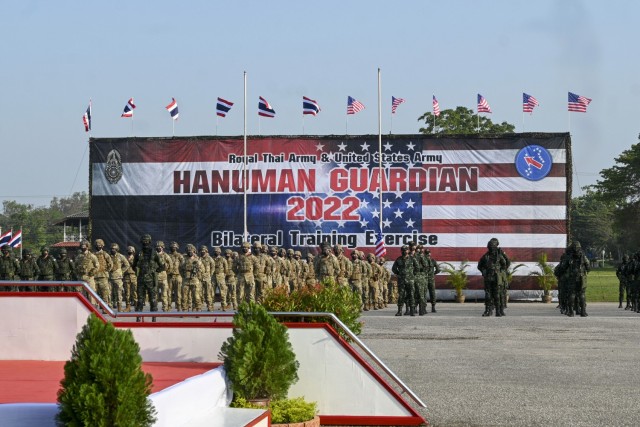
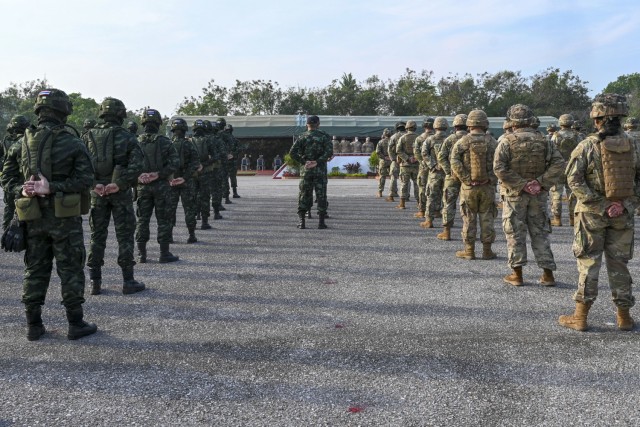
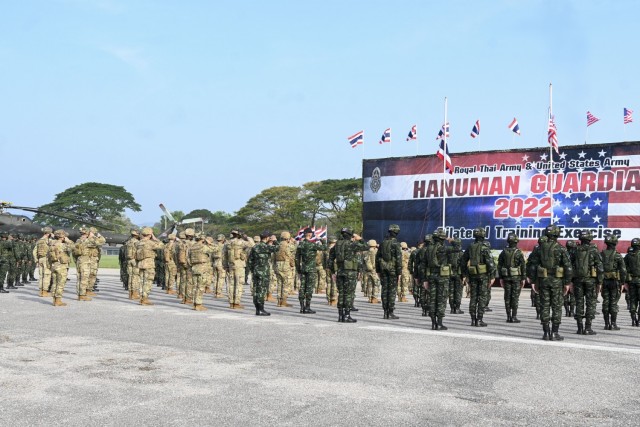
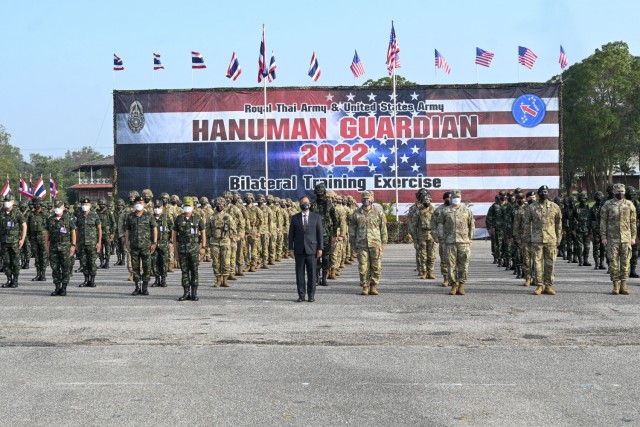
Soldiers with the U.S. Army and the Royal Thai Army stand in formation during the opening ceremony for Hanuman Guardian 2022 at the Infantry Center, Khao Noi, Kingdom of Thailand, Feb. 24, 2022. Hanuman Guardian 2022 is the 11th iteration of the annual bilateral U.S. Army Pacific Theater Security Cooperation Program event conducted with the Royal Thai Army in coordination with United States Indo-Pacific Command. As part of the Pacific Pathways series, the goal of HG22 is to foster closer relationships, increase readiness, and enhance interoperability among service members of the U.S. Army and Royal Thai Army. (U.S. Army photo by Danielle O’Donnell) (Photo Credit: Danielle ODonnell)
VIEW ORIGINAL
3 / 16 Show Caption + Hide Caption –
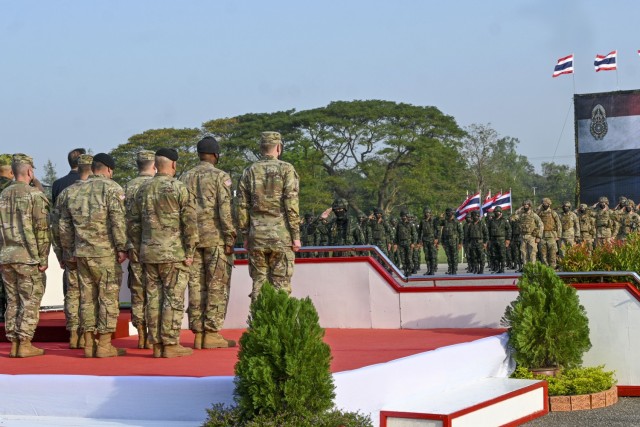
Soldiers with the U.S. Army and the Royal Thai Army stand in formation during the opening ceremony for Hanuman Guardian 2022 at the Infantry Center, Khao Noi, Kingdom of Thailand, Feb. 24, 2022. Hanuman Guardian 2022 is the 11th iteration of the annual bilateral U.S. Army Pacific Theater Security Cooperation Program event conducted with the Royal Thai Army in coordination with United States Indo-Pacific Command. As part of the Pacific Pathways series, the goal of HG22 is to foster closer relationships, increase readiness, and enhance interoperability among service members of the U.S. Army and Royal Thai Army. (U.S. Army photo by Danielle O’Donnell) (Photo Credit: Danielle ODonnell)
VIEW ORIGINAL
4 / 16 Show Caption + Hide Caption –
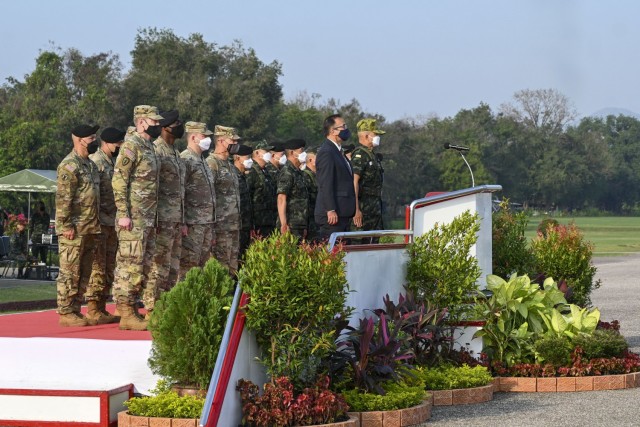
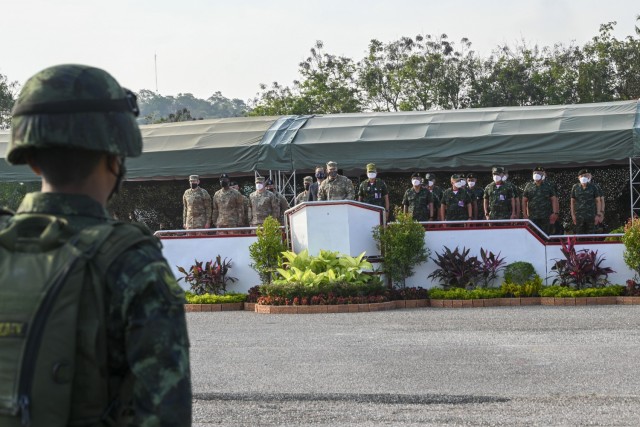
Key Leaders with the U.S. Army and the Royal Thai Army stand at attention during the opening ceremony for Hanuman Guardian 2022 at the Infantry Center, Khao Noi, Kingdom of Thailand, Feb. 24, 2022. Hanuman Guardian 2022 is the 11th iteration of the annual bilateral U.S. Army Pacific Theater Security Cooperation Program event conducted with the Royal Thai Army in coordination with United States Indo-Pacific Command. As part of the Pacific Pathways series, the goal of HG22 is to foster closer relationships, increase readiness, and enhance interoperability among service members of the U.S. Army and Royal Thai Army. (U.S. Army photo by Danielle O’Donnell) (Photo Credit: Danielle ODonnell)
VIEW ORIGINAL
5 / 16 Show Caption + Hide Caption –
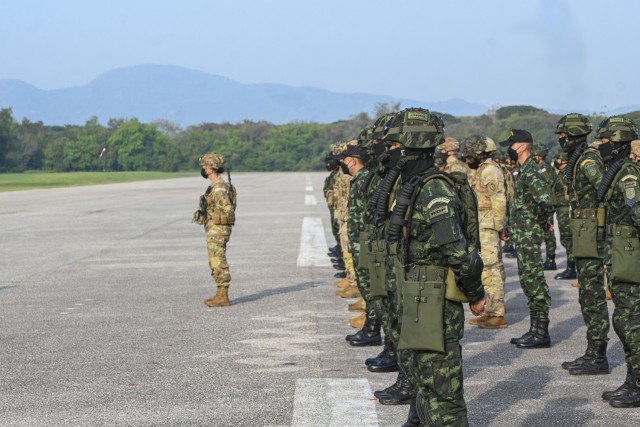
Soldiers with the U.S. Army and the Royal Thai Army stand in formation during the opening ceremony for Hanuman Guardian 2022 at the Infantry Center, Khao Noi, Kingdom of Thailand, Feb. 24, 2022. Hanuman Guardian 2022 is the 11th iteration of the annual bilateral U.S. Army Pacific Theater Security Cooperation Program event conducted with the Royal Thai Army in coordination with United States Indo-Pacific Command. As part of the Pacific Pathways series, the goal of HG22 is to foster closer relationships, increase readiness, and enhance interoperability among service members of the U.S. Army and Royal Thai Army. (U.S. Army photo by Danielle O’Donnell) (Photo Credit: Danielle ODonnell)
VIEW ORIGINAL
6 / 16 Show Caption + Hide Caption –
Soldiers with the U.S. Army and the Royal Thai Army stand in formation during the opening ceremony for Hanuman Guardian 2022 at the Infantry Center, Khao Noi, Kingdom of Thailand, Feb. 24, 2022. Hanuman Guardian 2022 is the 11th iteration of the annual bilateral U.S. Army Pacific Theater Security Cooperation Program event conducted with the Royal Thai Army in coordination with United States Indo-Pacific Command. As part of the Pacific Pathways series, the goal of HG22 is to foster closer relationships, increase readiness, and enhance interoperability among service members of the U.S. Army and Royal Thai Army. (U.S. Army photo by Danielle O’Donnell) (Photo Credit: Danielle ODonnell)
VIEW ORIGINAL
7 / 16 Show Caption + Hide Caption –
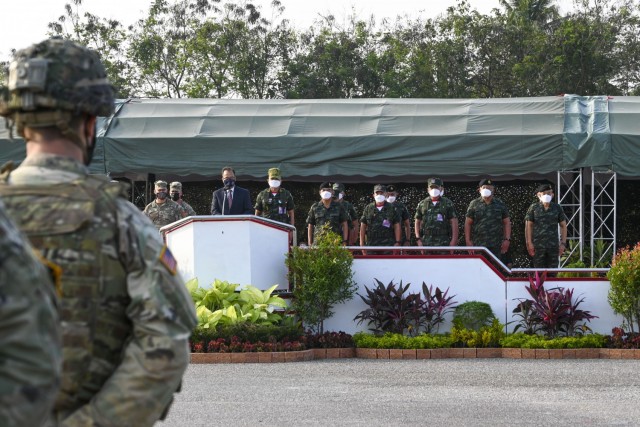
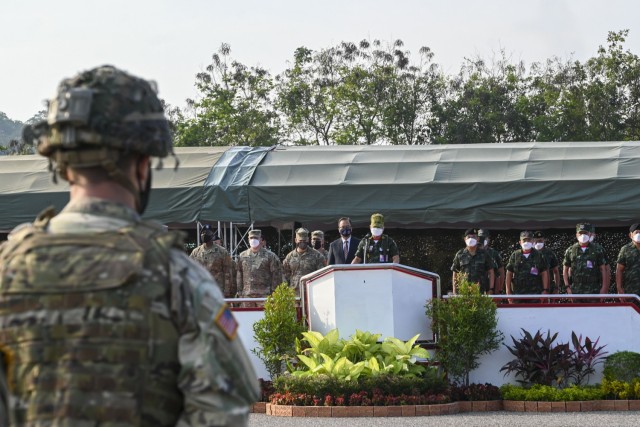
A U.S. Soldier stands in formation as Mr. Michael Heath, the Chargé d’ Affaires a.i. of the U.S. Mission in Thailand, gives remarks at the opening ceremony for Hanuman Guardian 2022 at the Infantry Center, Khao Noi, Kingdom of Thailand, Feb. 24, 2022. Hanuman Guardian 2022 is the 11th iteration of the annual bilateral U.S. Army Pacific Theater Security Cooperation Program event conducted with the Royal Thai Army in coordination with United States Indo-Pacific Command. As part of the Pacific Pathways series, the goal of HG22 is to foster closer relationships, increase readiness, and enhance interoperability among service members of the U.S. Army and Royal Thai Army. (U.S. Army photo by Danielle O’Donnell) (Photo Credit: Danielle ODonnell)
VIEW ORIGINAL
8 / 16 Show Caption + Hide Caption –
Army Maj. Gen. Joseph Ryan, the commanding general of the 25th Infantry Division, gives remarks at the opening ceremony for Hanuman Guardian 2022 at the Infantry Center, Khao Noi, Kingdom of Thailand, Feb. 24, 2022. Hanuman Guardian 2022 is the 11th iteration of the annual bilateral U.S. Army Pacific Theater Security Cooperation Program event conducted with the Royal Thai Army in coordination with United States Indo-Pacific Command. As part of the Pacific Pathways series, the goal of HG22 is to foster closer relationships, increase readiness, and enhance interoperability among service members of the U.S. Army and Royal Thai Army. (U.S. Army photo by Danielle O’Donnell) (Photo Credit: Danielle ODonnell)
VIEW ORIGINAL
9 / 16 Show Caption + Hide Caption –
A U.S. Soldier stands in formation as Gen. Narongpan Jitkaewthae, the commander-in-chief of the Royal Thai Army, gives remarks at the opening ceremony for Hanuman Guardian 2022 at the Infantry Center, Khao Noi, Kingdom of Thailand, Feb. 24, 2022. Hanuman Guardian 2022 is the 11th iteration of the annual bilateral U.S. Army Pacific Theater Security Cooperation Program event conducted with the Royal Thai Army in coordination with United States Indo-Pacific Command. As part of the Pacific Pathways series, the goal of HG22 is to foster closer relationships, increase readiness, and enhance interoperability among service members of the U.S. Army and Royal Thai Army. (U.S. Army photo by Danielle O’Donnell) (Photo Credit: Danielle ODonnell)
VIEW ORIGINAL
10 / 16 Show Caption + Hide Caption –
Soldiers with the U.S. Army and the Royal Thai Army salute their respective flags during the opening ceremony for Hanuman Guardian 2022 at the Infantry Center, Khao Noi, Kingdom of Thailand, Feb. 24, 2022. Hanuman Guardian 2022 is the 11th iteration of the annual bilateral U.S. Army Pacific Theater Security Cooperation Program event conducted with the Royal Thai Army in coordination with United States Indo-Pacific Command. As part of the Pacific Pathways series, the goal of HG22 is to foster closer relationships, increase readiness, and enhance interoperability among service members of the U.S. Army and Royal Thai Army. (U.S. Army photo by Danielle O’Donnell) (Photo Credit: Danielle ODonnell)
VIEW ORIGINAL
11 / 16 Show Caption + Hide Caption –
Army Maj. Gen. Joseph Ryan, right of center, the commanding general of the 25th Infantry Division, Mr. Michael Heath, center, the Chargé d’ Affaires a.i. of the U.S. Mission in Thailand, and General Narongpan Jitkaewthae, left of center, the commander-in-chief of the Royal Thai Army, stand in formation with the soldiers of the U.S. Army and Royal Thai Army during the opening ceremony of Hanuman Guardian 2022 at the Infantry Center, Khao Noi, Kingdom of Thailand, Feb. 24, 2022. Hanuman Guardian 2022 is the 11th iteration of the annual bilateral U.S. Army Pacific Theater Security Cooperation Program event conducted with the Royal Thai Army in coordination with United States Indo-Pacific Command. As part of the Pacific Pathways series, the goal of HG22 is to foster closer relationships, increase readiness, and enhance interoperability among service members of the U.S. Army and Royal Thai Army. (U.S. Army photo by Danielle O’Donnell) (Photo Credit: Danielle ODonnell)
VIEW ORIGINAL
12 / 16 Show Caption + Hide Caption –
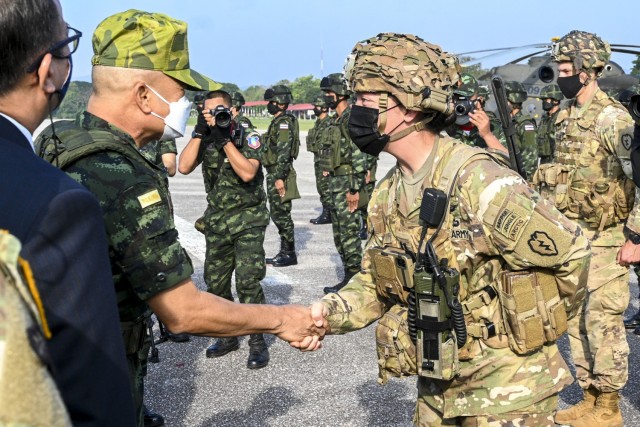
Gen. Narongpan Jitkaewthae, the commander-in-chief of the Royal Thai Army, congratulates Army Capt. Monday Price, commander of Headquarters and Headquarters Company, 29th Brigade Engineer Battalion, for showing leadership during the opening ceremony of Hanuman Guardian 2022 at the Infantry Center, Khao Noi, Kingdom of Thailand, Feb. 24, 2022. Hanuman Guardian 2022 is the 11th iteration of the annual bilateral U.S. Army Pacific Theater Security Cooperation Program event conducted with the Royal Thai Army in coordination with United States Indo-Pacific Command. As part of the Pacific Pathways series, the goal of HG22 is to foster closer relationships, increase readiness, and enhance interoperability among service members of the U.S. Army and Royal Thai Army. (U.S. Army photo by Danielle O’Donnell) (Photo Credit: Danielle ODonnell)
VIEW ORIGINAL
13 / 16 Show Caption + Hide Caption –
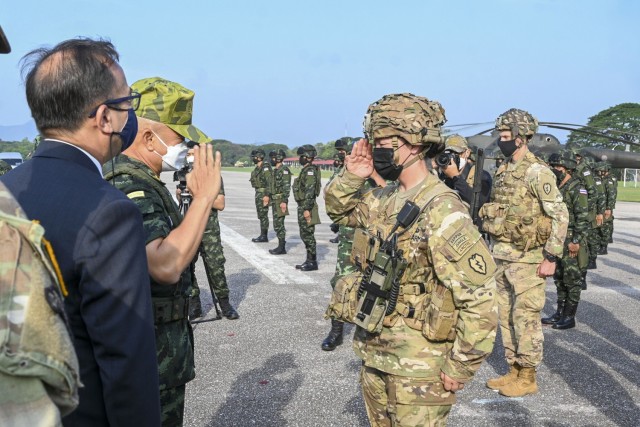
Gen. Narongpan Jitkaewthae, the commander-in-chief of the Royal Thai Army, returns the salute from Army Capt. Monday Price, commander of Headquarters and Headquarters Company, 29th Brigade Engineer Battalion, during the opening ceremony of Hanuman Guardian 2022 at the Infantry Center, Khao Noi, Kingdom of Thailand, Feb. 24, 2022. Hanuman Guardian 2022 is the 11th iteration of the annual bilateral U.S. Army Pacific Theater Security Cooperation Program event conducted with the Royal Thai Army in coordination with United States Indo-Pacific Command. As part of the Pacific Pathways series, the goal of HG22 is to foster closer relationships, increase readiness, and enhance interoperability among service members of the U.S. Army and Royal Thai Army. (U.S. Army photo by Danielle O’Donnell) (Photo Credit: Danielle ODonnell)
VIEW ORIGINAL
14 / 16 Show Caption + Hide Caption –
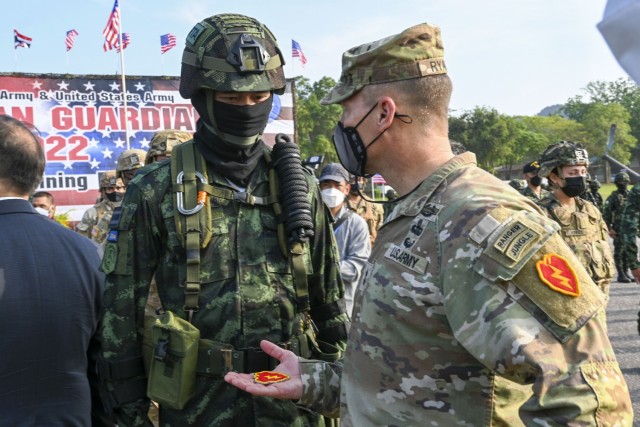
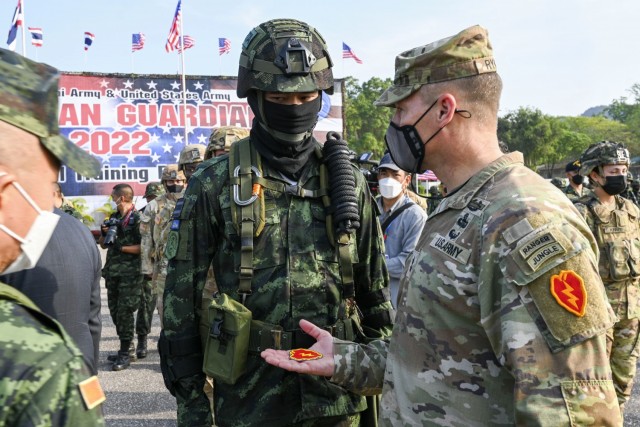
Army Maj. Gen. Joseph Ryan, the commanding general of the 25th Infantry Division, presents a Royal Thai Army soldier with a challenge coin after the opening ceremony of Hanuman Guardian 2022 at the Infantry Center, Khao Noi, Kingdom of Thailand, Feb. 24, 2022. Hanuman Guardian 2022 is the 11th iteration of the annual bilateral U.S. Army Pacific Theater Security Cooperation Program event conducted with the Royal Thai Army in coordination with United States Indo-Pacific Command. As part of the Pacific Pathways series, the goal of HG22 is to foster closer relationships, increase readiness, and enhance interoperability among service members of the U.S. Army and Royal Thai Army. (U.S. Army photo by Danielle O’Donnell) (Photo Credit: Danielle ODonnell)
VIEW ORIGINAL
15 / 16 Show Caption + Hide Caption –
Army Maj. Gen. Joseph Ryan, the commanding general of the 25th Infantry Division, presents a Royal Thai Army soldier with a challenge coin after the opening ceremony of Hanuman Guardian 2022 at the Infantry Center, Khao Noi, Kingdom of Thailand, Feb. 24, 2022. Hanuman Guardian 2022 is the 11th iteration of the annual bilateral U.S. Army Pacific Theater Security Cooperation Program event conducted with the Royal Thai Army in coordination with United States Indo-Pacific Command. As part of the Pacific Pathways series, the goal of HG22 is to foster closer relationships, increase readiness, and enhance interoperability among service members of the U.S. Army and Royal Thai Army. (U.S. Army photo by Danielle O’Donnell) (Photo Credit: Danielle ODonnell)
VIEW ORIGINAL
16 / 16 Show Caption + Hide Caption –
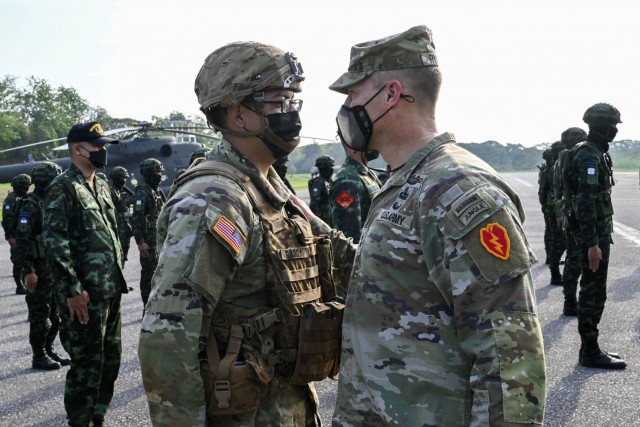
Army Maj. Gen. Joseph Ryan, the commanding general of the 25th Infantry Division, inspects a U.S. Soldier assigned to the 25th Infantry Division during the opening ceremony for Hanuman Guardian 2022 at the Infantry Center, Khao Noi, Kingdom of Thailand, Feb. 24, 2022. Hanuman Guardian 2022 is the 11th iteration of the annual bilateral U.S. Army Pacific Theater Security Cooperation Program event conducted with the Royal Thai Army in coordination with United States Indo-Pacific Command. As part of the Pacific Pathways series, the goal of HG22 is to foster closer relationships, increase readiness, and enhance interoperability among service members of the U.S. Army and Royal Thai Army. (U.S. Army photo by Danielle O’Donnell) (Photo Credit: Danielle ODonnell)
VIEW ORIGINAL
Prachuap Khiri Khan, Thailand – With a snap to attention and salutes rendered to their commanders, Exercise Hanuman Guardian 2022 officially kicked off for the troops of the 29th Brigade Engineer Battalion, part of the famed 25th Infantry Division “Tropic Lightning,” and their counterparts from the Royal Thai Army here at the Infantry Centre Feb. 24, 2022.
HG22 is the 11th iteration of the annual bilateral U.S. Army Pacific Theater Security Cooperation Program event conducted with the Royal Thai Army in coordination with the U.S. Indo-Pacific Command.
“Hanuman Guardian represents the United States’ ironclad commitment to the Royal Thai Army,” said U.S. Army Gen. Joseph A. Ryan, commanding general of the 25th Infantry Division. “This Army-to-Army engagement further cements the strong relationships between our two proud nations through tough, realistic training.”
The goal of HG22 is to foster closer relationships, increase readiness, and enhance interoperability among service members of the U.S. Army and Royal Thai Army.
“This is a good opportunity for our troops to learn and share experience as well as extend the knowledge of different tactics, enhance capabilities, and procedures to develop interoperability between the Royal Thai Army and the U.S. Army,” said Gen. Narongpan Jittkaewtae, the commander-in-chief of the Royal Thai Army.
Designed to enhance bilateral aviation, medical, battle staff, and other warrior capabilities, Hanuman Guardian develops combat-ready and credible Soldiers.
“The exercise develops individual skill of soldiers and extend the knowledge of using T-11 parachutes as well as practicing airborne unit capability to meet requirement to respond to crisis anywhere in the world,” said Jittkaewtae.
The T-11 Advanced Tactical Parachute System, in use since 2007, replaced the T-10 system that had been the standard since 1955. Here at HG22, this parachute training will fall to the 4th Infantry Brigade Combat Team (Airborne), with aviation assets provided by the 25th Combat Aviation Brigade, both under the Tropic Lightning banner. This training will push the participating units by requiring them to sustain their capabilities, in collaboration with partners and allies, for extended periods during the three week exercise.
“We are learning some new techniques,” said U.S. Army 2nd Lt. Lauren Kinney, from the 29th Brigade Engineer Battalion, 25th Infantry Division. Kinney looks forward to collaborating with her Royal Thai Army counterparts and learning from each other during the exercise. “We have a topic of the day, where we take turns teaching each other how we accomplish certain tasks, we have a lot of similarities” she said.
HG22 enhances the military-to-military relationships and mission readiness at the battalion level with a combined arms operation. This includes pairing officers and key positions with their counterparts from their partner nation. For Kinney, this meant working alongside Royal Thai Army 2nd Lt. Phurin Junphut of the 5th Infantry Division.
Speaking of her counterpart, Kinney said, “in eight years, this is his first time working with foreigners and he also looks forward to learning from each other and working with the U.S Army Combat Engineers.”
HG22 enables the armies to further strengthen these relationships through training and responsible maneuvers in a COVID-constrained environment. The foundation of Hanuman Guardian is based on enhancing interoperability and furthering the longstanding military relationship between the Royal Thai Armed Forces and U.S Army.
“I am extremely confident that this year’s exercise will successfully contribute to our collective readiness, and I am proud that Soldiers from the Tropic Lightning Division can be a part of it,” Ryan said.
ATHENS — Greene County veterans converged on the TGM American Legion Post 187 in Athens on Thursday to learn about all of the government and nonprofit services available to them at a veterans resource fair hosted by New York state Sen. Michelle Hinchey.
The senator has organized four veterans resource fairs since last fall in the 46th district. The Athens fair on Thursday was the second in Greene County, following an event at the Cairo Public Library on Nov. 16.
As the event was scheduled to begin at 3 p.m. on Thursday, the legion’s parking lot was already full, necessitating street parking for the large crowd interested in gathering information on veterans’ programs.
“Word is getting out,” Hinchey said. “Cairo was our very first Veterans Resource Fair and it was new. So, I think we’ve been spreading the word. We’ve also been in Saugerties and Altamont, and now here in Athens I think people are seeing it. Word spreads and people are showing up. The organizations that are here are really incredible. So, I think people are hearing that when they go they can actually get help and resources. It’s definitely growing, which is good to see and we’ll do more.”
Hinchey’s father, the late U.S. Rep. Maurice Hinchey, D-26, 22, was a U.S. Navy veteran, making the event a personal perspective for the senator.
“We have a big responsibility to our veterans and to the people who have dedicated their time and skills and much of their lives to protecting our country so the rest of us can live in freedom,” she said. “We do not do, as a country, a good enough job of making sure that our veterans are supported and protected when they come home. Ones who serve abroad and those who stay here. So it’s really important for me, coming from a military family, that we offer more and show our veterans, very clearly, that we support them and we’re here to help them.”
Kevin Hicks, the service officer of American Legion Post 983 in Cairo, served 29 years in the U.S. Army and noted that fostering a sense of community among veterans was critical after they leave the service.
“This is important because it seems like once a service member transitions from the service, they lose that sense of connection and camaraderie they had,” he said of the fair. “The whole time they were in the service, they have a buddy-team system and there’s a chain of command. There’s always some way to get support. Once they transition, it’s really difficult for a lot of veterans to figure out where the support networks are. So, events like this highlight all of the organizations in the local community that a veteran two blocks away might not have had any idea about.”
Adam Schnopp, case manager with Soldier On, a program that combats veteran homelessness and promotes home ownership among those who’ve served their country, manned a booth at the fair.
“We help veterans who are homeless or who are at risk of becoming homeless,” he said. “I think this is a good place to reach veterans, maybe not homeless veterans, specifically, but the veteran community is very well-connected and a lot of it is word of mouth. So, if any veteran in here finds someone who happens to be homeless, I believe they would reach out and let them connect with any of the services here.”
George Skraastad, of Cairo, served from 1964 to 1987 in the U.S. Navy and perused the booths at Thursday’s fair.
“Maybe I can find something that will help me out,” he said. “Most of it I’m too old for now, but this is really a good thing, especially for the younger veterans.”
With his staff running late to the event, Greene County Administrator Shaun Groden set up the county’s booth at the fair and noticed the impact of the event immediately.
“I had two vets come to me right away with issues with red tape with the federal administration,” he said. “So, I think the significance is that by the community outreach, they can go to somebody and hopefully they can get their cause championed. Plus while they’re there, there’s 13 other agencies they can get services from. So, the collection of the number of service levels there was as equally important as to what the individual agency could provide them.”
Officer Beatrice Urciuoli, of the New York State Department of Corrections and Community Supervision, presented veterans with literature about potential employment opportunities in the prison industry.
“We’re just here recruiting for corrections officers and parole officers, civilian jobs and health care opportunities,” she said.
Urciuoli added that it was a priority to employ veterans in the correctional sector.
Greene County Legislator Harry Lennon, D-Cairo, attended the fair and was impressed with the robust turnout, which filled the Athens hall.
“You can look around and see that the attendance is overwhelming,” he said. “I think it’s very important for our veterans. We can never forget the service that they gave to our country.”
Lennon said he was hopeful the veterans event was the second of many to come in the county.
“I understand there’s one in the works for Coxsackie and I think there will be others in Greene County, too,” Lennon said. “I thank Sen. Hinchey for bringing this forward.”
Michael and Jolee Hicks conversed with veterans about their program -HicksStrong Inc., which honors their late son Macoy Hicks.
“Our mission is to save military lives,” Michael said. “The reason we’re here is that we lost our son in 2019. He was active duty in the Navy and he took his own life. We realized how much need there was in our military and their families. So what we do is we link them with therapists and we cover the costs of 25 sessions.”
-HicksStrong Inc. is based in Clifton Park, but the organization provides services to soldiers nationally.
Gordon Mosher, commander of the Athens American Legion post, said another resource fair is already being planned for the Athens American Legion this summer at a date to be determined.
“We have to get the information out to veterans,” he said. “We’ve spread the word out around the county to get people here. It’s a good turnout, which is very nice.”
Greene County Legislator Daryl Legg, D-Hunter, said the fair was a welcome gesture of support for the local veteran community.
“The best part about it is that the veterans know that they’re appreciated,” he said. “It’s a nice kind of payback for them, to know that they can get something from our community that they helped protect.”
Greene County Legislature Vice Chairman Matt Luvera, R-Catskill, said the wide array of organizations gathered at the fair made it a much-needed resource for veterans.
Hinchey said the elected officials at the event were there to serve the military community.
“We want veterans to use us as a resource,” she said. “The best way to do that is to go to places like this and bring the resources to them. There’s a lot of resources out there and it’s hard to navigate and it’s hard to know what’s available. It’s oftentimes very difficult to navigate, so we thought it would be easier and better to just bring everybody to one spot and connect the dots for care and support.”
As an Amazon Associate I earn from qualifying purchases.
While the nation is seeing a decline in COVID-19 cases, hospitals and other facilities across the country are still reeling.
At the request of the Federal Emergency Management Agency, nearly 1,000 U.S. Air Force active duty, Reserve, and Air National Guard medics are serving in civilian hospitals, care facilities, and other public institutions. The Air Force Medical Service has continued to step up as part of the federal COVID-19 response, working alongside other military departments and federal agencies.
The Air Force has upwards of 24 active duty and Reserve teams currently deployed across the country, made up of pulmonologists, trauma nurses, respiratory therapist and medical technicians. Civilian medical facilities and other institutions in 34 states are also receiving support from ANG medics.
“As military medics, it is our duty to go where our nation calls us, and that means continuing our COVID-19 mission,” said Air Force Surgeon General Lt. Gen. Robert Miller. “We ask a lot of our medics, who have played an integral role in the joint fight against COVID-19, working across federal agencies, military departments and the entire health care system.”
One of the recent deployments included the Cleveland Clinic, in Ohio, a premier medical center that both Ohioans and the nation relies on for elite specialty medical care. Like other hospitals, COVID-19 surges have impacted the Cleveland Clinic staff.
“A lot of their staff have been stretched very thin taking care of these very sick COVID patients and it has also effected their ability to do their normal mission to take in transfers and specialty care from around Ohio,” said Maj. Peter Johnson, internal medicine physician assigned to Joint Base Andrews, Maryland. “We are here in a variety of ways, as physicians, as nurses, and respiratory therapists.”
From JB Andrews, the Air Force sent a team of 20 medics to Cleveland in January to provide hospital augmentation support in the intensive care unit, emergency room and medical-surgical areas. Additionally, a 20-person team has been sent to Oklahoma and another 10-person team has been sent to Louisiana.
Joining the team from JB Andrews, Joint Base Langley-Eustis also sent a 10 medical personnel team to Louisiana.
From JB San Antonio-Lackland, three 20-person teams have been deployed to Pennsylvania, Maine and Connecticut.
Keesler Air Force Base has sent two teams, including a 15-person team to Pennsylvania, and a 20-person team to New York.
“We, in Air Education and Training Command, are extremely proud of the numerous teams of medics from all of our bases who have deployed forward conducting COVID-19 support operations in a variety of hospitals and areas throughout the country,” said Col. Michael J. Higgins, AETC command surgeon. “Taking care of our own people in this way is a sacred and honorable calling. Our lead medical centers from the 59th Medical Wing at JB San Antonio and the 81st Medical Group at Keesler AFB (Mississippi) shoulder an incredible responsibility. Our smaller medical groups volunteered their precious staff to augment these teams as well, a testament to their professionalism and sense of duty.”
Three medical teams from Nellis AFB, Nevada have been deployed to New Hampshire, Connecticut and New York.
The two 20-person teams deployed to New York are specifically providing support to the University of Rochester Medicine’s Strong Memorial Hospital where they have received training on the hospital’s systems and procedures and will integrate into the staff.
“Our team is excited to be here and help out during this time of need,” said Lt. Col. Allan Delgado, a Family and Aerospace Medicine nurse practitioner with the 99th Medical Group, Nellis AFB. “We’re proud and grateful to support FEMA and the great state of New York, serving alongside those who we swore to protect.”
Travis AFB, California deployed two 20-person teams, one to Connecticut and another to Louisiana. A 15-person team was also sent to California, specifically supporting the Emanate Health Queen of the Valley Hospital in West Covina.
“The hospital itself has been very welcoming and making the process very easy for us,” said 1st Lt. Katelyn Warren, 60th Medical Group physician assistant at Travis AFB. “So, our nurses, for example, are working with other nurses. They’re working the same schedules and they’re doing the same exact things that not only we’ve been trained to do, but also what is asked of them and needed here to help alleviate the strain that the hospital’s under.”
From Wright-Patterson AFB, Ohio, a 15-person team has been sent to Maine, a 20-person team to Oklahoma, and another 20-person team to Massachusetts.
“Our Airmen are always proud to serve, but there is something even more special to our team members in providing care to our nation’s citizens alongside our civilian medical partners,” said Col. Christian Lyons, 88th Medical Group commander, Wright-Patterson AFB. “Nothing is more inspiring than the military-civilian partnership being demonstrated right now to save lives.”
Eglin AFB, Florida has deployed a 20-person team to Maine, a 15-person team to Arizona and a 20-person team to Massachusetts.
“I am so proud of our Air Combat Command medics who demonstrate excellence daily by simultaneously providing COVID staffing relief to numerous civilian hospitals across the United States,” said Brig. Gen. Robert Bogart, ACC command surgeon. “At the same time, they have also found innovative ways to generate ready medics for the future fight and deliver timely, high-quality medical care to our Airmen and their families.”
Air Force Reserve medical personnel are also currently deployed to New York, consisting of two 20-person teams.
“I am just honored to support the effort with the COVID-19 operation in the U.S. in a hospital setting,” said Maj. Sanjiv M. Baxi, a physician activated from the 349th Medical Squadron at Travis AFB. “We are particularly trained to bring unique skill sets to help Americans on American soil, and it’s just a tremendous thing.”
These deployments in support of FEMA were approved by Secretary of Defense Lloyd J. Austin III Dec. 30, 2021.
“Air Force core values and our AFMS Trusted Care culture promotes competency and individual leadership within complex systems, which prepares our medics to enter an unfamiliar environment and quickly provide valuable professional skills and leadership,” said Col. James Sampson, Air Force Surgeon General chief surgical consultant. “In the long term, I expect that for many individuals the experience of working alongside our civilian and joint partners across the U.S. will result in even greater commitment to service. The lessons learned from this will enable greater agility and greater capabilities to meet the challenges of tomorrow.”
ANG medical personnel are currently deployed to 34 states, totaling nearly 500 doctors, nurses and other medical specialties deployed to long-term care and nursing homes, mobile blood drives, and COVID-19 vaccine administration facilities.
“This is a Total Force effort, and whether we are responding in our state or across the nation, we are wearing Air Force blue, and our participation in these missions assists the goals of the chief of staff of the Air Force and the Department of Defense,” said Maj. Gen. Brett A. Wyrick, ANG assistant to the Surgeon General. “Our participation assures the people of America that we are always ready and always there in time of need.”
While these are temporary deployments, there is also an impact to some military treatment facilities. As Air Force medics deploy, staff at military treatment facilities are working to ensure patients continue getting the care they need.
“The nation has leaned on our medics for the last two years and I cannot express my gratitude enough for their incredible dedication,” said Chief Master Sgt. Dawn Kolczynski, Medical Enlisted Force chief and Enlisted Corps chief. “Each time we ask you to respond to our nation’s need, you have stepped up with integrity and excellence in all you do.”
State / Number of U.S. Air Force Active Duty Medics
Pennsylvania / 35
New Hampshire / 15
California / 15
Maine / 55
Arizona / 15
Connecticut / 60
Oklahoma / 40
Louisiana / 40
New York / 40
Massachusetts / 40
State / Number of U.S. Air Force Reserve Medics
New York / 40
Mid-Atlantic Regional Maintenance Center (MARMC) hosted a remotely operated vehicle (ROV) tank inspection demonstration aboard USS Iwo Jima (LHD 7) Feb. 16 to assess how the technology could be used to improve maintenance availability efficiency.
A team from Puget Sound Naval Shipyard and Intermediate Maintenance Facility (PSNS & IMF) led the demonstration, inspecting a 9,000 square-feet ballast tank aboard the amphibious assault ship with a VideoRay Pro 4 ROV. PSNS & IMF have been using the ROV for some nuclear tanks and voids inspections for a couple of years. With that success, the Navy is looking at the possibility of broadening its use at regional maintenance centers and other maintenance facilities.
Nearly 20 leaders in maintenance and innovation from Puget Sound Naval Shipyard, Southeast Regional Maintenance Center, Southwest Regional Maintenance Center, warfare centers, and other ship maintenance facilities watched as the ROV navigated through the tank water recording and capturing images of the tank’s structural integrity.
“We were able to get a pretty clear and accurate view of inside of the tank,” said Ty Curtin, MARMC Tanks, Voids and Structural Branch Head. “We could see a lot of items in this tank that were documented previously by our assessors. When the ship enters its availability this summer, we can go in and compare what we saw today.”
Tank inspections and overhauls are routinely conducted during maintenance availabilities. The process of emptying a tank; drying it out; conducting a gas-free assessment requires a lot of time, money and man-hours.
“There’s an entire process we have to go through before we could get someone into a tank to conduct an inspection that most times takes only a couple of hours to complete,” said Kevin Baum, MARMC Ventilation and Damage Control Branch Head (Code 243). “On the DDGs and CGs, where stability is critical, having the ability to conduct an accurate and descriptive inspection or check on a specific issue without having to go through that preliminary process could be a game changer for us.”
Embracing innovative ways to improve on-time delivery while increasing cost-saving efforts is a major focus in the Navy’s ship repair construct, and is vital to sustaining the fleet’s mission-readiness.
Kirk Jenne, Chief of Innovation, Surface Ship Maintenance Modernization and Sustainment (SEA 21) and Commander, Navy Regional Maintenance Center (CNRMC) points out that what was learned can be used to leverage what is needed for tomorrow. “We learned a lot from all the participants in this collaboration with Puget Sound Naval Shipyard and MARMC. We intend to leverage our new knowledge with investments by DoD and the Office of Naval Research to extend current technologies to a new level of autonomous inspection technologies in these challenging spaces.”
Rear Adm. Eric Ver Hage, CNRMC lauded the team’s effort saying, “I’m very pleased to see shipyards, warfare centers, and regional maintenance centers coming together like this to solve difficult problems we face over and over. Their use of technology, their collaborative spirit, and their exploration of ideas to reduce the duration, cost, and complexity of tank inspection is tremendous and we need more of it in many areas. This effort is a great demonstration of the old adage, ‘we are better together!”
MARMC, a field under Naval Sea Systems Command (NAVSEA), provides surface ship maintenance, management and oversight of private sector maintenance and fleet technical assistance to ships in the Mid-Atlantic region of the United States and provides support to the fifth and sixth Fleet Area of Responsibilities. They are also responsible for the floating dry-dock Dynamic (AFDL-6).
February 27, 2022 – LOS ANGELES, Calif. — Last Friday, Department of Veterans Affairs Secretary Denis McDonough established new goals in VA’s efforts to prevent and end homelessness among Veterans.
During his visit, Feb. 25, McDonough participated in the local Point-in-Time Count and announced the following action being taken in the Greater Los Angeles (GLA) area:
Placing at least 1,500 Veterans experiencing homelessness into permanent housing, which would represent a greater than 10% increase in permanent housing placements since calendar year 2021.
Increasing the percentage of Housing and Urban Development-Veterans Affairs Supportive Housing vouchers under lease to at least 75%, which would represent the highest voucher utilization rate since 2018.
Increasing to 50% the percentage of Veterans admitted to HUD-VASH who are housed within 90 days.
Reaching these goals in calendar year 2022 would mark GLA’s best outcomes helping Veterans exit homelessness and remain in stable housing in several years and would represent a clear and substantial improvement on Veteran homelessness locally.
“The Los Angeles Homeless Services Authority and our partners have a shared belief that all Veterans deserve a place to call home,” said the authority’s Executive Director Heidi Marston. “We are eager to support VA in its effort to provide permanent and stable homes for 1,500 Veterans.”
In October, after seeing a homeless Veteran encampment on San Vicente Boulevard, near the West Los Angeles VA Medical Center, McDonough set a goal to house 500 Veterans by the end of 2021. The VA Greater Los Angeles Health Care System exceeded that goal through a variety of temporary, transitional and permanent housing programs. Veterans also enrolled in supportive programs that help with the transition to permanent housing.
To increase housing stock dedicated to Veterans experiencing homelessness, VA and HUD will support the state of California and Project Homekey by committing available HUD-VASH vouchers housing projects awarded throughout the state. There are more than 5,000 HUD-VASH vouchers currently available for use in California. This approach creates new housing stock for Veterans while addressing the underutilization of this valuable resource that makes market rate housing affordable for eligible Veterans.
“Due to significant investments from Congress in the last three years, we have substantial resources to invest in homeless prevention,” McDonough said. “We also have proven strategies that have not only decreased the number of homeless Veterans, but also prevented Veterans and their families from experiencing homelessness in the first place. What remains is the energy and effort needed to finish the job. These initiatives will help us get there.”
The number of Veterans experiencing homelessness in the U.S. has declined by nearly half since 2010 with more than 920,000 Veterans and their family members permanently housed or prevented from becoming homeless since then.
Veterans experiencing homelessness should visit their local VA medical center for assistance. Find the nearest VA medical center. For immediate assistance, contact the National Call Center for Homeless Veterans at 877-4AID-VET or 877-424-3838. Source: VA
“It makes perfect sense,” saidone former intelligence official who is advising the military in the planning, citing its more expansive geographic responsibilities than other military branches and access to global — and even galactic — surveillance technologies through the U.S. Space Command. “There is no limit to the Space Force mission. It doesn’t have a geographic boundary like the other services.”
But the former official also said some fear it will only deepen the branch’s public relations challenge by providing more material for the jokes, science-fiction-themed memes and other forms of popular ridicule that the Space Force has endured since it was championed by then-President Donald Trump in 2018, who made it an applause line in his political rallies.
“They really are sensitive to that,” the former official said. “They want people to take them seriously. They don’t want to do anything that is embarrassing. But this is national security. This is their job.”
The deliberations over what to do next about the unexplained sightings of high performance aircraft are part of a new push to establish a more permanent government research effort.
A June report to Congress from the director of national intelligence concluded that all but one of 144 UFO sightings that were reviewed could not be explained, including 18 that appeared to exhibit advanced properties.
The unclassified summary stated that “we currently lack sufficient information in our dataset to attribute incidents to specific explanations.” It also concluded that the unknown craft “clearly pose a safety of flight issue and may pose a challenge to U.S. national security.”
In response, the undersecretary of defense for intelligence and security is developing a plan to “formalize the mission” after being instructed by Deputy Defense Secretary Kathleen Hicks.
In a memo to senior military leaders following the report’s release, Hicks sought a plan “for the establishment and operation of the new activity, to include the organizational alignment, resources and staffing required, as well as any necessary authorities.”
The issue has primarily been overseen by a temporary Pentagon UAP Task Force that was stood up in 2020 and led by the Navy, whose pilots, radars and other surveillance systems have compiled most of the recent reports of unexplained sightings.
The Pentagon has provided few details about the deliberations over what will replace the task force. “Planning for an activity to take over the UAPTF’s mission is ongoing,” said Pentagon spokesperson Susan Gough.
The Space Force declined to address the internal deliberations. The Department of the Air Force, which oversees the Space Force, also deferred questions to Gough.
Congress, which requested the UAP report, is also planning to play more of a role.
The Senate’s version of the fiscal 2022 Intelligence Act includes several provisions on the subject, including requiring classified reports to Congress on UAP sightings and analysis every quarter, as well as calling on all agencies to share any data they have so that a more comprehensive UFO file can be compiled for further study.
A congressional staffer also told POLITICO the classified portion of the bill includes a provision outlining more parameters for tackling the subject over the longer term, including recommending additional funding to finance the effort.
A former Pentagon official also said he expects there will also be legislative guidance on UAPs in a final version of the National Defense Authorization Act.
But in additionto the Space Force,which works in tandem with the newly reestablished U.S. Space Command, officials are considering a number of military and intelligence organizations at this early stage that could take the lead or combine their efforts in a new organization.
One is the secretive Space Security and Defense Program, which reports to both the Pentagon and thedirector of national intelligence, which oversees all spy agencies.
The outfit has a broad writ to assess potential space threats and also has authority to award contracts to develop new collection capabilities. Other candidates for a greater role in overseeing UFO issues are the Defense Intelligence Agency, which studies foreign weapons systems and has a history of researching such sightings, as well as the North American Aerospace Defense Command in Colorado, which is responsible for defending the nation’s airspace.
Chris Mellon, a former senior Pentagon intelligence official and congressional staffer who has been advising the military on the topic, said whoever is tasked with leading a more permanent effort needs to be willing to work closely with numerous military, intelligence and law enforcement agencies across the government as well as the academic and scientific communities and the public.
“NORAD would seem to make sense, but again its willingness to share information with other organizations is questionable. Still, they have money and contracting authority and the heft needed to make changes to the status quo if they were willing to aggressively pursue the issue,” he wrote in a recent blog post.
“Regardless,” he added, “the first and most important step for Congress to take is to either identify a permanent home for the mission or require DoD and the [intelligence community]to do so and to explain their resulting rationale with the oversight committees.”
FORT SHAFTER, Hawaii — Black Americans have served and sacrificed in every conflict in the history of the United States, contributing greatly the U.S. Army and the freedom of our nation. The development and advancement of Army logistics can be attributed in great part to Black Soldiers.
Prior to the desegregation of the military in 1948 by President Harry Truman, the majority of Black Soldiers served in logistics-related fields under the Services of Supply branch, according to the National Archives.
Many of the fundamentals of Army logistics today can be traced to the Services of Supply branch of the Army during World War II. Historians across disciplines have researched these contributions and the results are not only fascinating, but ones to be celebrated and discussed more.
Red Ball Express drivers, like these men from the 666th Quartermaster Truck Company, drove more than 20,000 miles while supporting the advance of US forces across France. (National Archives, 208-AA-32P-3) (Photo Credit: National Archives)
VIEW ORIGINAL
The Red Ball Express
U.S. Army sustainers can look to the Red Ball Express to learn how to overcome under established and broken infrastructure when planning and preparing for Large Scale Combat Operations. The Red Ball Express, established during World War II, delivered fuel and materiel to Soldiers across France through motor transportation convoys. Due to the damaged rail infrastructure from the war, and the fast pace of the mission, sustainers faced logistical challenges to delivery necessary supplies. The Allied forces relied heavily on the Red Ball Express drivers, the majority of whom were African American, to meet their supply needs. The sustainment provided by the Red Ball Express led to the success of the Allied forces in Europe.
Learn more: The Red Ball Express: Past Lessons for Future Wars
Black Logistics Soldier was awarded Medal of Honor
Pvt. George Watson, a member of 29th Quartermaster Regiment during World War II, was one of seven Black Soldiers awarded the Medal of Honor by President Bill Clinton in 1997. While six of the recipients served in combat units, Pvt. Watson was recognized for his courageous efforts saving others after enemy bombers hit the U.S. Army transport ship he was on while off the coast of New Guinea. Watson ultimately drowned with the ship.
Learn more: Logisticians Celebrate Black History Month
U.S.-built Army trucks wind along the side of the mountain over the Ledo supply road now open from India into Burma (Photo Credit: Photo courtesy of the National Archives)
VIEW ORIGINAL
WWII Black Quartermaster Profiles
War historian and member of the editorial board for the Quarterly Journal of the Army War College, Douglas Bristol, Jr., profiled four Black Quartermasters who served during World War II. He shared their experiences and how these Soldiers, and others like them, were indispensable in the success of the U.S. Army in the European and Pacific theaters.
Learn more: What Can We Learn About World War II From Black Quartermasters?
Visit the Black Americans in the U.S. Army microsite